Theta Decay Explained: Why Your Long Calls Are Bleeding Out

📊 November 12, 2026
- Buying cheap out-of-the-money long calls is a slow-motion transfer of your wealth straight into market maker pockets.
- Traders treat options like leveraged stock shares while completely ignoring that daily extrinsic bleed accelerates exponentially inside 45 days.
- Trade deep in-the-money contracts with 60 to 90 days of runway or use vertical spreads to finance your time decay.
— Ben, Find Better Trades
Theta decay is the daily measurement of how much an option contract’s extrinsic value erodes simply because the clock is ticking down to expiration. When you buy a call option, theta is a fixed headwind charging you rent every single morning just to hold the position.
The tool I use for this: Gravity Zone Indicator. Gravity Zone detects hidden institutional accumulation on TradingView — so you’re in the breakout while retail is still waiting for confirmation. See Gravity Zone In Action →
Most retail accounts blow up not because their technical analysis was wrong, but because their timing was too slow for the contract they picked. You can nail the direction of the underlying stock and still watch your account balance disintegrate when theta outruns price expansion.
Why Everyone Gets This Wrong
Retail traders consistently fall into the trap of buying thirty-day, out-of-the-money (OTM) calls because the nominal price tag looks deceptively affordable. You look at a stock setting up a breakout and decide a $1.20 option contract sounds much safer to risk than buying full shares. That logic is dead wrong.
An out-of-the-money call contains exactly zero intrinsic value, meaning every single cent of that $1.20 purchase price is pure extrinsic premium. When an option consists entirely of extrinsic value, theta decay does not just nick your position; it butchers it.
Say a stock trades at $100 and has spent three weeks coiling cleanly beneath a heavy horizontal resistance line at $102. You buy the 30-day $105 strike call for $1.50, expecting a push through resistance to send your contract to the moon. Over the next fourteen days, your technical analysis plays out smoothly as the stock breaks resistance and grinds up to $104.
You got the directional breakout you planned for, but you now have an option with sixteen days left that is still one dollar out-of-the-money. Because the curve of theta decay turns vertical inside thirty days, your $1.50 call is now trading at roughly $0.65. You were completely right on the chart, yet you took a 56% loss on the trade.
What Actually Works
Theta decay is a mathematical certainty, not a random market variable, which means you can plan around it with exact mechanics. If you want to survive as a directional options buyer, you must stop fighting the steep end of the decay curve and start forcing math onto your side.
When I trade directional setups using long options, I operate on three non-negotiable rules designed to neutralize theta:
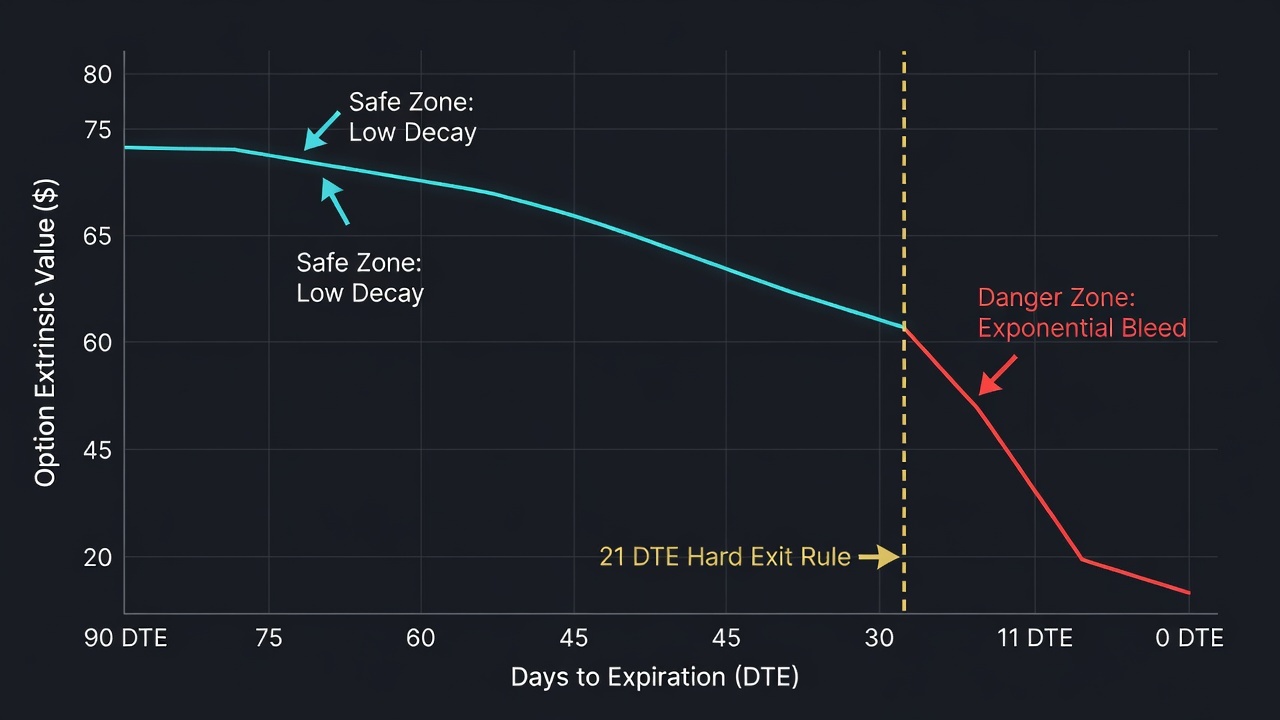
- Buy 65 to 90 Days to Expiration (DTE): Theta decay is a slow, flat bleed above 60 DTE before turning parabolic inside 30 DTE. Giving yourself two to three months of duration gives your technical setup breathing room without charging you punitive daily decay.
- Target a 70+ Delta: Deep in-the-money options carry heavy intrinsic value and very little extrinsic value. If a contract is mostly real share value, theta has very little extrinsic fluff to chew away.
- Cut the Cord at 21 DTE: Never hold long single-leg calls past three weeks to expiration. If the stock has not triggered your target by 21 DTE, close the position and roll it out regardless of your emotional attachment to the chart.
If you lack the account capital to buy deep in-the-money 70-delta contracts with two months of time, stop buying naked calls altogether. Build a bull call vertical spread instead by purchasing an at-the-money call and selling an out-of-the-money call against it. The short strike you sell collects theta decay every day, which directly cancels out the theta decay eating your long strike.
| Strategy | Theta Impact | Capital Requirement | Management Rule |
|---|---|---|---|
| 30 DTE OTM Call | Extreme headwind | Very Low | Pure gamble; avoid entirely |
| 70 DTE ITM Call (75 Delta) | Minimal drag | High | Sell unconditionally at 21 DTE |
| Vertical Debit Spread | Nearly neutral | Moderate | Close at 50% max profit target |
When Buying Short-Term Long Calls Can Still Make Sense
There is exactly one scenario where buying a short-dated, high-theta call option is technically justifiable: intraday momentum scalping on explosive volume breakouts. If an asset is breaking out of a multi-month consolidation pattern on massive relative volume, the sudden spike in implied volatility and rapid underlying delta expansion can temporarily overwhelm theta decay.
However, if you take that shot, your holding period must be measured in hours or minutes, never days. The second the stock halts its upward momentum and moves sideways into consolidation, that contract will bleed out aggressively.
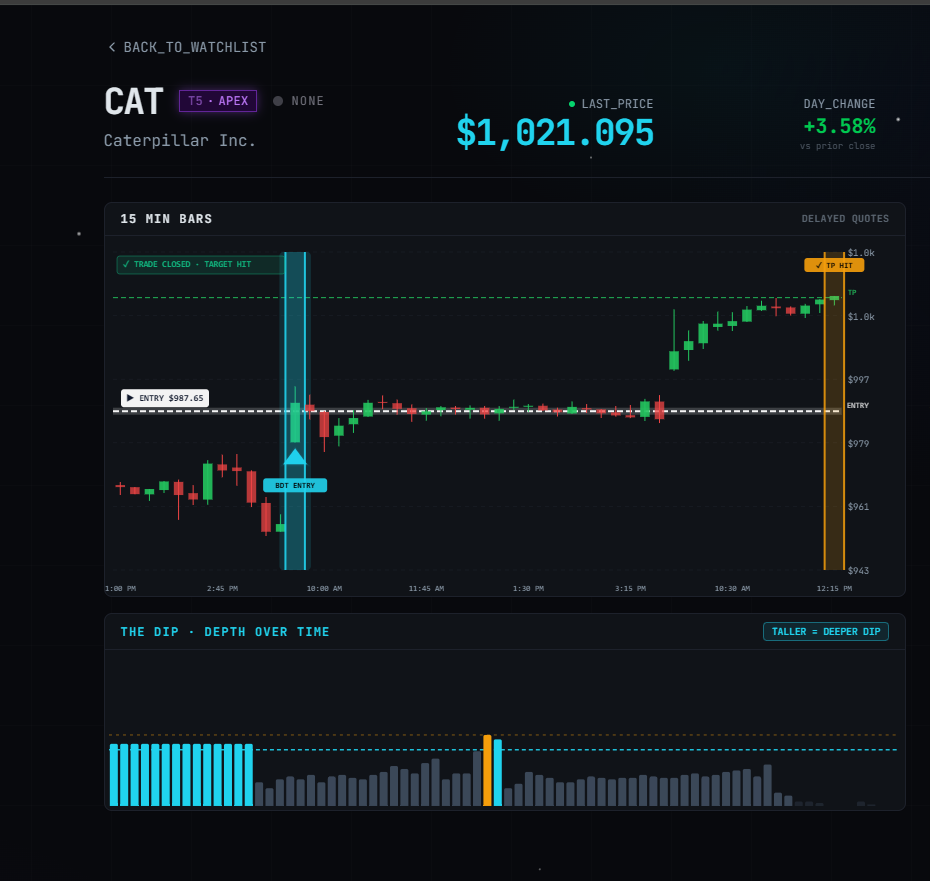
🎯 Want Setups Like These? The Big Dipper Does the Scanning For You.
Every morning the Big Dipper delivers curated DIP ZONE trade ideas — stocks already at high-probability entry levels, with targets pre-set. No guessing, no scanning. Just setups.

From Find Better Trades
When The Coil Is Ready To Explode, You’ll Know
Auto-maps ascending, descending, and symmetrical triangles with breakout alerts the moment price escapes the pattern.

Frequently Asked Questions About Theta Decay
Q: At what point does theta decay accelerate the fastest?
A: Theta decay accelerates most rapidly inside the final 30 to 45 days before expiration, with the steepest decline occurring in the last 14 days. This parabolic drop happens because an option’s remaining extrinsic value must drop to exactly zero by expiration day.
Q: Does theta decay hurt in-the-money or out-of-the-money options more?
A: Theta hurts out-of-the-money options significantly more in terms of percentage loss because their entire premium is composed of extrinsic value. In-the-money options hold intrinsic value that theta cannot touch, which preserves the contract’s baseline equity.
Q: Does theta decay happen on weekends and holidays?
A: Yes, options lose time value over weekends and market holidays because expiration dates are fixed calendar days. Market makers routinely price weekend decay into Friday afternoon premiums, meaning you cannot dodge decay simply by holding over the weekend.
📈 Want More? Join Our Free Trading Community
- Trading Strategy Guides Telegram — daily strategy tips and market insights
- Find Better Trades Telegram — free trade signals delivered to your phone
- Find Better Trades on YouTube — live trade breakdowns and tutorials