Delta Is the Only Greek Beginners Need to Trade


📊 November 10, 2026
- Options delta is the single Greek beginner traders should track because it directly governs synthetic share count and price movement.
- Novice traders fail by obsessing over complex multi-Greek models while buying cheap, low-delta lottery tickets that cannot profit from correct technical calls.
- Trade directional swings using deep 0.70 to 0.80 delta contracts with over 45 days to expiration, ignoring the rest of the Greek alphabet.
— Ben, Find Better Trades
Options delta is the mathematical measurement of how much an option premium changes for every one-dollar move in the underlying stock. Beginners do not need to memorize a textbook full of Greeks to pull consistent cash out of directional setups. If you cannot look at a 0.70 delta call and immediately treat it as 70 synthetic shares of stock, tracking Theta decay or Vega curves is a complete waste of your time.
The tool I use for this: Gravity Zone Indicator. Gravity Zone detects hidden institutional accumulation on TradingView — so you’re in the breakout while retail is still waiting for confirmation. See Gravity Zone In Action →
Most options educators overcomplicate the learning curve immediately. They bury beginners under partial differential equations before teaching them basic directional risk.
Why Everyone Gets This Wrong
Options education routinely dumps Delta, Gamma, Theta, and Vega on beginners in their very first week. Retail traders end up staring at implied volatility skew and second-order Greeks like academic researchers, yet they consistently buy 0.15 delta out-of-the-money trash because the contracts cost fifty bucks. They master the vocabulary of risk while completely ignoring actual position exposure.
Say a stock consolidates tightly against resistance at $100 after riding a rising 20-period exponential moving average. The technical setup looks pristine for a breakout toward $106. A beginner, terrified of risking capital on proper contracts, purchases an out-of-the-money $110 call trading at 0.12 delta for $0.35.
The stock executes the technical move cleanly, ripping from $100 to $104 over four days. Yet the beginner’s call option barely creeps to $0.42 before stalling, because the delta was too weak to overcome daily extrinsic time erosion. The underlying trade thesis was spot on, but the trader walked away with scrap change or a loss.
Traders inevitably blame time decay or implied volatility crush for these failures. The real culprit was zero understanding of delta leverage: you cannot profit from an edge in technical analysis if your contract possesses almost zero sensitivity to the stock’s actual movement.
What Actually Works
Options delta functions as your direct bridge between equity technical analysis and derivatives pricing. When you buy a call option with a 0.75 delta, that contract gains approximately $0.75 for every $1.00 advance in the underlying equity. It behaves almost identically to owning 75 shares of stock, but demands a fraction of the outright capital.
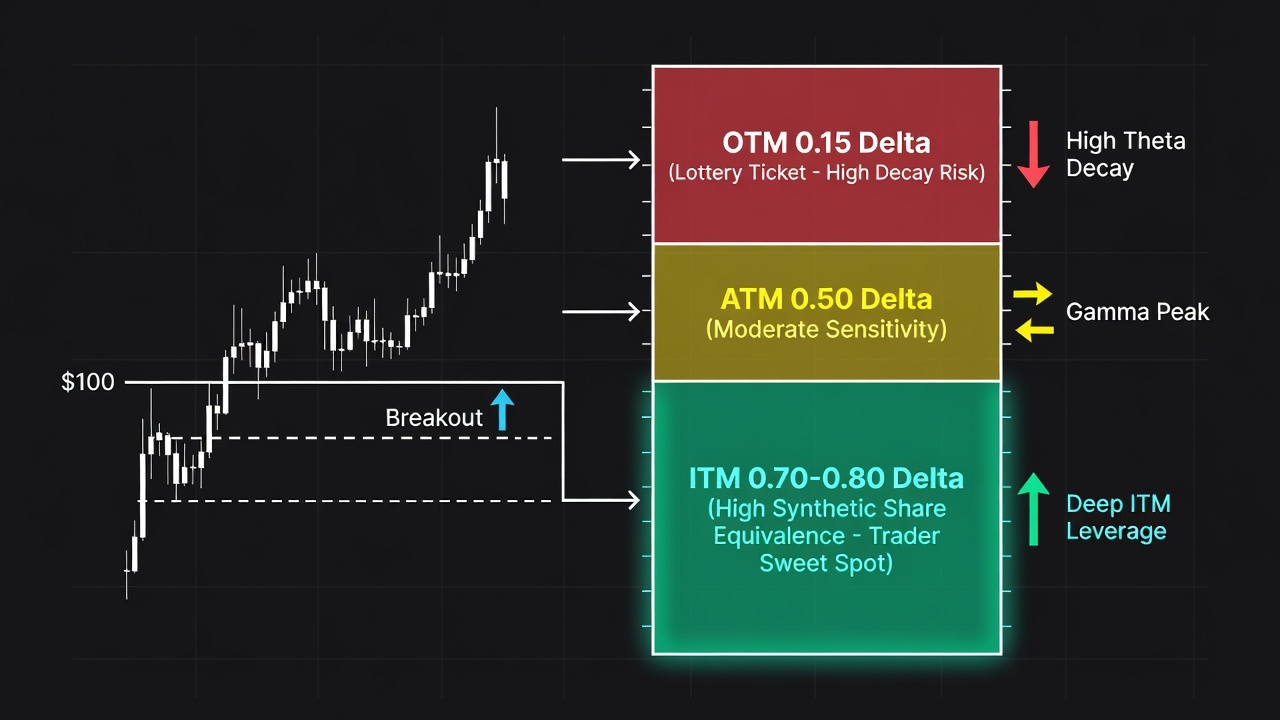
When I trade directional breakout or trend-continuation swings, I anchor my strike selection strictly to the 0.70 to 0.80 delta band. Choosing an in-the-money strike inside this range accomplishes two critical objectives: it guarantees high price sensitivity to the stock, and it significantly reduces the percentage of extrinsic premium vulnerable to decay.
| Strike Selection | Delta Range | Synthetic Share Equivalent | Best Use Case |
|---|---|---|---|
| Deep Out-of-the-Money | 0.10 – 0.25 | 10 to 25 shares | Low-probability speculative lottery tickets; avoid entirely |
| At-the-Money | 0.45 – 0.55 | 45 to 55 shares | Aggressive momentum day trades with immediate follow-through |
| In-the-Money (Sweet Spot) | 0.70 – 0.80 | 70 to 80 shares | High-conviction swing trades mirroring stock movement |
Position sizing with this approach becomes clean and repeatable. If your risk rule allows you to trade 200 shares of a $50 equity, you can simply purchase three 0.70 delta call contracts to control roughly 210 synthetic shares. You maintain identical exposure without guessing how secondary volatility metrics will impact your fill.
Manage the trade on the underlying chart, not the option screen. If the stock drops below your technical invalidation level—such as a close below the daily 20 EMA or a breakdown through support—exit the contract immediately. Never hold a decaying contract expecting a miracle bounce.
When Complex Greek Tracking Can Still Make Sense
Tracking the broader Greek spectrum becomes necessary only when you abandon pure directional trading to sell non-directional premium or run market-neutral spreads. If you are selling iron condors or trading earnings announcements where implied volatility crashes overnight, Vega and Theta tracking are non-negotiable.
Until you step into complex multi-leg volatility strategies, Delta is the only Greek that matters for your bottom line. Master directional equity execution with high-delta contracts first, and leave the theoretical Greek models for later.
🎯 Want Setups Like These? The Big Dipper Does the Scanning For You.
Every morning the Big Dipper delivers curated DIP ZONE trade ideas — stocks already at high-probability entry levels, with targets pre-set. No guessing, no scanning. Just setups.
From Find Better Trades
Consistent Income. Any Market Direction.
A low-risk debit spread every Thursday, built to make steady returns whether the market runs up, down, or sideways.
Options Delta FAQ
Q: Does delta predict the probability of an option expiring in the money?
A: Traders frequently treat delta as a rough rule of thumb for expiration probability, such as a 0.70 delta having a theoretical 70% chance of finishing in the money. However, delta is strictly a pricing derivative calculation measuring directional price sensitivity, not a forward-looking predictive guarantee.
Q: Why should beginners avoid buying 0.20 or 0.30 delta options?
A: Contracts with 0.20 or 0.30 delta consist entirely of extrinsic value and possess weak price sensitivity to the underlying stock. They require explosive, immediate moves in the underlying equity just to outpace regular daily time decay, which drastically lowers your win rate over time.
Q: What delta is best for swing trading calls and puts?
A: A delta between 0.70 and 0.80 paired with at least 45 to 60 days to expiration delivers the best balance for directional swings. This structure ensures your trade tracks the underlying chart closely while minimizing the percentage drag from extrinsic premium loss.
📈 Want More? Join Our Free Trading Community
- Trading Strategy Guides Telegram — daily strategy tips and market insights
- Find Better Trades Telegram — free trade signals delivered to your phone
- Find Better Trades on YouTube — live trade breakdowns and tutorials