Options Basics: What That $2 Quote Really Costs

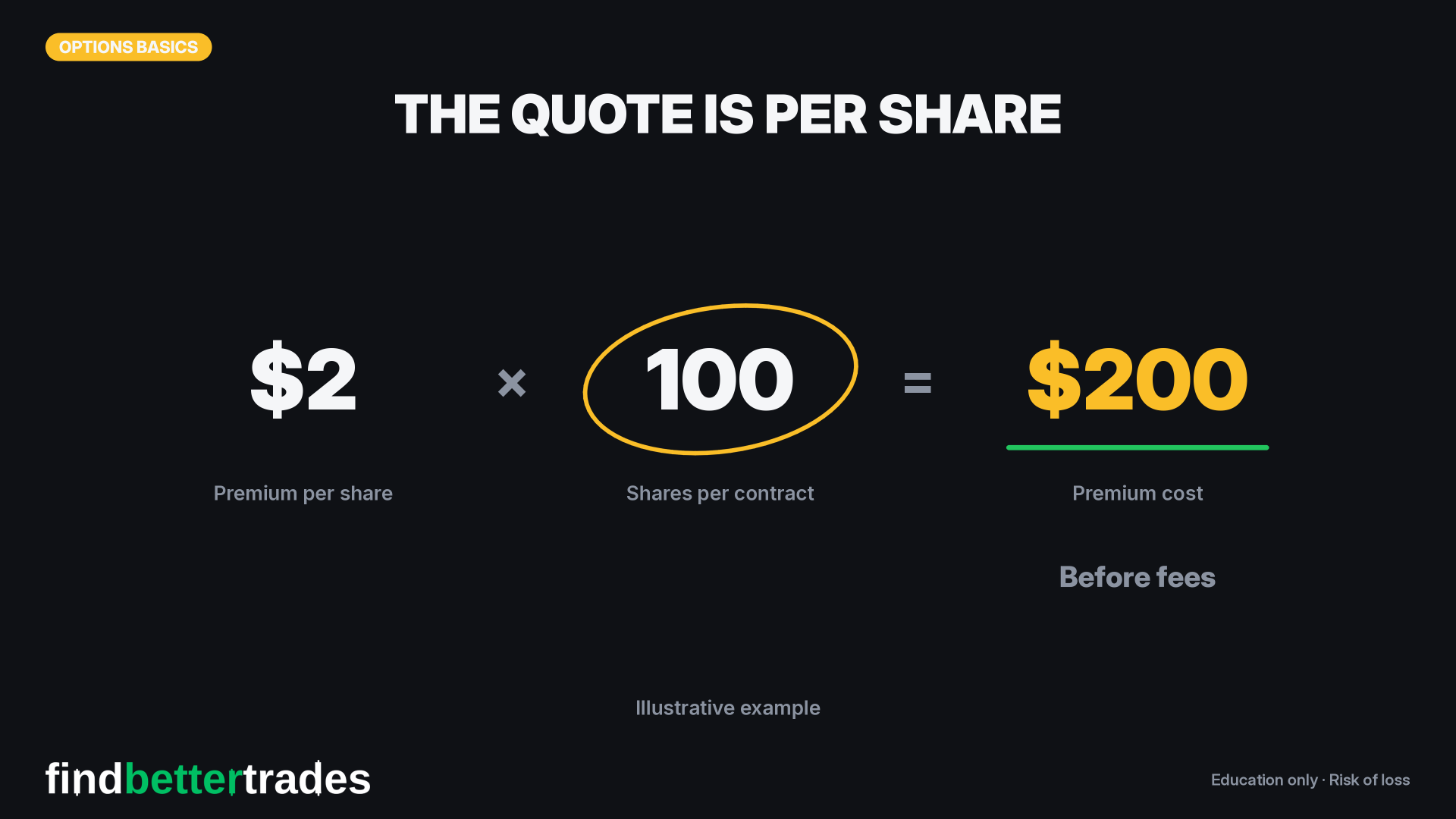
You pull up an option chain, spot a call at $2.00, and think, “Two bucks? Easy.” Then you hit preview and the order ticket says $200. Nothing’s broken. That’s just how option quotes work, and it’s the first thing worth nailing down before you ever touch the buy button.
This guide goes with our new video. We’ll use one made-up stock and one simple contract, and walk through what you’re actually buying. No predictions, no hot tickers. Just the parts that change your money and your risk.
Free report: Options Greeks in Plain English → Keep it handy as you read. Today we’re starting one step before the Greeks.
An option is a contract, not a share
Buying an option isn’t the same as buying the stock. You’re paying for a contract that comes with specific rights and a deadline.
- A call gives the buyer the right to buy the underlying shares at a set price.
- A put gives the buyer the right to sell the underlying shares at a set price.
Those are rights, not promises that either trade will make money. And every contract has someone on the other side. A seller who opens a short option takes on an obligation if assigned: a call seller may have to deliver shares, a put seller may have to buy them. That’s a very different risk profile from the buyer’s, so everything below is about buying one option.
The ×100 multiplier: why $2 really means $200
Here’s our example. A made-up stock trades at $100. A call option on it shows a premium of $2.00.
That $2 is quoted per share. A standard equity option usually covers 100 shares. So:
$2.00 × 100 shares = $200 per contract, before fees.
The number on the screen and the cash leaving your account are two different numbers. Buy five contracts and you’re at $1,000, not $10.
One caveat: ×100 is common for standard equity options, but it isn’t a law of nature. Corporate actions like splits or mergers can create adjusted contracts with different deliverables, and index options can work differently. Read the actual contract specs instead of auto-multiplying everything by 100.
Strike price: not the same as the premium
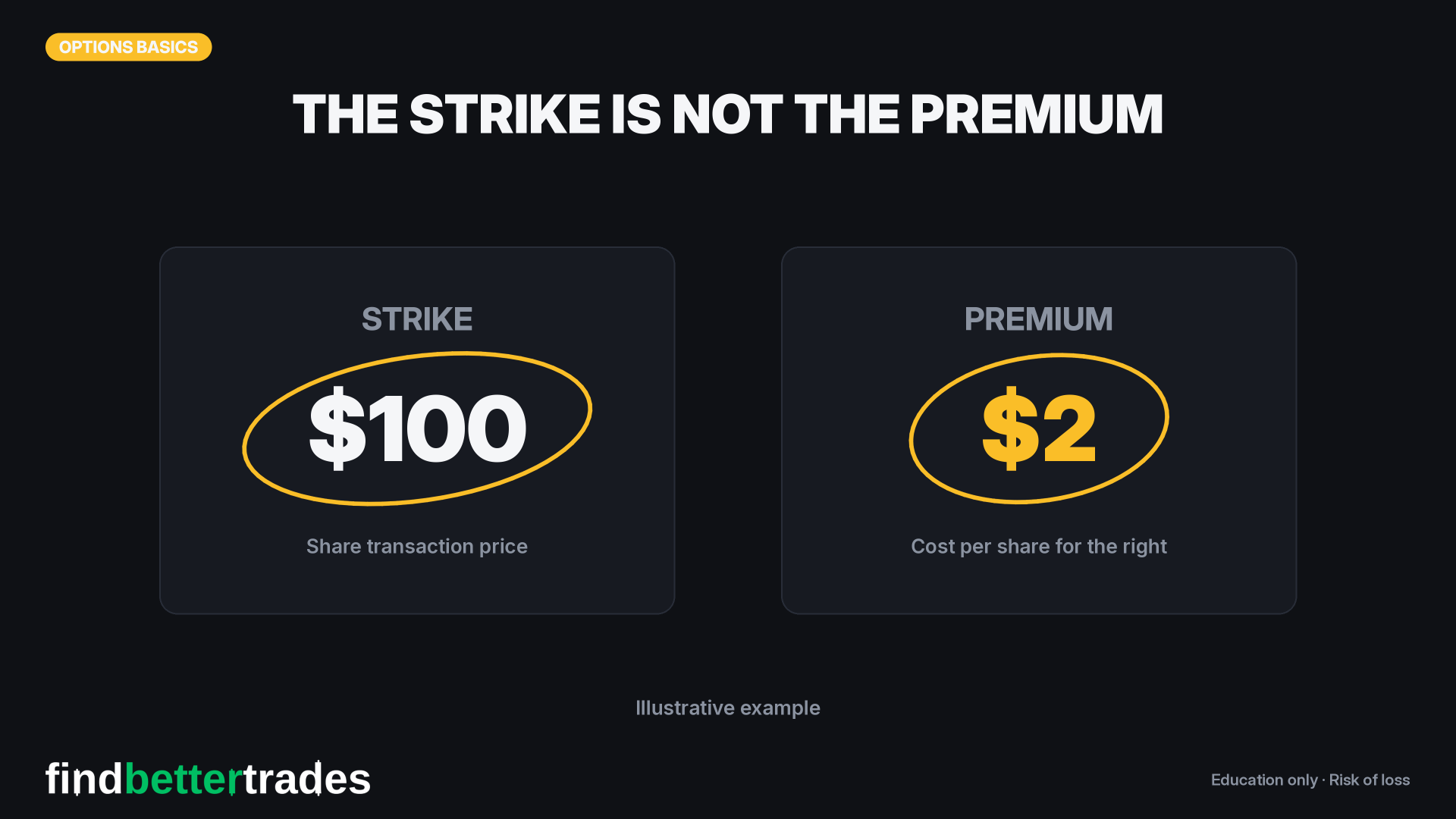
The strike is the price written into the contract. Our $100 call gives the buyer the right to buy shares at $100 each. The $2 premium is what the right itself costs per share.
Two numbers, two questions:
- Strike: at what price can the shares change hands?
- Premium: what am I paying for that right?
Expiration: the right has a deadline
Expiration is the contract’s deadline, and the exact date matters, not just “November” or “Friday.” Two calls on the same stock with the same strike but different expirations are different contracts with different prices.
More time often costs more, other things equal. That doesn’t make a longer-dated trade safe. Check the full date on the order ticket every single time.
Put it all together and our contract reads: example stock, call, $100 strike, example expiration, $2 premium, 100-share multiplier. Change the underlying, option type, strike or expiration and you’re buying a different contract. The premium can change while the contract stays the same. Reading only the premium is like reading a price tag without checking what’s in the box.
Reading the options chain
An options chain is a menu of contracts, not a list of recommendations. Below is a fully illustrative chain (not live quotes) with one expiration and three call strikes: $95, $100 and $105. Each row is its own contract.
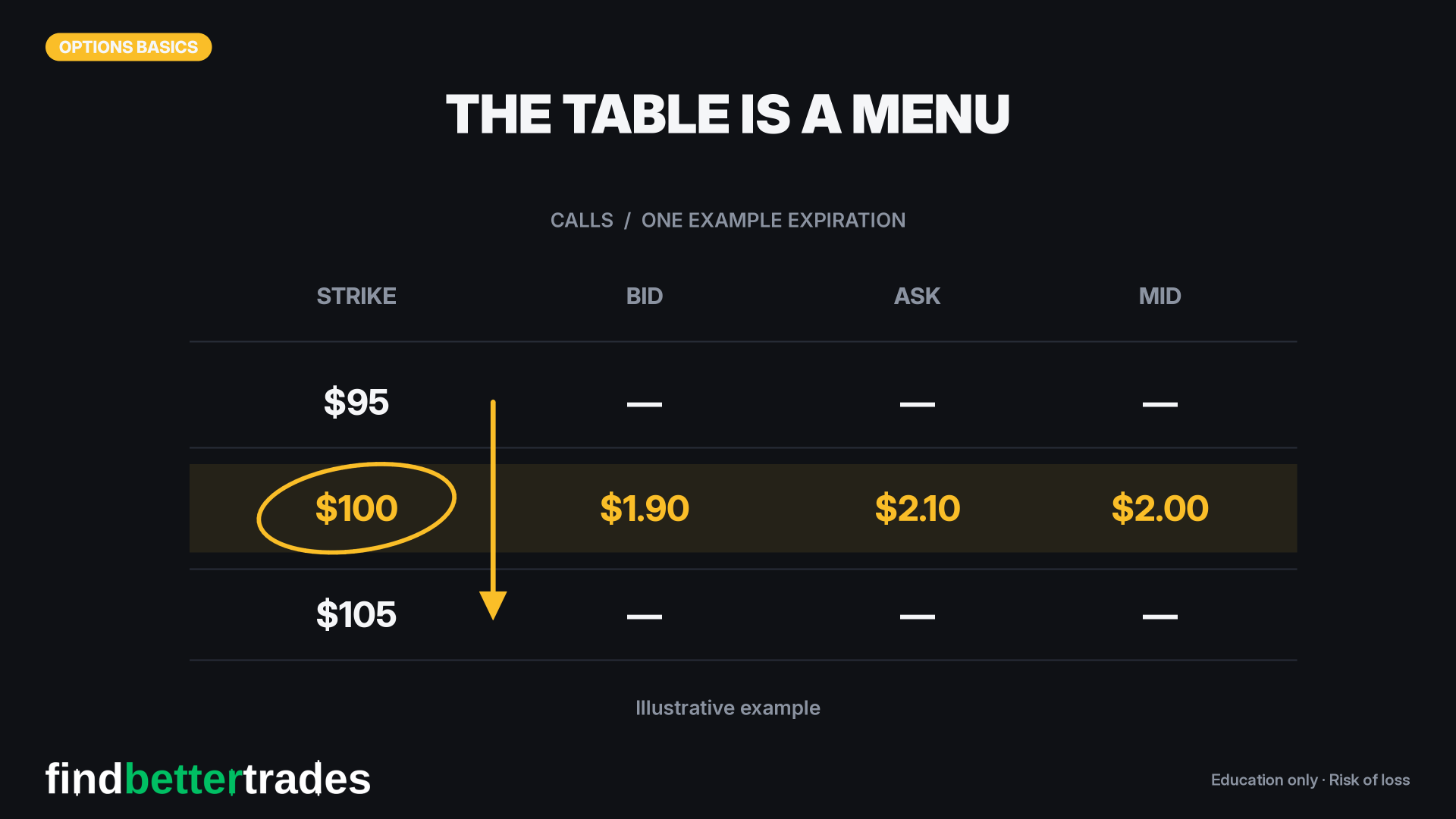
Before comparing prices, make sure you’re comparing the contract type, date and strike you actually meant to pick.
Want the next layer? Grab the free Options Greeks guide →
Bid and ask: a quote is not a fill
Look at the $100 row. The bid is $1.90 and the ask is $2.10, so the midpoint is $2.00.
- The bid is roughly what buyers are offering right now. It’s closer to what you’d get selling.
- The ask is roughly what sellers want. It’s closer to what you’d pay buying.
- The spread here is $0.20 per share, which is $20 per contract.
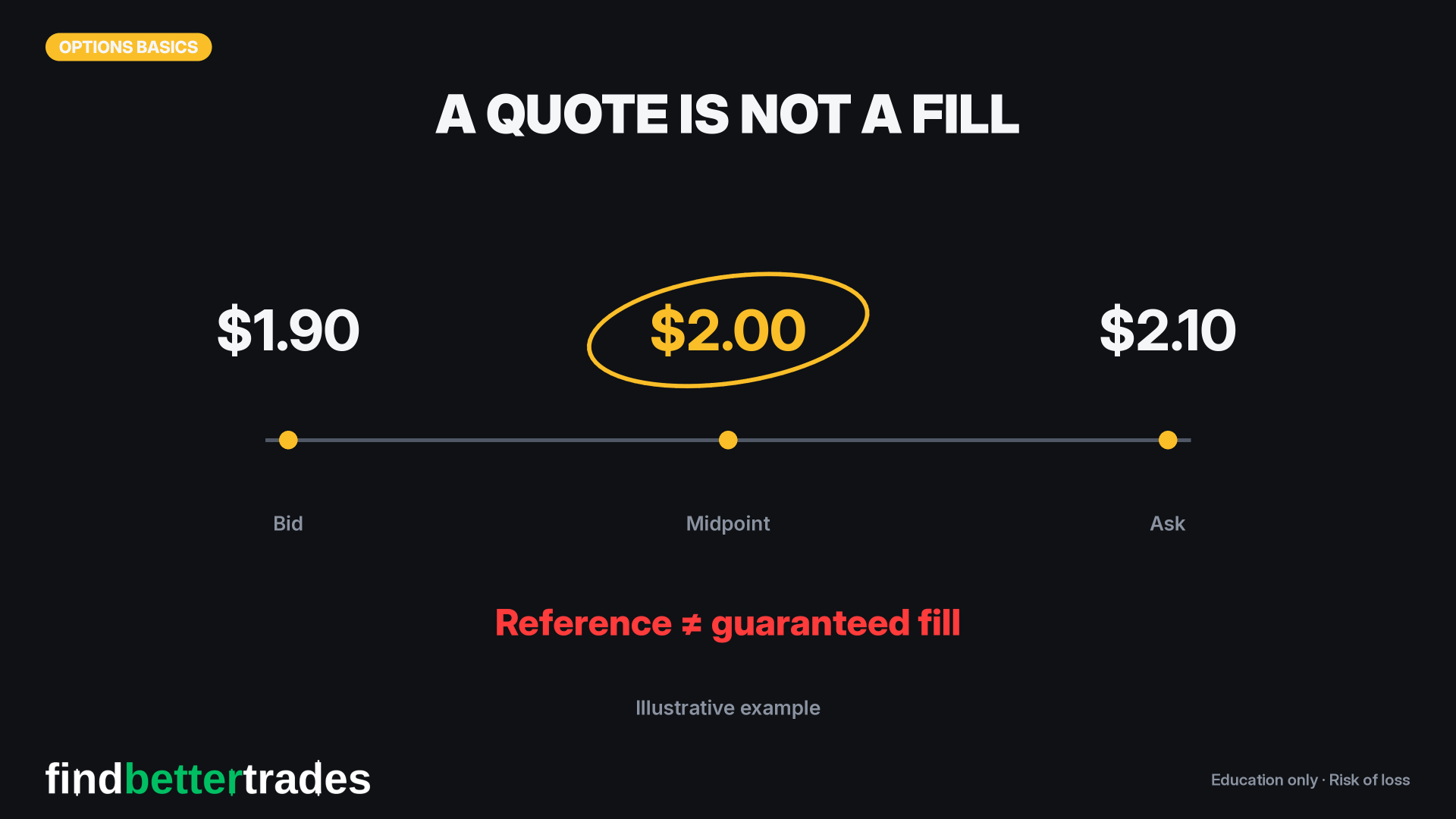
That midpoint is a reference, not a guaranteed price. Quotes move and can be stale. A buy limit order caps what you’re willing to pay, but it might not fill. Wider spreads mean more cost just to get in and out.
Worked example: one call, start to finish
Let’s run the made-up trade at expiration. This is a payoff sketch, not a forecast.
- Buy: one $100 call at $2.00 → $200 paid, plus fees.
- Stock at $100 or lower at expiration: the call has no intrinsic value. You lose the full $200.
- Stock at $101: the call is worth $1 per share ($100). You paid $200, so you’re still down about $100. In the money doesn’t mean profitable.
- Stock at $102: break-even. Strike ($100) + premium ($2) = $102, before fees.
- Stock at $105: worth $5 per share ($500). Minus the $200 paid = $300 before fees.
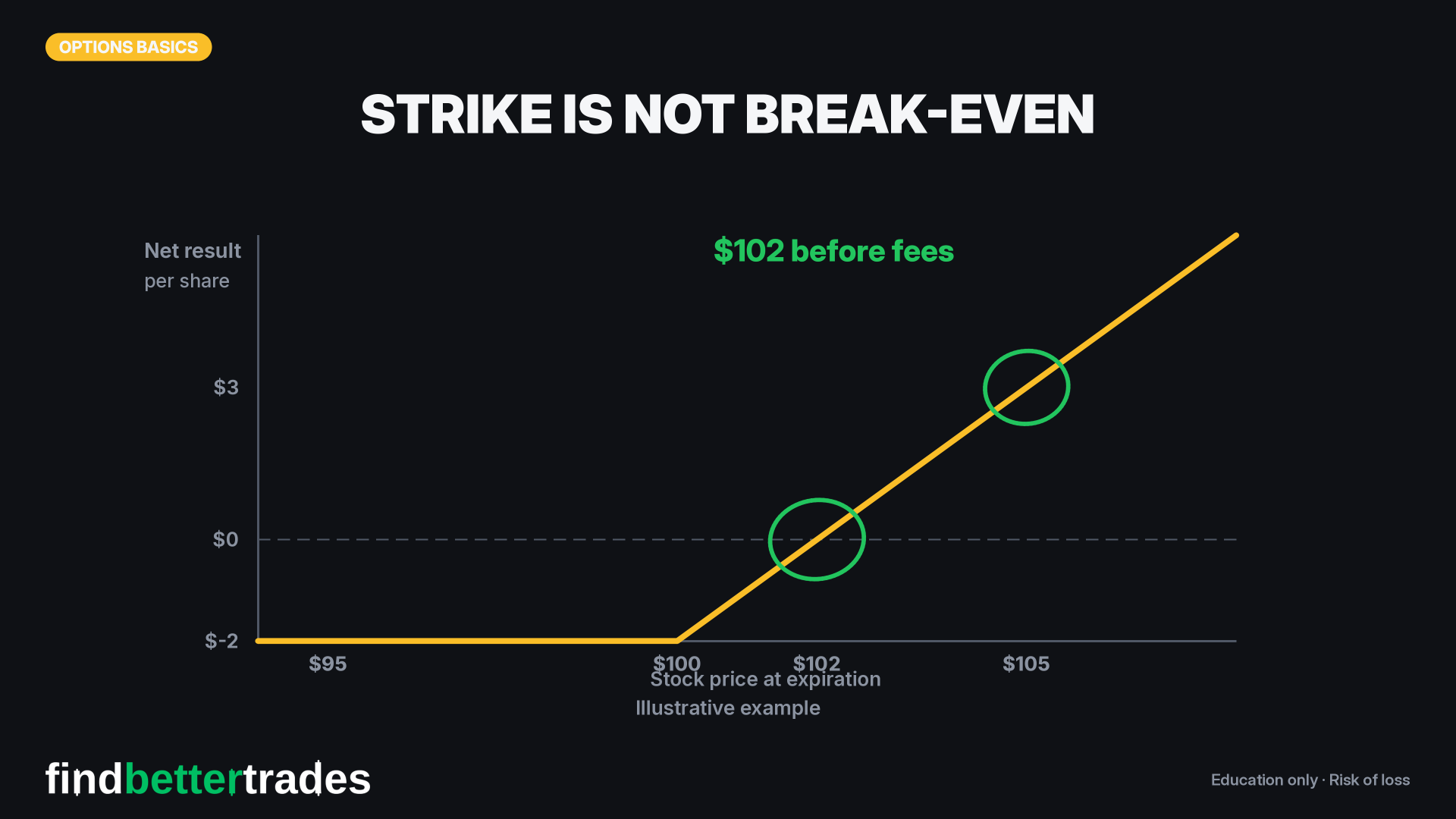
See why the stock crossing the strike isn’t enough? The premium has to be earned back first.
Before expiration, it’s messier. An option’s market price includes time value on top of intrinsic value, and it moves with the stock price, time left and implied volatility. So the stock ticking up doesn’t guarantee your call is up. (That’s exactly what the Greeks help explain.)
A put uses the same vocabulary with the right flipped: a $100 put lets the buyer sell at $100, and its intrinsic value grows as the stock falls below the strike. Same deal on premium, though. The buyer can still lose all of it.
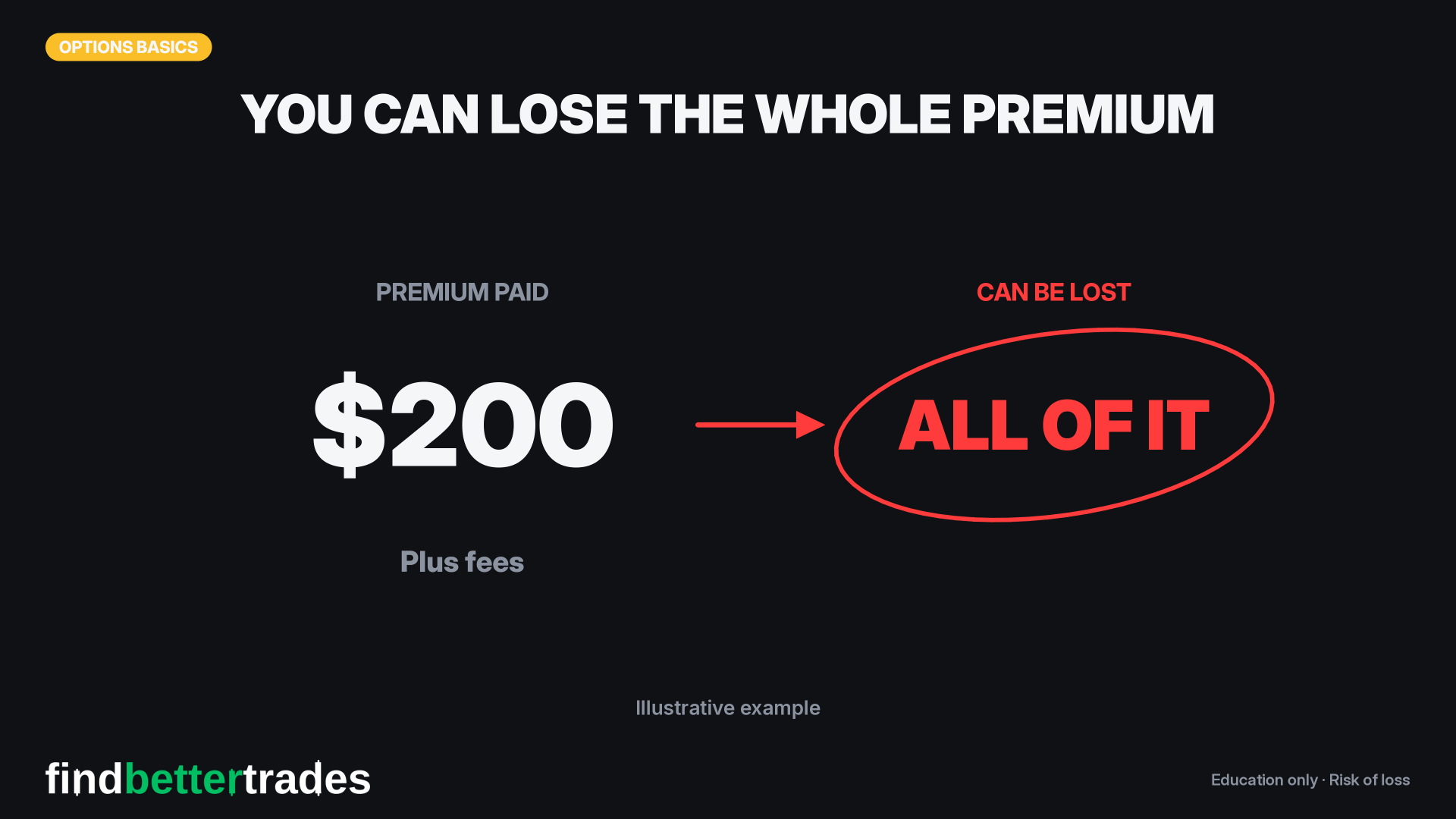
You can lose the whole premium
For the purchased call itself, the maximum loss is the $200 premium plus fees. Exercising, including automatic exercise, creates a stock position with separate funding requirements and additional downside risk. A smaller cash outlay than buying 100 shares doesn’t mean a smaller chance of losing that outlay. Options can and do expire worthless.
A few more things not to sleep on:
- Closing vs. exercising: you can try to sell to close before expiration, but the price may be lower than you paid and it isn’t done until it fills. Exercising is different: it can turn into an actual share position with its own cash needs.
- Don’t drift into expiration: American-style equity options can generally be exercised early, and in-the-money contracts may be exercised automatically. Know your broker’s rules and deadlines.
Say the contract out loud
Before any order, try this read-back: “I’m looking at a call on this stock. Strike $100. Expiration is the exact date I picked. One standard contract. At $2.00, that’s $200 before fees. I can lose all of it. And I know whether this order opens or closes a position.”
If you can’t fill in every blank, you’re not ready to click yet. And a cheaper premium on the next row isn’t automatically a better deal. It could be a different strike, a different date or a thinner market. Contract first, price second.
Next step
Now that the quote makes sense, the next question is why that $2 moves around. That’s the Greeks: delta, theta, vega and friends, in plain English.
Download the free Options Greeks in Plain English report →
Risk disclosure: Options involve significant risk and aren’t suitable for all investors. You can lose the entire premium paid, and some strategies carry losses beyond the premium. All examples here are hypothetical and for education only. They aren’t recommendations or predictions of future results. Read the Characteristics and Risks of Standardized Options and talk to your broker before trading.
Lesson 67 of 75 in the free Options Trading Course.
← Previous: Broken Wing Butterfly: How to Trade Options With Risk on One Side
Next: NVDA Earnings: Options Are Pricing a ~$17 Move. Is That Too Much? →