How I Use RSI at Support and Resistance to Filter Out Bad Trades

📊 August 6, 2026
- Blindly buying oversold RSI signals at key support levels is the fastest way to bleed your trading account.
- Retail traders treat RSI 30 as an automatic buy trigger, ignoring that strong trends regularly crush oversold readings.
- Use RSI divergence as a momentum confirmation filter at key structural zones rather than a standalone entry trigger.
— Ben, Find Better Trades
Most retail traders treat RSI like an automated cash register. They see price touch a support level, notice RSI dipping below 30, and blindly hit the buy button. That single habit is responsible for blowing up more trading accounts than almost anything else in technical analysis.
Why Everyone Gets This Wrong
The conventional wisdom teaches you that RSI below 30 means a stock is oversold and bound to bounce. When price hits a key support line at the same time, traders assume it is a bulletproof trade setup.
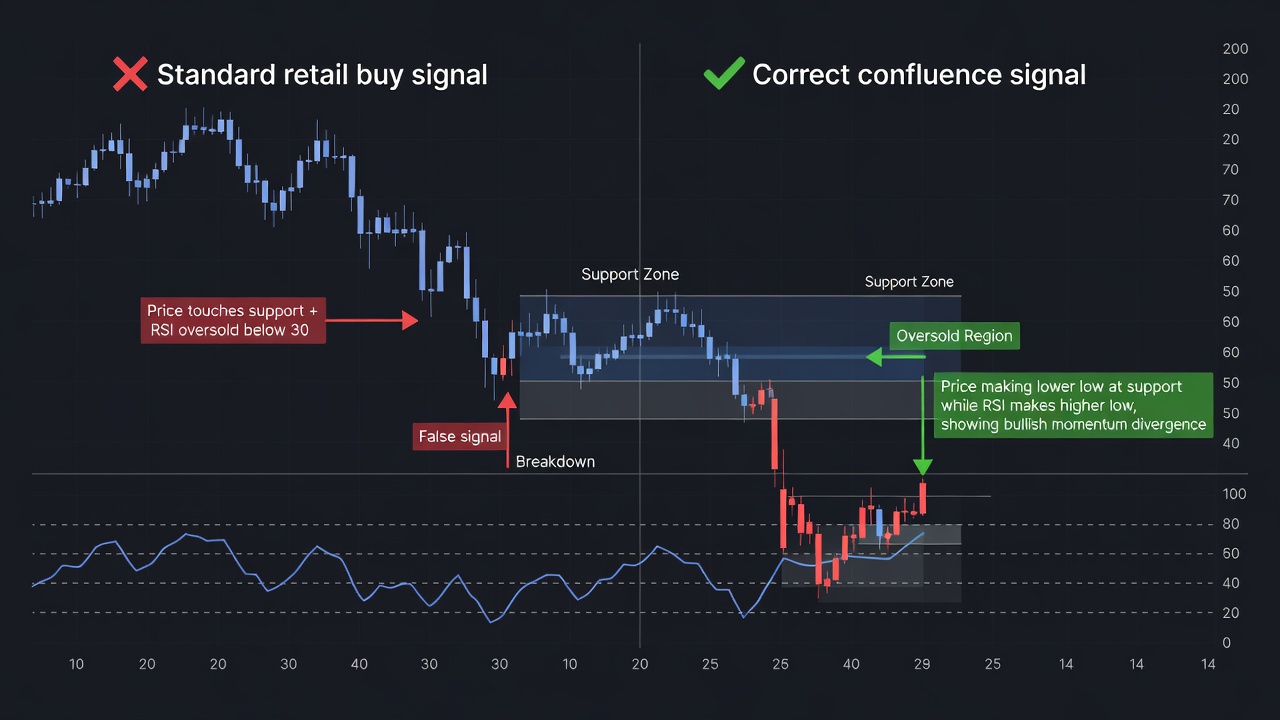
Here is what actually happens in a real market environment. Strong downtrends push RSI into oversold territory and keep it pinned there while price slices right through your supposed support zone like butter.
When price breaks support on heavy institutional selling, RSI stays low because momentum is heavily bearish. Trying to catch a falling knife just because a mathematical oscillator hit an arbitrary number like 30 is pure gambling.
You are essentially trading against institutional order flow. Indicators follow price; price does not follow indicators.
What Actually Works
I never buy simply because price hit support and RSI is low. Instead, I use RSI purely as a momentum filter to confirm whether buyers are actually stepping in.
The secret is looking for bullish RSI divergence at key structural zones. If price prints a lower low into key support, but RSI prints a higher low, momentum is slowing down despite the lower price hit.
That divergence tells me sellers are losing steam and buyers are absorbing supply at support. Once I see that momentum divergence, I wait for a clear price action trigger, like a bullish engulfing candle, before risking a single dollar.
By forcing RSI to confirm a loss in momentum before taking a support bounce, I instantly eliminate the majority of fakeouts that trap retail traders.
When RSI Can Still Help
RSI is not a useless tool; it is just widely misused by traders looking for lazy signals. When aligned with market structure and clear price context, it provides valuable insights into hidden momentum shifts.
Treat RSI as a filter to disqualify bad trades rather than a green light to enter. If price is at resistance but RSI shows strong higher highs with zero exhaustion, I refuse to short that level every single time.
🎯 Want Setups Like These? The Big Dipper Does the Scanning For You.
Every morning the Big Dipper delivers curated DIP ZONE trade ideas — stocks already at high-probability entry levels, with targets pre-set. No guessing, no scanning. Just setups.
RSI at Support and Resistance FAQ
Q: Should I trade RSI oversold bounces without support level context?
A: Never trade RSI in a vacuum. Buying oversold readings without higher-timeframe support context is a direct path to getting crushed in strong downtrends.
Q: What RSI timeframe works best for filtering support and resistance trades?
A: Higher timeframes like the daily or 4-hour charts offer the most reliable RSI divergence signals at major key levels, stripping away intraday market noise.
Free For Traders
One Clear Arrow. Every High-Probability Setup. Free.
The Fusion Indicator combines multiple signals into a single buy/sell arrow on TradingView so you never miss a move.

From Find Better Trades
The First 60 Minutes Pay The Best. Be There.
Rapid-fire day trading setups for the opening hour — when institutional volume is at its absolute peak.

📈 Want More? Join Our Free Trading Community
- Trading Strategy Guides Telegram — daily strategy tips and market insights
- Find Better Trades Telegram — free trade signals delivered to your phone
- Find Better Trades on YouTube — live trade breakdowns and tutorials