Broken Wing Butterfly: How to Trade Options With Risk on One Side


📚 Options Strategies, Step by Step — Part 13 of 30
- Part 1: The Bull Call Spread: A Cheaper Way to Bet on a Rise
- Part 2: The Bear Put Spread: Profiting From a Drop With Defined Risk
- Part 3: Bull Put Credit Spreads: Getting Paid to Be Right on Direction
- Part 4: Bear Call Credit Spreads: Selling Premium Above Resistance
- Part 5: Managing Credit Spreads: Closing Early at 50% Profit
- Part 6: The Iron Butterfly: When You Expect a Stock to Pin a Price
- Part 7: The Reverse Iron Condor: Profiting From a Breakout
- Part 8: Short Straddles and Strangles: The Risk Nobody Explains
- Part 9: Calendar Spreads: Trading Time Decay Between Two Expirations
- Part 10: Diagonal Spreads: A Calendar Spread With a Directional Lean
- Part 11: The Double Diagonal: Income From a Range With Room to Breathe
- Part 12: Butterfly Spreads: Cheap Trades Aimed at a Target Price
- Part 13: Broken Wing Butterflies: Taking the Risk Off One Side (you are here)
⚡ Key Takeaways
- A broken wing butterfly alters one wing’s strike width to eliminate capital risk on one side of the trade entirely.
- Structuring the trade for a net credit guarantees you cannot lose money if the underlying asset moves away from your target in the wrong direction.
- The trade-off for eliminating risk on one side is accepting a larger, defined maximum loss on the side with the widened wing.
— Ben, Find Better Trades
A broken wing butterfly is an options spread that widens one outer strike to eliminate capital risk on one side of the market. In Part 13 of our series, we are solving the most frustrating problem with standard butterflies: losing money when the underlying stock refuses to move.
When traders first discover standard butterflies, they love the tiny entry cost but hate that a flat stock can cause a total loss. By modifying just one strike price, you can turn a neutral trade into a directional hybrid that lets you be completely wrong on one side without losing a cent.
What Is a Broken Wing Butterfly?
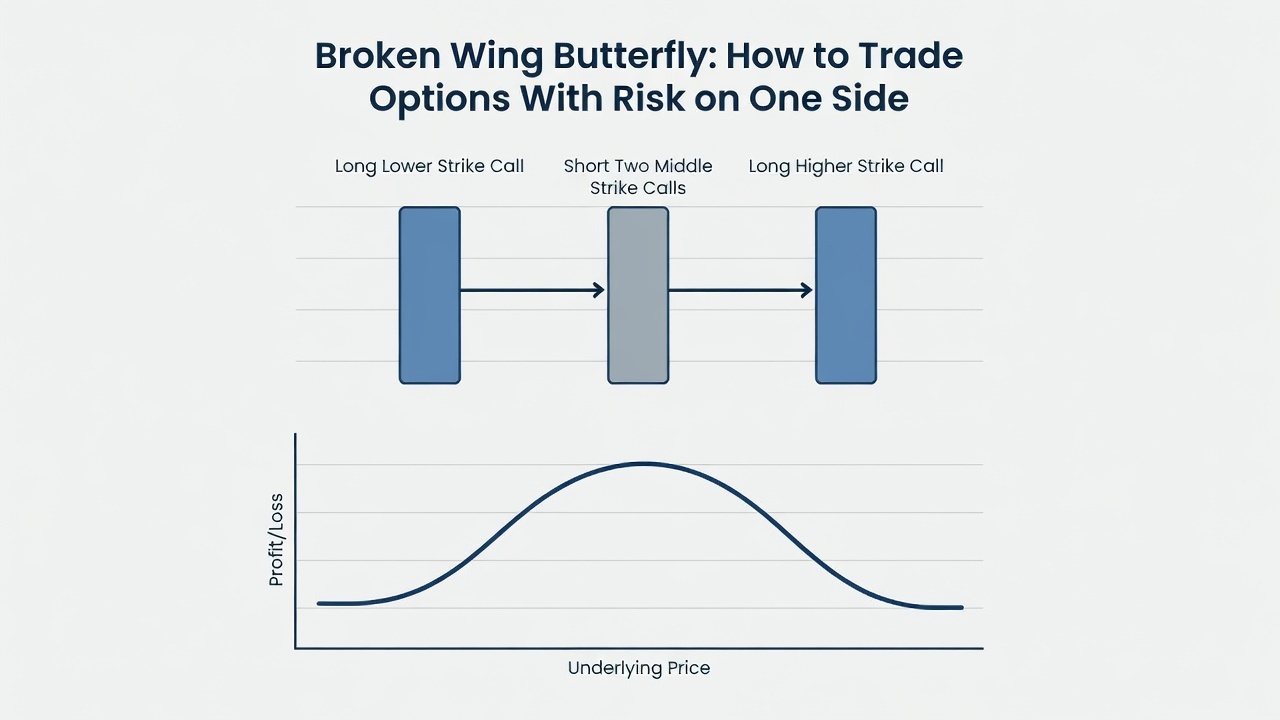
A broken wing butterfly is a three-legged options spread where one wing is positioned farther away from the middle strikes than the other. Like the standard butterfly we covered in Part 12, it uses a 1-2-1 contract ratio.
In a standard butterfly, the distance between every strike is identical. For example, you might buy a 95 strike, sell two 100 strikes, and buy a 105 strike, creating balanced five-point wings on both sides.
A broken wing butterfly intentionally snaps that symmetry. You keep the center strikes untouched, but you push one of the outer protective wings farther away from the center.
Think of it like an airplane where mechanics installed an oversized glider wing on the left side while leaving the right wing at standard length. The plane tilts toward the longer wing, changing how it handles the air.
In options trading, that structural tilt removes the cash debit required to open the position. When constructed correctly, you can enter the trade for zero cost or even collect a net credit up front.
If you enter for a net credit, you completely erase risk in the direction of the narrower wing. If the stock drops sharply away from your target on a call spread, every option expires worthless, and you keep that opening credit.
How Asymmetrical Wings Erase Directional Risk
Asymmetrical wings erase risk because moving an option strike farther out of the money reduces its market price. When you purchase a cheaper protective option, you spend less capital than you would on a balanced spread.
Every butterfly consists of two distinct vertical spreads glued together at the center strikes. In a balanced call butterfly, you own an in-the-money bull call spread and sell an out-of-the-money bear call spread of equal width.
Because options decay and lose value the farther they sit from the current stock price, buying an outer strike five strikes farther out costs pennies compared to buying one close by. That saved premium pays for the rest of the trade.
When the premium saved on that distant strike matches or exceeds the cost of the closer spread, the trade becomes cash-flow positive. You transition from paying a debit to receiving money into your account immediately.
This dynamic eliminates the traditional two-sided risk profile that intimidates new butterfly traders. You no longer have to fear the underlying asset doing nothing and leaving your trade stranded.
However, the options market never offers a free lunch without demanding collateral somewhere else. The side with the wider, broken wing now contains a wider gap between strikes, which produces a defined zone of maximum risk if the stock runs too far.
Call Broken Wing Butterfly: A Worked Bullish Example
A call broken wing butterfly is an asymmetrical spread built with calls to profit from a modest upward drift while eliminating downside risk. Let us walk through the exact numbers using a hypothetical stock named XYZ trading at $100 per share.
You believe XYZ will climb toward $105 over the next 30 days, but you do not want to lose money if the stock suddenly drops back down to $90. To set this up, you buy one 100 Call, sell two 105 Calls, and buy one 115 Call instead of the balanced 110 Call.
Suppose the 100 Call costs you $4.20 per share, while you sell the two 105 Calls for $2.40 each, generating $4.80 in total credit. Finally, you buy the distant 115 Call for $0.40 to complete the broken structure.
Now calculate your net entry cash flow by comparing the cost of your long calls against the cash collected from the short calls. You paid $4.20 plus $0.40, which equals $4.60 in debits, while collecting $4.80 from the short calls.
Because $4.80 is greater than $4.60, you receive a net credit of $0.20, or $20 per contract package, deposited into your brokerage balance. Let us observe how this trade performs across three distinct expiration scenarios.
If XYZ collapses to $92, all four call options expire out of the money with zero value. You keep the entire $0.20 credit ($20), experiencing zero downside loss despite being completely wrong on the stock’s direction.
If XYZ lands precisely on your sweet spot at $105, your 100 Call is worth $5.00, while the two 105 Calls and the 115 Call expire worthless. You collect the full $5.00 intrinsic value plus your $0.20 initial credit, netting a maximum profit of $5.20 ($520).
If XYZ unexpectedly skyrockets to $125, your risk on the broken upper wing gets realized. The lower spread pays you $5.00, but the broken upper spread loses $10.00, leaving a net loss of $5.00 minus your $0.20 credit, capping your maximum loss at $4.80 ($480).

Put Broken Wing Butterfly: Trading Downside Skew
A put broken wing butterfly uses put options to target a moderate downward decline while completely eliminating capital risk to the upside. Options traders often lean on this variation because equity options naturally exhibit downside volatility skew.
Because investors buy out-of-the-money puts for portfolio insurance, out-of-the-money put premiums are routinely elevated. This skew allows you to collect larger net credits on put broken wing butterflies than on comparable call structures.
Suppose stock ABC is trading at $50 per share, and you expect a light pullback toward the $45 support level. You want to make money if it drifts lower, but you refuse to lose capital if the stock breaks out to new highs.
You construct the trade by buying one 50 Put for $2.50, selling two 45 Puts for $1.40 each ($2.80 collected), and skipping strikes to buy one 38 Put for $0.20. Your total debit to buy the outer puts is $2.70 ($2.50 + $0.20), while you collected $2.80.
This creates an upfront net credit of $0.10, or $10 per trade. If ABC rallies to $60, every single put expires worthless, and you walk away with the $10 credit in your pocket.
If ABC pins your short strikes at $45 on expiration day, the 50 Put is worth $5.00, while the remaining options expire worthless. Adding your $0.10 starting credit yields a maximum gain of $5.10 ($510) on the position.
If ABC suffers a catastrophic crash down to $30, your broken lower wing caps your risk. The lower spread difference is seven points ($45 minus $38) while the upper spread is five points ($50 minus $45), creating a two-point spread deficit that limits your maximum loss to $1.90 ($190 after subtracting your $0.10 credit).
Comparing Standard Butterflies to Broken Wing Butterflies
Choosing between a standard butterfly and a broken wing butterfly comes down to how much directional certainty you have. While both strategies utilize a 1-2-1 structure, their profit and loss curves function under completely different market philosophies.
A standard butterfly requires an initial debit, meaning you lose money if the underlying asset moves too far in either direction or fails to move at all. The broken wing butterfly sacrifices symmetry to eliminate one of those losing zones.
| Feature | Standard Butterfly | Broken Wing Butterfly |
|---|---|---|
| Wing Width | Symmetrical on both sides | Asymmetrical (one wing widened) |
| Entry Cash Flow | Always a net debit | Typically a net credit or even money |
| Risk to One Side | Full debit lost if price misses | Zero risk (small profit kept) |
| Risk to Broken Side | Equal to initial debit | Larger defined loss (wing differential) |
| Target Environment | Pure range-bound, low movement | Slight directional bias with safety margin |
Traders who hate taking losses on trades where nothing happens generally prefer the broken wing configuration. It removes the stress of watching theta decay eat away at your capital when an underlying stock trades flat.
The trade-off is emotional discipline when the stock moves toward your broken wing. You must manage risk aggressively on the widened side because the potential loss is significantly larger than a standard butterfly debit.
From Find Better Trades
Consistent Income. Any Market Direction.
A low-risk debit spread every Thursday, built to make steady returns whether the market runs up, down, or sideways.
Ideal Market Conditions and Stock Selection
The best environment for a broken wing butterfly is a market where you have a modest directional view and implied volatility is elevated. High implied volatility inflates the value of the short center strikes, making it much easier to generate an upfront credit.
When selecting stocks, look for clear technical levels such as major support, resistance, or moving averages. Place your double short strikes directly at these structural levels where price is likely to stall or consolidate.
Avoid running broken wing butterflies right before unpredictable binary events like earnings announcements or regulatory approvals. A massive, sudden gap through your broken wing can push the trade directly into its maximum loss zone overnight.
Indices and large-cap exchange-traded funds make ideal candidates for this strategy because they rarely experience erratic overnight moves compared to individual momentum stocks. They tend to trend predictably and respect technical support and resistance levels.
Always verify the options chain liquidity before placing your order. Because a broken wing butterfly involves three separate strikes across four total contracts, wide bid-ask spreads will severely penalize your entry and exit execution.
Managing the Trade: Profit Targets and Stop-Loss Rules
Managing a broken wing butterfly requires taking profits well before expiration day. Waiting around hoping for a perfect pin at your short strikes is a dangerous habit that gives back gains.
I establish a rule to close the trade as soon as it reaches 30% to 50% of its maximum potential theoretical profit. At that stage, you have harvested the bulk of the available time decay without exposing yourself to late-stage gamma risk.
Gamma increases rapidly during expiration week, which means small moves in the underlying stock can trigger wild swings in your position’s value. Closing the trade 7 to 10 days before expiration protects your accumulated profits from erratic price spikes.
For risk management, place a hard stop-loss based on the price of the underlying asset rather than options pricing models. If the stock breaches your short strikes and continues marching toward your broken outer wing, exit the trade immediately.
Do not wait for the position to reach maximum loss before taking action. If your trade is tested on the broken side, cutting the position when the loss equals twice your initial target profit keeps your trading account safe over the long run.
Common Mistakes Beginners Make With This
Forgetting which side holds the open risk. Beginners often get so excited about eliminating risk on one side that they lose track of the wide wing. If the stock runs past your widened strike, the losses accumulate fast; you must always know where your risk cliff sits.
Holding into expiration Friday for a perfect pin. Many novices refuse to take profits at 40% gain because they dream of collecting the theoretical maximum profit at the center peak. In the final hours of trading, a tiny move can push the stock past your short strike, converting a winning trade into a loss instantly.
Entering the position for an unnecessary debit. If you pay a significant debit to open a broken wing butterfly, you defeat the primary purpose of the strategy. Unless you have a very specific technical reason, you should structure the strikes to collect a modest credit or enter at dead-even scratch.
Sizing positions based on the credit instead of the max loss. A rookie trader sees a $20 credit and opens twenty contracts because the entry requires no cash out of pocket. That trader fails to realize that twenty contracts with a $500 maximum loss per spread creates $10,000 of real portfolio risk.
Broken Wing Butterfly FAQs
Why is it called a broken wing butterfly?
It gets its name because one of the outer protective wings is intentionally widened farther out than the other, breaking the symmetrical shape of a standard butterfly spread. This structural asymmetry alters the payoff profile to reduce or eliminate capital risk on one side.
Can you lose money on both sides of a broken wing butterfly?
No, not if you structure the trade for an upfront net credit. If the stock moves entirely away from your target in the direction of the narrow wing, every option expires worthless and you keep the initial credit you collected.
Is a broken wing butterfly bullish or bearish?
It can be structured for either direction depending on whether you use calls or puts. A call broken wing butterfly is generally mildly bullish to neutral, while a put broken wing butterfly is typically mildly bearish to neutral.
What is the maximum risk on a broken wing butterfly?
The maximum risk is equal to the difference in width between the wide wing and the narrow wing, minus any net credit collected at entry. This loss only occurs if the stock moves entirely beyond your widened outer protective strike at expiration.
Next up in Part 14, I will show you how to trade Christmas Tree spreads—a directional butterfly variation that gives you an even wider profit zone when you want to lean hard into a trend.
📈 Want More? Join Our Free Trading Community
- Trading Strategy Guides Telegram — daily strategy tips and market insights
- Find Better Trades Telegram — free trade signals delivered to your phone
- Find Better Trades on YouTube — live trade breakdowns and tutorials