Election Premium Just Got Crushed. Here’s What Option Traders Do Next

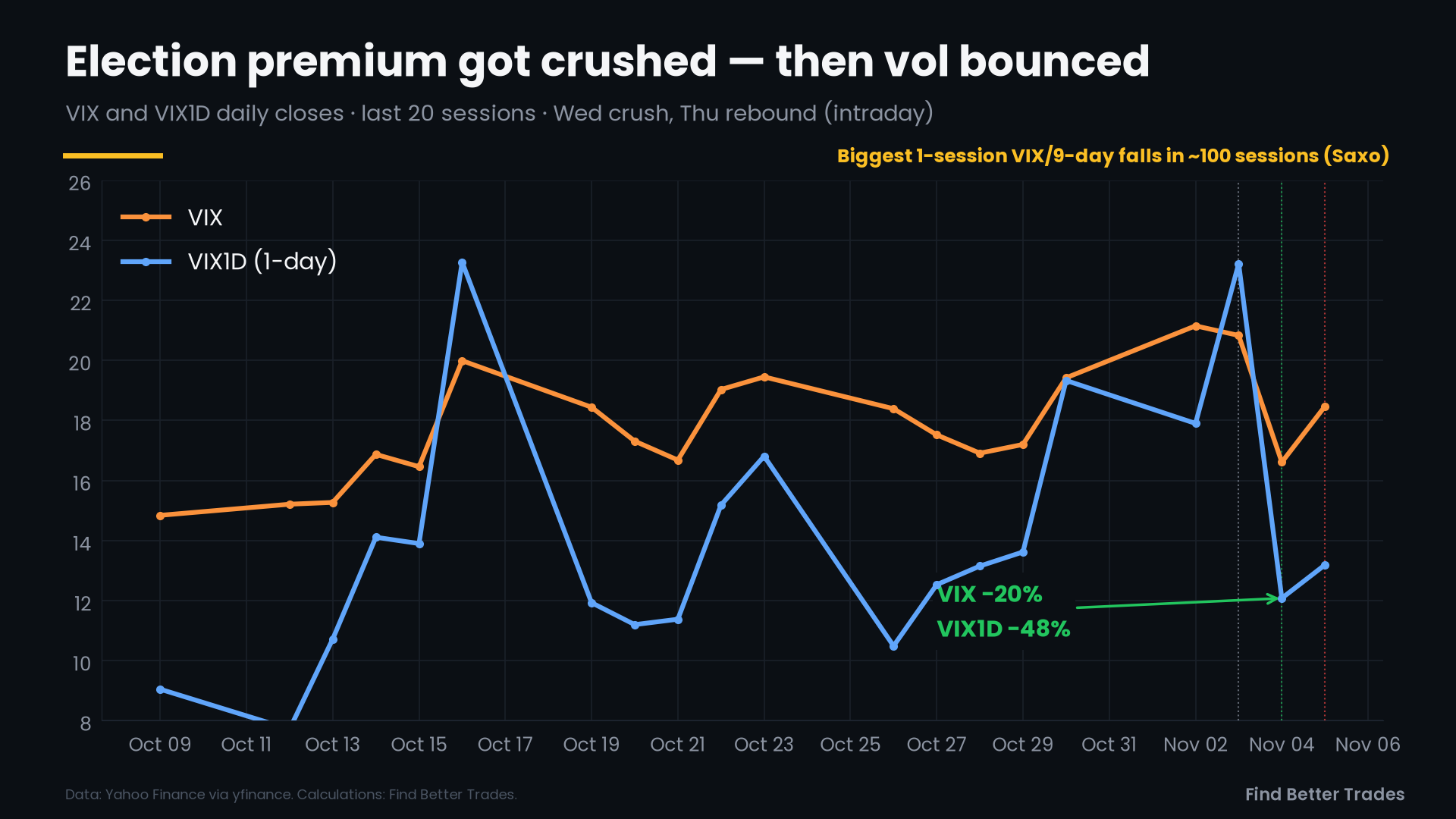
Wednesday was the first full session after the midterms, and the options market did what it always does when the binary event ends: it dumped the front-end hedge. VIX closed 16.61, down about 20% from Tuesday. The one-day gauge, VIX1D, got cut nearly in half. Then Thursday morning showed up and tested the “cheap vol” story before lunch. Here’s the tape, the Options 101 behind it, and what I’d actually watch from here. Not a prediction. A playbook.
What just happened
Wednesday’s cash close told a clean story. Per Saxo’s Options Brief (Nov 5) and Yahoo Finance:
- S&P 500 closed 7,688.62, +1.58%
- Dow +3.03%
- Nasdaq-100 +0.91%
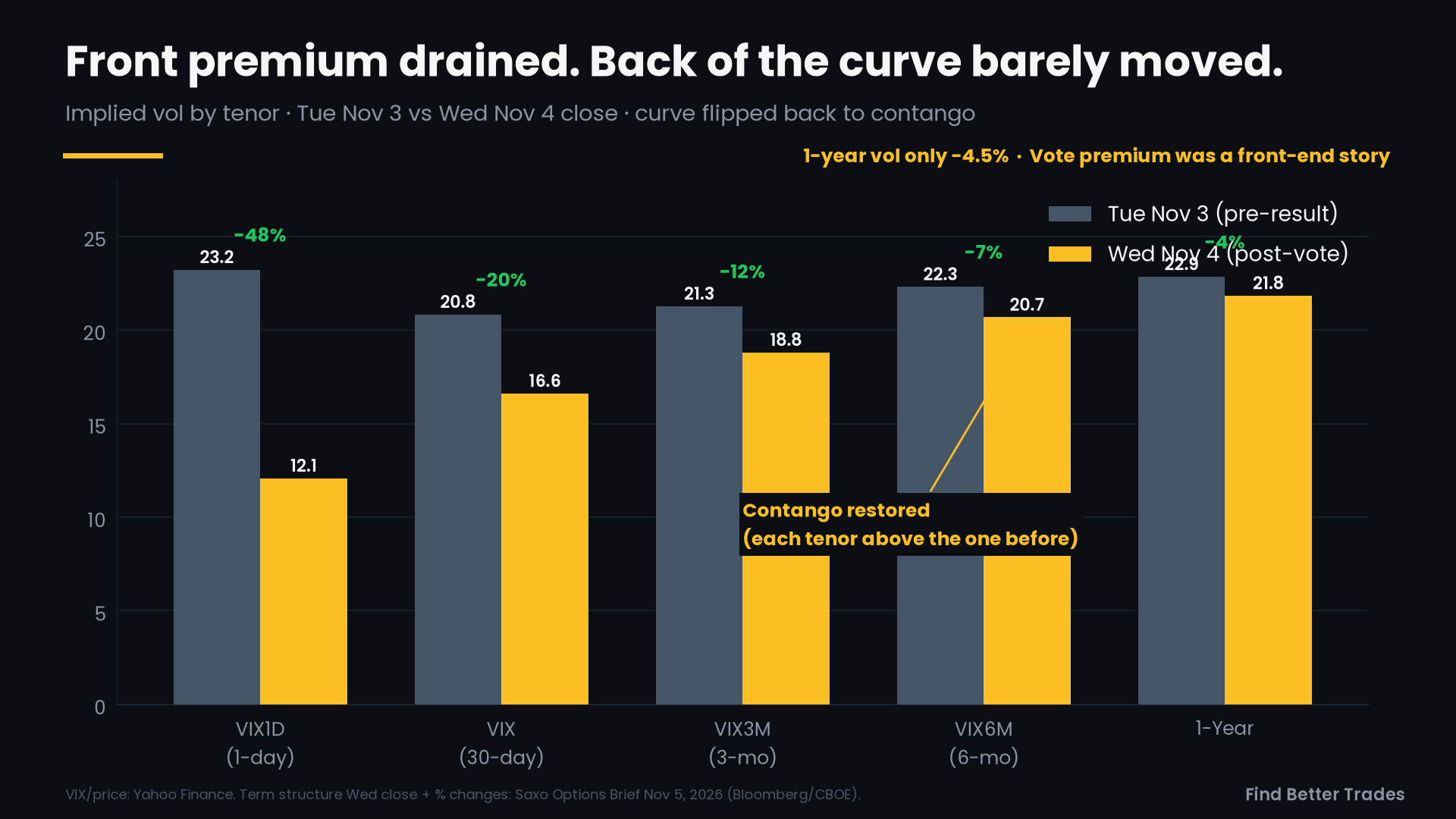
- VIX 20.83 → 16.61 (−20%)
- VIX1D 23.22 → 12.08 (−48%)
Saxo called those the biggest one-session drops for the VIX and the nine-day gauge in their ~100-session store. The curve flipped back to contango — each tenor sitting above the one in front of it. The punchline? One-year vol barely moved (−4.5%). Traders weren’t rewriting the next twelve months. They were dumping the vote hedge.
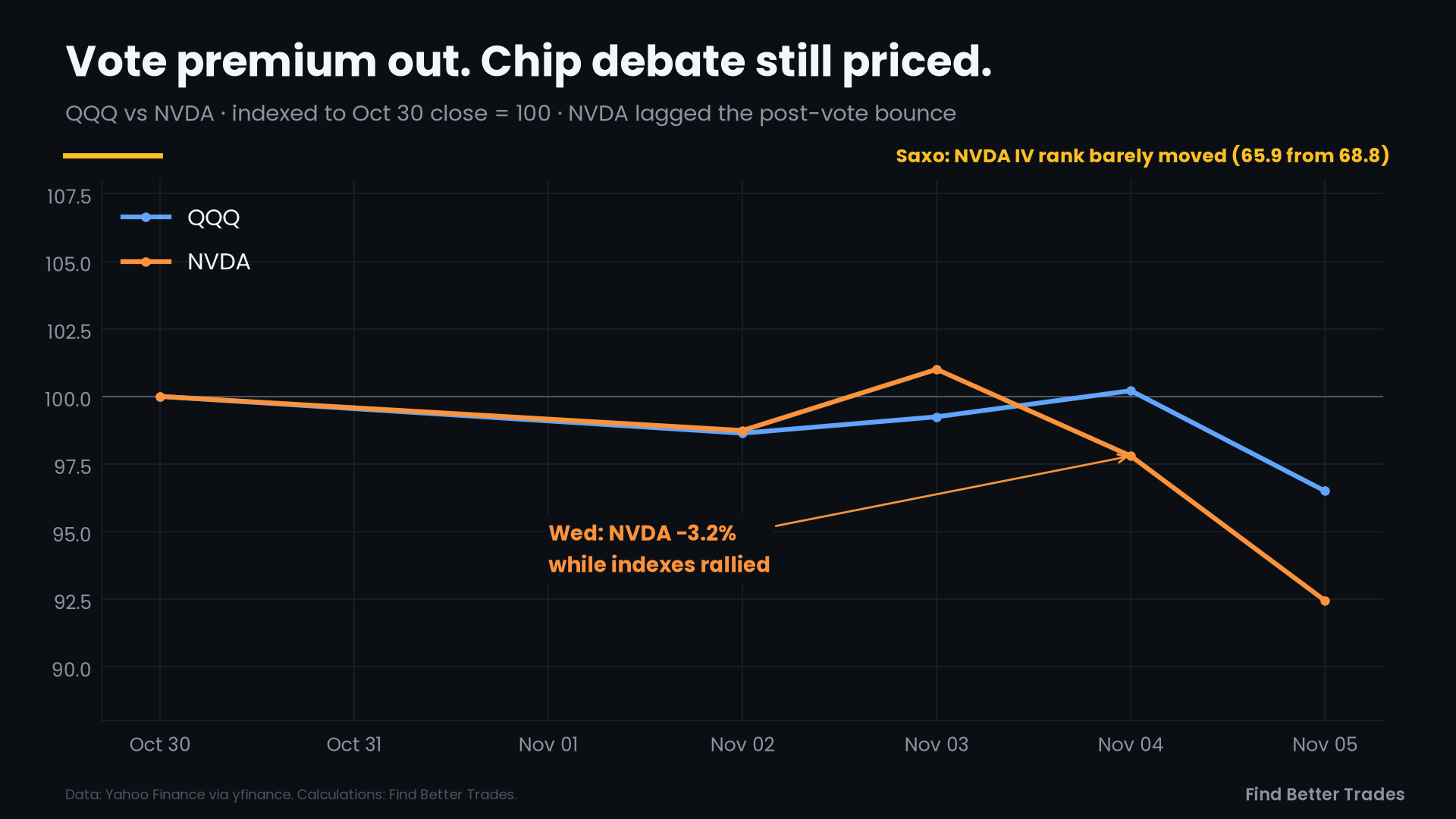
And the part a lot of people skimmed: SKEW held near 150.90 while VIX fell a fifth. Tails still cost money. NVDA dropped 3.17% Wednesday on regulation chatter, and Saxo noted its IV rank barely budged (about 65.9 from 68.8). Market stopped paying for the vote. It did not stop paying for the chip/AI debate. We covered that split on the price side yesterday in Midterm Results 2026: What They Mean for AI and Tech Stocks — levels and policy risk. This piece is the options read of the same tape.
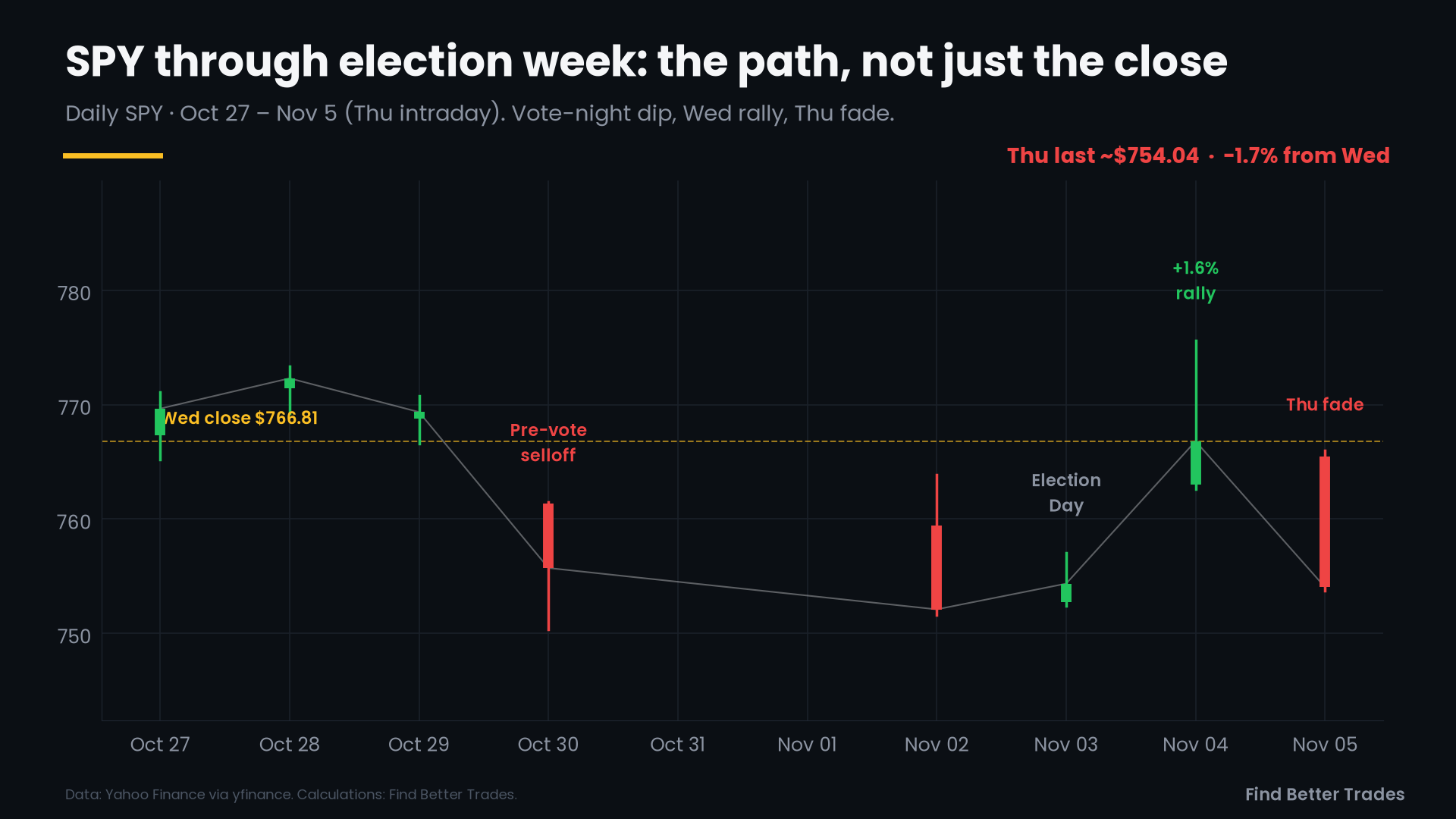
Thursday morning update (as of ~10 AM ET, Yahoo Finance): the “vol is cheap now” story already got stress-tested. VIX opened around 17.14 and was trading near 18.5. SPY and QQQ were selling off hard from Wednesday’s highs — SPY roughly −1.7%, QQQ closer to −3.7%, NVDA another leg lower. Front vol didn’t stay quiet for even one session.
What “event premium” actually is
Plain English. Before a known binary — elections, FOMC, big earnings — option prices bake in extra implied volatility. You’re not just paying for “normal” daily noise. You’re paying for the chance the tape gaps when the answer lands.
That extra juice is event premium.
It lives mostly in the front of the curve. One-day and week-out options get fat. Six-month and one-year stuff? Usually yawns. That’s exactly what we saw into the midterms: VIX1D spiked above the VIX into the vote, then collapsed the second the result was in the books.
After the event, two things hit the people who paid for that premium:
- The uncertainty collapses — implied vol drops even if the stock barely moves.
- Time decay accelerates — that fat premium you paid for “what if” starts rotting the second the “what if” is answered.
Buyers who held through the event needed a bigger move than they got priced, or they donated. Sellers who sized it right collected. Neither side is “smart” by default. The edge is knowing which premium you’re trading — vote risk vs. AI regulation risk vs. Friday payrolls risk. Those are different bets with different expirations.
Want a cleaner way to read expected moves and IV without guessing? Grab our free options report — it walks through how we frame setups before the next catalyst hits. No fluff. Just the process.
Bull case vs bear case for this vol regime
Bull case (calm holds / premium stays offered): Election hedge is gone. Contango is back. Median single-name IV rank fell into the high-30s per Saxo. If payrolls don’t shock and the tape grinds, short-dated premium keeps getting sold, realized vol stays below implied, and “sell the crush” traders look like geniuses for a few sessions. That’s the classic post-event playbook.
Bear case (cheap vol gets expensive again fast): Thursday already started the argument. Spot sold, VIX bounced. SKEW still ~150 says the market never stopped caring about a left-tail day. NVDA and semis kept their own IV — so single-name risk didn’t leave with the vote. Add Friday payrolls (Saxo had options pricing about 0.87% into Friday after draining election premium — down from 1.68% the day before) and you’ve got a fresh catalyst sitting on a thinner vol cushion. One ugly print and the “cheap” front end reprices in an hour.
I’m not picking a team here. I’m saying the regime flipped from event-rich to event-thin, and thin regimes punish people who size like the hedge is still expensive.
Practical playbook (education, not signals)
No promised returns. No “do this trade.” Just how I’d think about it:
- Respect the expected move. Into Friday, Saxo had roughly 0.87% priced for the S&P window that includes payrolls. That’s your ruler. A move inside that band is “priced.” A move that blows through it is new information. Don’t confuse the two.
- Don’t chase crushed IV blindly. VIX at 16 after a −20% day feels cheap next to Tuesday. It might not be cheap next to what happens next. Thursday’s bounce was the market saying “we’re not done.” Buying calls or puts just because IV fell is how accounts shrink.
- SKEW matters. When VIX falls and SKEW stays elevated, vanilla vol got cheaper — crash protection didn’t get nearly as cheap. If you’re short premium, know which strike region you’re short. Far OTMs still had a bid.
- Separate the stories. Index vote premium ≠ NVDA regulation premium ≠ payrolls premium. We talked levels and AI policy risk in the TSG midterms piece. Options traders need the same split: which expiration is pricing which fear?
- Size for the bounce, not the crush. Post-event vol can look dead for a morning and wake up into the next print. If you’re selling premium after a crush, size like Thursday already tried to teach you something.
- Watch the curve, not just the VIX print. Contango with a quiet front end is one regime. Contango with VIX1D ripping back toward the VIX is another. The shape tells you if the market is pricing a quiet week or just a quiet overnight.
Bottom line
The election premium got taken out of the front of the curve in one session. That’s not a mystery — that’s how event vol works. What is interesting: tails stayed expensive, chip IV barely flinched, and Thursday morning already poked the “we’re fine” narrative. Payrolls are still ahead.
Trade the premium that’s actually left. Don’t trade the ghost of Tuesday’s VIX.
— Ben