Butterfly Spread: Cheap Trades Aimed at a Target Price


📚 Options Strategies, Step by Step — Part 12 of 30
- Part 1: The Bull Call Spread: A Cheaper Way to Bet on a Rise
- Part 2: The Bear Put Spread: Profiting From a Drop With Defined Risk
- Part 3: Bull Put Credit Spreads: Getting Paid to Be Right on Direction
- Part 4: Bear Call Credit Spreads: Selling Premium Above Resistance
- Part 5: Managing Credit Spreads: Closing Early at 50% Profit
- Part 6: The Iron Butterfly: When You Expect a Stock to Pin a Price
- Part 7: The Reverse Iron Condor: Profiting From a Breakout
- Part 8: Short Straddles and Strangles: The Risk Nobody Explains
- Part 9: Calendar Spreads: Trading Time Decay Between Two Expirations
- Part 10: Diagonal Spreads: A Calendar Spread With a Directional Lean
- Part 11: The Double Diagonal: Income From a Range With Room to Breathe
- Part 12: Butterfly Spreads: Cheap Trades Aimed at a Target Price (you are here)
⚡ Key Takeaways
- A butterfly spread is a three-legged, defined-risk options structure designed to profit when an underlying stock lands directly on a specific target price at expiration.
- The setup combines one lower long strike, two short middle strikes, and one higher long strike, giving you a very cheap entry cost relative to its potential payout.
- You do not need the stock to pin the center strike perfectly to profit; closing the trade early at a 25% to 50% gain often yields the cleanest risk-adjusted outcome.
— Ben, Find Better Trades
A butterfly spread is an options strategy built by combining three different strike prices to target a specific price pin with strictly limited risk and high potential reward. Welcome to Part 12 of my “Options Strategies, Step by Step” series. Most traders look at options purely as expensive directional lottery tickets, but this setup flips that math completely upside down by giving you cheap entries when you have a clear price target.
What Is a Butterfly Spread?
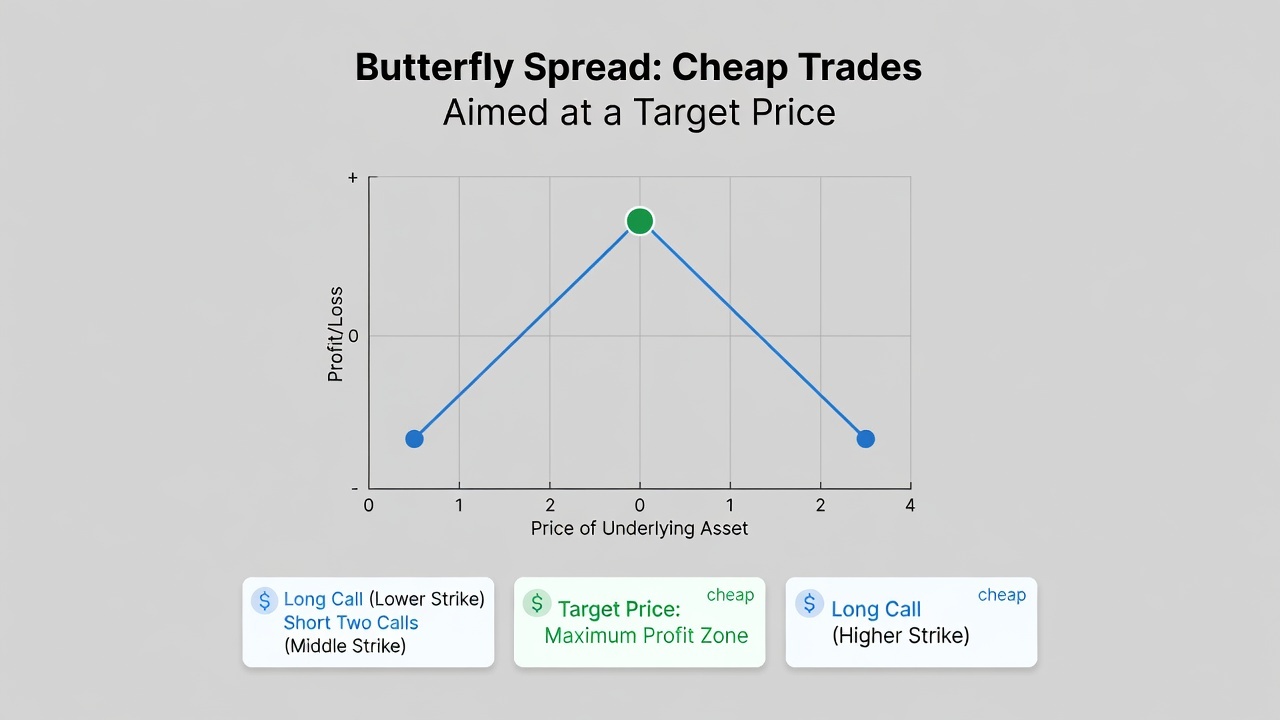
A standard butterfly spread is a three-strike options trade that combines an out-of-the-money debit spread with an out-of-the-money credit spread using all calls or all puts. It earns its name from its visual payoff diagram, where the two outside purchased strikes resemble wings and the two shared middle short strikes form the body.
Think of the butterfly spread like a game of precision darts. In standard long option buying, you simply want the stock to run as far and as fast as humanly possible. With a butterfly spread, you are aiming directly for the bullseye on the board, and you get paid the absolute most if the dart lands dead in the center.
Because you sell two options right at your target price, those short contracts pay for the majority of the two outside long options you buy. This credit drastically lowers your overall cash outlay, making the trade surprisingly inexpensive to enter. If you pay $1.00 for the spread, your total financial risk is locked at that single dollar no matter how wild the market becomes.
We covered the Iron Butterfly earlier in Part 6 of this series, but that strategy used both calls and puts to collect an upfront net credit. By contrast, a standard butterfly spread uses exclusively calls or exclusively puts and is paid for as a net debit upfront. It offers an exceptionally cheap way to take a focused shot on a specific price level without exposing your account to catastrophic loss.
How a Long Call Butterfly Spread Works Step by Step
A long call butterfly spread uses three strike prices at equal distances apart: you buy one lower call, sell two middle calls, and buy one higher call, all sharing the exact same expiration date. The middle strike represents your target price, which is where you believe the underlying asset will settle when the contracts expire.
Let’s say XYZ stock is trading at $100 per share, and your chart analysis suggests it will stall near $105 in 30 days. To build a $5-wide call butterfly, you buy one $100 call, sell two $105 calls, and buy one $110 call.
Suppose the $100 call costs $6.00, the $105 calls sell for $3.00 each (bringing in $6.00 total), and the $110 call costs $1.20. Your net cost is calculated by taking the cash paid for the wings and subtracting the cash received for the body: $6.00 plus $1.20 equals $7.20 paid, minus the $6.00 collected from the two short calls, leaving you with a net debit of $1.20 per share ($120 total).
That $120 net debit is the absolute most you can lose on the trade. If the stock drops to $80 or rallies to $150, your loss never exceeds that initial $120. Maximum profit happens if the stock closes at exactly $105 on expiration day, making the $100 call worth $5.00 while the two short $105 calls and the long $110 call expire completely worthless, generating $500 of value minus your $120 entry cost for a net gain of $380.
The Math Behind Max Profit, Max Loss, and Breakeven Points
The math of a butterfly spread is straightforward because the wing width sets the maximum gross value the trade can ever achieve. Your maximum gross payout is always equal to the distance between the strikes minus the net debit paid upfront.
To find your upper and lower breakeven levels at expiration, you simply add and subtract your net debit from the outside strikes. The lower breakeven is the lowest strike plus the net debit paid, while the upper breakeven is the highest strike minus that same net debit.
Here is how the numbers line up for our $100 / $105 / $110 call butterfly spread entered at a net cost of $1.20:
| Stock Price at Expiration | Position Value | Net Profit / Loss ($1.20 Debit) |
|---|---|---|
| $95.00 (Below Lower Strike) | $0.00 | -$120 (Max Loss) |
| $101.20 (Lower Breakeven) | $1.20 | $0.00 (Breakeven) |
| $105.00 (Target Pin) | $5.00 | +$380 (Max Profit) |
| $108.80 (Upper Breakeven) | $1.20 | $0.00 (Breakeven) |
| $115.00 (Above Upper Strike) | $0.00 | -$120 (Max Loss) |
Notice how narrow your risk window is compared to your upside potential. You are risking $120 to potentially make up to $380, creating a risk-to-reward ratio better than 1-to-3 on a strictly defined trade.
However, that high reward comes with a trade-off in probability. Your stock must stay within the $101.20 to $108.80 price pocket by expiration day to see a profit, which is why entry pricing and strike selection matter so much.

Call Butterfly vs. Put Butterfly: Does It Actually Matter?
A put butterfly spread uses identical strike spacings as a call butterfly but constructs the position using exclusively put options instead of calls. Specifically, you buy one higher put, sell two middle puts, and buy one lower put.
In theoretical pricing models, a put butterfly and a call butterfly with the exact same strikes and expiration date should trade for roughly the same price. This balance occurs due to put-call parity, an options pricing law that keeps equivalent synthetic structures in financial equilibrium.
In the real world, you should pick whichever structure uses out-of-the-money contracts to enter the trade. If your target price is above the current stock price, build the trade with calls because out-of-the-money call strikes typically have tighter bid-ask spreads and higher market volume. If your target price is below the current stock price, build it with puts for the exact same liquidity advantage.
Trading in-the-money options to build a butterfly creates unnecessary friction and assignment headaches. Sticking to the out-of-the-money side guarantees that your position stays cleaner, easier to fill, and less exposed to surprise early assignments before expiration week.
A Real-World Trade Setup: Pinning a Post-Earnings Retracement
Butterfly spreads excel when a volatile stock experiences an aggressive move and you expect it to settle down around a major technical level like moving average support. Let’s look at a realistic trade on a hypothetical tech stock named ABC, currently sitting at $210 after a steep rally.
You review your chart and notice strong horizontal support sitting at $200, which also coincides with the stock’s 50-day moving average. You expect ABC to slowly pull back and stall near that $200 mark over the next 21 days.
Because your target is below the current market price, you choose a long put butterfly spread with $10-wide wings. You buy one $190 put, sell two $200 puts, and buy one $210 put, all expiring in three weeks.
Let’s track the pricing breakdown for this trade:
- Buy 1 ABC $210 Put for $11.50
- Sell 2 ABC $200 Puts for $5.50 each (collecting $11.00 total)
- Buy 1 ABC $190 Put for $2.00
Your net debit is $11.50 paid plus $2.00 paid, minus the $11.00 collected from the two short puts, resulting in a net entry cost of $2.50 per share ($250 per contract). That $250 is your total capital at risk. With $10-wide wings, your absolute maximum profit potential is $10.00 minus $2.50, which equals $7.50 per share ($750 total profit) if ABC pins $200 on expiration day.
From Find Better Trades
Consistent Income. Any Market Direction.
A low-risk debit spread every Thursday, built to make steady returns whether the market runs up, down, or sideways.
 → See Layered Options

When Should You Use a Butterfly Spread (And When Should You Avoid It)?
Butterfly spreads are built for low-volatility environments or post-announcement lulls where price action is expected to grind sideways into a consolidation range. They work best when an underlying stock has already completed a major move and is losing momentum near an obvious psychological support or resistance zone.
This strategy is ideal for traders with smaller accounts who want high-reward setups without paying the huge upfront price tags associated with single-leg options. Instead of spending $800 to buy a single long call that decays daily, a butterfly lets you target the exact same zone for $100 to $150.
Conversely, you should avoid butterfly spreads when an asset is experiencing extreme momentum or leading up to a binary catalyst like an earnings release. If a stock gaps wildly in one direction, it will blow clean through your wings before time decay has a chance to work in your favor.
Never trade butterfly spreads on low-volume, illiquid stocks. Because this trade has three separate strikes and four individual option contracts, wide bid-ask spreads will eat your edge before you even get filled.
How to Manage and Exit Butterfly Spreads for Consistent Gains
The single best habit you can develop with butterfly spreads is taking your profit off the table well before expiration day. Waiting for a stock to land on your exact center strike at 4:00 PM on a Friday is a fool’s errand that turns winning trades into losers.
Because the trade carries such a low cost basis, a modest move into your profit tent creates an immediate, sizable percentage gain. If you paid $1.00 for a spread and its market price rises to $1.40 or $1.50 with two weeks left on the clock, you are sitting on a 40% to 50% return on your capital.
Take that profit and close the trade. As expiration draws closer, the trade’s gamma spikes dramatically, meaning tiny price swings in the underlying stock cause erratic, violent changes in your spread’s value. Closing early locks in cash and protects you from wild last-minute price swings.
If the stock moves immediately against your target and shows zero signs of stabilizing, you can let the spread expire for the defined debit paid, or close it early for pennies to salvage a small fraction of your capital. When I trade these, I place a standing limit order to close the entire butterfly whenever it hits a 30% to 50% gain, removing emotion entirely from the process.
Common Mistakes Beginners Make With This
Holding out for maximum profit. Beginners often stare at the maximum profit graph and refuse to exit until the stock hits the exact center strike on expiration day. That top point on the chart is nearly impossible to hit perfectly, and holding too long exposes you to late-stage pin risk and sudden reversals.
Trading illiquid option chains. Because a butterfly involves buying one contract, selling two contracts, and buying another contract, you are paying the spread across four individual legs. If the bid-ask spread is $0.20 wide on each strike, slippage alone can chew up half of your potential profit before the trade begins.
Setting wings that are too narrow. Trying to make the trade dirt cheap by picking strikes that are only $1 or $2 wide creates a profit tent so small that the stock rarely stays inside it. Give your trade room to breathe by matching your wing width to the stock’s typical expected move.
Trading butterflies right before earnings. Buying a debit butterfly right before an earnings report sounds appealing because it is cheap, but implied volatility collapses instantly after the numbers drop. While IV crush helps your short body, it wrecks the value of your long wings, often dragging the entire spread down in value.
Frequently Asked Questions About Butterfly Spreads
Can you lose more money than you pay for a butterfly spread? No, you cannot lose more than your initial net debit on a standard long butterfly spread, provided you close the position before expiration. Your risk is fully capped because your two outside long options completely protect the two short options you sold in the middle.
What is pin risk on a butterfly spread? Pin risk occurs when the underlying stock closes right at or near your short middle strike on expiration day, leaving you uncertain whether your short options will be assigned over the weekend. You can completely avoid pin risk by closing the entire four-leg spread on Friday afternoon before the market closes.
Is an Iron Butterfly better than a regular Butterfly Spread? Neither strategy is inherently superior; they simply express different cash flows. A standard butterfly is entered for a net debit using all calls or all puts, while an Iron Butterfly is entered for a net credit using both calls and puts across the same strike structure.
How far out in time should I buy a butterfly spread? A sweet spot for standard butterfly spreads is between 21 and 45 days to expiration. This timeframe gives the underlying stock enough time to migrate toward your target price while allowing the rapid time decay of the final month to work on your short middle options.
In Part 13, we’re going to alter this structure by shifting one of the wings to build the Broken Wing Butterfly, a clever adjustment that completely eliminates your downside risk on one side of the trade.
📈 Want More? Join Our Free Trading Community
- Trading Strategy Guides Telegram — daily strategy tips and market insights
- Find Better Trades Telegram — free trade signals delivered to your phone
- Find Better Trades on YouTube — live trade breakdowns and tutorials
Lesson 63 of 63 in the free Options Trading Course.
← Previous: Double Diagonal Spread: Range Income Step by StepYou have reached the latest lesson. New lessons are added every week.