Double Diagonal Spread: Range Income Step by Step

📚 Options Strategies, Step by Step — Part 11 of 30
- Part 1: The Bull Call Spread: A Cheaper Way to Bet on a Rise
- Part 2: The Bear Put Spread: Profiting From a Drop With Defined Risk
- Part 3: Bull Put Credit Spreads: Getting Paid to Be Right on Direction
- Part 4: Bear Call Credit Spreads: Selling Premium Above Resistance
- Part 5: Managing Credit Spreads: Closing Early at 50% Profit
- Part 6: The Iron Butterfly: When You Expect a Stock to Pin a Price
- Part 7: The Reverse Iron Condor: Profiting From a Breakout
- Part 8: Short Straddles and Strangles: The Risk Nobody Explains
- Part 9: Calendar Spreads: Trading Time Decay Between Two Expirations
- Part 10: Diagonal Spreads: A Calendar Spread With a Directional Lean
- Part 11: The Double Diagonal: Income From a Range With Room to Breathe (you are here)
⚡ Key Takeaways
- A double diagonal spread combines two diagonal spreads to collect premium from a range-bound stock while retaining long-dated downside and upside protection.
- Unlike an iron condor, a double diagonal is net long Vega, meaning an unexpected spike in market volatility actually cushions your position rather than crushing it.
- The trade targets 15% to 25% profit on debit paid by letting the faster front-month options decay while the back-month options hold their value.
— Ben, Find Better Trades
A double diagonal spread is a neutral options strategy where you buy long-dated out-of-the-money calls and puts while simultaneously selling short-dated calls and puts closer to the stock price. This four-legged setup creates a wide profit tent where you collect fast time decay from the near-term contracts, while the further-out contracts act as shock absorbers against unexpected market moves.
The tool I use for this: Gravity Zone Indicator. Gravity Zone detects hidden institutional accumulation on TradingView — so you’re in the breakout while retail is still waiting for confirmation. See Gravity Zone In Action →
Welcome to Part 11 of our “Options Strategies, Step by Step” series. Most beginners struggle with range-bound trading because typical credit spreads punish you viciously the moment volatility explodes, but this setup offers a smarter way to stay protected.
What Is a Double Diagonal Spread?
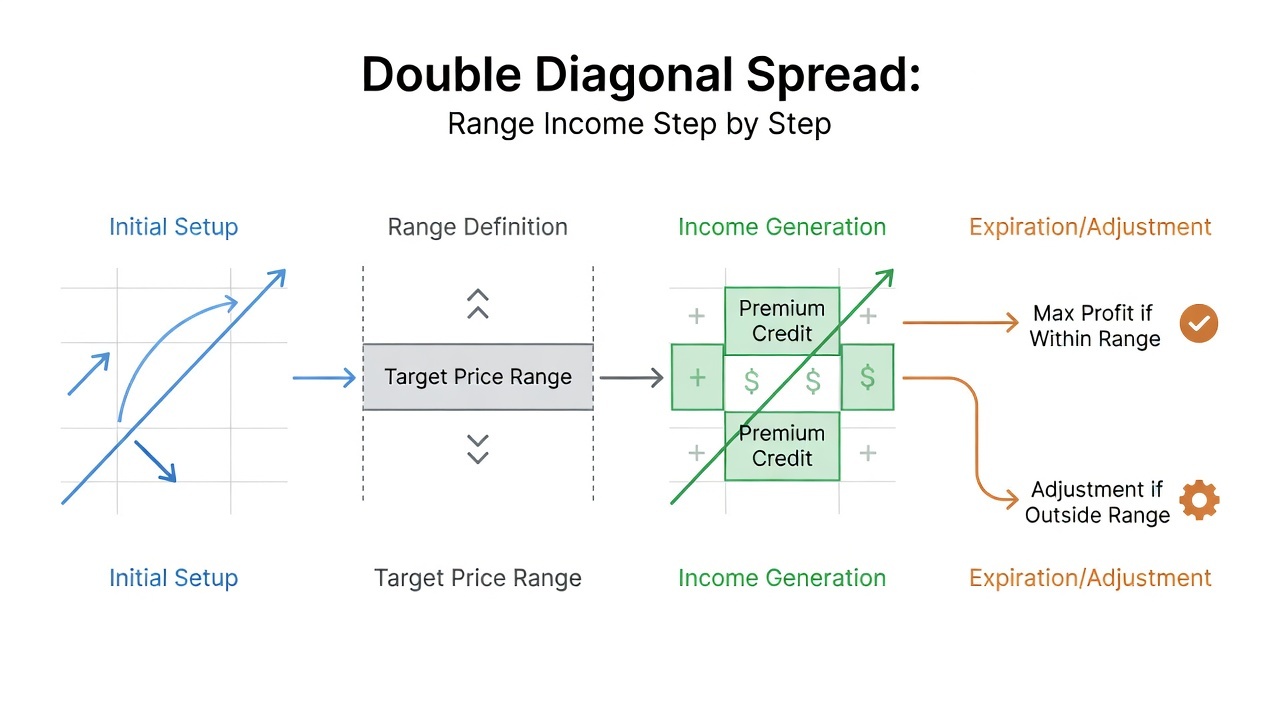
A double diagonal spread is simply the combination of an out-of-the-money put diagonal spread and an out-of-the-money call diagonal spread opened on the same underlying stock. You are establishing two separate calendar-style spreads at the exact same time: one working the downside and one working the upside.
Earlier in the series, we covered calendar spreads and diagonal spreads, where you discovered how different expiration dates decay at completely different speeds. A double diagonal takes that exact mechanic and turns it into a delta-neutral, two-sided income engine.
Think of this structure like renting out two beachfront cottages for short weekend getaways while you hold long-term annual leases on two larger homes behind them. The short-term renters pay you immediate cash upfront, while your long-term leases guarantee your presence in the neighborhood even if the weekend weather turns sour.
Because the options you sell expire much faster than the options you buy, time decay works in your favor every single day the stock stays relatively quiet. Theta, which measures how much value an option loses each day just from time passing, chips away at your short options at an accelerating rate.
Meanwhile, the longer-dated options you bought decay much more slowly. That difference in decay rates is where your trading profit comes from.
You end up with a wide comfort zone between your two short strikes. As long as the stock remains drifting inside that channel, your trade quietly accumulates value without requiring dramatic market moves.
How a Double Diagonal Is Built
A double diagonal spread consists of four distinct option contracts split across two different expiration dates. You buy two outer-wing contracts with more time on the clock and sell two inner contracts with less time on the clock.
To build the trade, you look roughly 30 to 45 days out for your front-month expiration and roughly 60 to 90 days out for your back-month expiration. The front month is where you sell options to collect decay, and the back month is where you buy options for protection and durability.
On the call side, you sell a front-month call above the current stock price and buy a back-month call even further out of the money. On the put side, you sell a front-month put below the current stock price and buy a back-month put further down.
Here is how the four legs line up on an underlying stock:
| Leg | Action | Expiration | Strike Selection | Role in Trade |
|---|---|---|---|---|
| Long Put | Buy to Open | Back Month (60-90 DTE) | Far OTM (~15-20 Delta) | Downside Tail Protection |
| Short Put | Sell to Open | Front Month (30-45 DTE) | Near OTM (~25-30 Delta) | Income Generation |
| Short Call | Sell to Open | Front Month (30-45 DTE) | Near OTM (~25-30 Delta) | Income Generation |
| Long Call | Buy to Open | Back Month (60-90 DTE) | Far OTM (~15-20 Delta) | Upside Tail Protection |
Notice that because you buy options further out in time, this trade almost always opens for a net debit. You pay cash upfront out of your account to establish the position.
That initial debit defines your maximum theoretical risk if the underlying stock pins completely flat for months without you managing it. In practice, however, your actual risk is far smaller because the long back-month contracts maintain substantial residual value.
Double Diagonal vs. Iron Condor: Why the Extra Time Matters
A double diagonal spread and an iron condor share a similar visual payoff diagram, but their sensitivity to volatility and time behaves in radically different ways. We looked at range strategies like the iron butterfly earlier in this series, and an iron condor operates on the same single-expiration framework.
In an iron condor, all four contracts expire on the exact same afternoon. If the market panics and implied volatility spikes, your short iron condor suffers instantly because higher volatility raises the value of every single contract you sold.
A double diagonal completely changes this dynamic because your long options live in a later expiration cycle. Long-dated options carry a much higher Vega, meaning they gain substantial cash value whenever volatility surges across the market.
If the stock experiences a sudden drop, market volatility naturally climbs. In an iron condor, that expansion hurts you, but in a double diagonal, your back-month long put inflates rapidly in price and absorbs a big chunk of the damage.
| Feature | Standard Iron Condor | Double Diagonal Spread |
|---|---|---|
| Expiration Dates | Single expiration for all 4 legs | Two distinct expirations (Front vs. Back) |
| Initial Trade Flow | Net credit received upfront | Net debit paid upfront |
| Volatility Exposure (Vega) | Short Vega (hurts when IV spikes) | Net Long Vega (benefits when IV rises) |
| Rolling Flexibility | Limited to rolling entire credit spreads | Can roll front-month shorts multiple times |
The other major advantage is rolling flexibility. When the front-month options expire worthless, your back-month options are still active with 30 to 45 days left on them.
That means you have the option to sell a second batch of front-month options against those same long contracts. You effectively get a second round of income without paying to enter a brand-new trade.

Step-by-Step Example: Setting Up a Trade on a $100 Stock
To see how the numbers play out in real life, let us walk through a hypothetical setup on a stock trading at $100 per share. We will use clean numbers so you can follow the debit math line by line.
Assume XYZ stock trades at exactly $100, and we anticipate it will spend the next four weeks drifting between $94 and $106. We pull up the option chain and select our two expiration cycles: the front month expiring in 30 days and the back month expiring in 60 days.
First, we structure the downside put diagonal spread. We sell the 30-day $95 put for $1.10 and buy the 60-day $90 put for $1.85, resulting in an initial debit on the put side of $0.75 per share, or $75.
Next, we structure the upside call diagonal spread. We sell the 30-day $105 call for $1.15 and buy the 60-day $110 call for $1.90, which requires a debit on the call side of $0.75 per share, or $75.
We combine both halves into one ticket. Our total cost to enter the double diagonal spread is $0.75 plus $0.75, which equals a total net debit of $1.50 per share, or $150 total capital invested.
Now consider what happens after 25 days if XYZ stock simply chops sideways and trades at $101. The front-month options have lost nearly all their time value due to heavy theta decay.
The 30-day $95 put has collapsed from $1.10 down to $0.05, and the 30-day $105 call has fallen from $1.15 down to $0.10. Meanwhile, the 60-day options still have 35 days remaining, so their prices drop much less: the $90 put is worth $1.10 and the $110 call is worth $1.25.
We close the entire position by buying back our short options for $0.15 combined and selling our long options for $2.35 combined. We collect a net closing credit of $2.20 ($220 total).
Subtracting our original $1.50 debit from our $2.20 closing credit leaves us with a net profit of $0.70 per share, or $70 on the spread. That represents a 46% return on our capital risk in less than a month.
How Implied Volatility and Vega Impact the Trade
Implied volatility is the secret engine that powers a double diagonal spread, and you must understand its direction before opening the position. Implied volatility reflects the market’s expectation of future price swings priced into option premiums.
Because your long options sit further out in calendar time, they possess a higher Vega coefficient than the short options sitting in the front month. This means for every 1% jump in implied volatility across both cycles, your back-month long options gain more dollar value than your front-month short options lose.
This positive Vega profile makes the double diagonal an exceptional strategy when entering during periods of relatively low or depressed volatility. When volatility normalizes upward, your long contracts appreciate, expanding your profit margin and widening your cushion against price drift.
Conversely, a volatility collapse damages a double diagonal. If you enter this trade right before an earnings announcement when implied volatility is wildly inflated, the post-earnings volatility crush will deflate your back-month options faster than your front shorts can compensate.
This is why you should avoid holding double diagonals across major binary corporate catalysts like earnings reports or product launches. You want calm, steady market environments where implied volatility is low or grinding gradually higher.
Understanding this Greek relationship protects you from the confusion that hits beginners when a stock stays flat but their trade loses money. If implied volatility tanks, your back-month wings lose value even if the stock price never budged an inch.
From Find Better Trades
Consistent Income. Any Market Direction.
A low-risk debit spread every Thursday, built to make steady returns whether the market runs up, down, or sideways.
 → See Layered Options

Managing the Trade When the Stock Tests a Strike
Every options trader eventually faces a trade that moves against them, and the real skill lies in managing the test calmly. Let us look at what happens when our hypothetical $100 stock makes an aggressive run toward our upper boundary.
Suppose XYZ rallies from $100 up to $104.50 within the first two weeks of our trade. Our short $105 call is now under threat, while our put side is sitting far out of the money and has decayed almost to zero.
First, evaluate the untested put side. The short 30-day $95 put is likely trading for just a few cents, meaning that half of your trade has already done almost all the work it can possibly do.
When this happens, I immediately close out the put diagonal spread to lock in whatever profit remains on that half of the trade. Leaving the put side open accomplishes nothing because there is virtually no remaining premium left to decay.
Now you turn your attention to the tested call side. Because your long 60-day $110 call gained significant value during the stock rally, the call spread itself is not suffering as badly as a naked short call would.
You have three clear choices depending on your outlook for the stock. If you think the rally is running out of steam, you can simply close the entire trade early for a small scratch or modest loss.
If you prefer to stay in the trade, you can roll your front-month $105 short call up to the $107 strike while simultaneously rolling it out to the back-month expiration date. Rolling shifts your break-even point higher and buys you additional time for the stock to settle down.
Never let the stock blast completely through your short strike into deep in-the-money territory. If the stock crosses your short strike and momentum shows zero signs of stopping, take your defined exit and protect your capital.
My Rules for Entering and Exiting Double Diagonals
Consistency in options trading comes from executing the exact same rules on every single setup. I use strict, repeatable criteria before I ever risk a dollar on a double diagonal spread.
First, I check the implied volatility rank or percentile of the underlying stock. I only enter when the IV rank sits below 35, ensuring I am buying my long back-month options when they are relatively inexpensive.
Second, I target 30 to 40 days to expiration for my short front-month options and 60 to 75 days to expiration for my long back-month options. This 30-day gap between the expirations creates the optimal decay gradient where front theta outpaces back theta.
Third, I select my strikes based on delta rather than arbitrary dollar distances. I sell the 25-delta front-month strikes and buy the 15-delta back-month strikes on both sides, which naturally accounts for the market’s expected price range.
Fourth, I set a mechanical profit target of 20% to 25% of the initial debit paid. If I paid $150 to enter the spread, I place a standing limit order to exit the trade as soon as I can close it for a $35 to $40 profit.
Fifth, I establish a firm stop loss at 25% of the debit paid or whenever the stock price touches either of my short strikes. Taking a small loss when a boundary is touched preserves your mental clarity and leaves your trading account intact for the next opportunity.
Common Mistakes Beginners Make With This
The most frequent error is holding a double diagonal straight through an earnings announcement. Beginners see the huge premiums on the front-month options and think they will make an easy profit, only to watch their long back-month options get wiped out by the post-earnings volatility crush.
Another common mistake is placing the short strikes too close to the current stock price in order to collect higher premiums. Selling high-delta strikes severely narrows your profit window and guarantees that normal daily stock fluctuations will constantly threaten your position.
Many new traders also forget to close the untested side of the trade when the stock makes a strong move in one direction. If the stock rallies hard, leaving your put side open leaves you vulnerable to a sharp reversal that erases all your earlier gains.
Finally, beginners often choose expiration dates that are too far apart, such as selling a 15-day option against an 8-month option. While this seems safe on paper, the long-dated option moves too slowly, creating an inefficient drag on your overall portfolio capital.
Double Diagonal Strategy FAQs
Can you lose more money than your initial debit on a double diagonal?
No, your maximum theoretical loss at entry is capped at the total net debit paid to establish the spread. Because you own long options that sit further out in time, those long contracts provide a hard cap on your total risk, provided you do not hold short legs past their expiration.
Is a double diagonal spread a debit or credit trade?
A double diagonal is entered as a net debit trade because longer-dated options cost more money than shorter-dated options. Even though you sell two options to collect cash, buying two options with more time value requires a net cash outflow from your brokerage account.
What happens if the stock finishes right between both short strikes at front expiration?
This is the ideal profit scenario for the strategy. Both of your front-month short options will expire completely worthless, allowing you to either close your remaining long options for profit or sell a brand-new set of front-month options against them for additional income.
When is the best time to exit a double diagonal spread?
The best time to exit is typically 7 to 10 days before the front-month options expire, or as soon as you hit your 20% to 25% profit target. Holding contracts during their final week introduces gamma risk, where small price moves cause wild swings in your position’s value.
Next up, we are tackling Butterfly Spreads: Cheap Trades Aimed at a Target Price — and I’ll show you how to risk tiny dollars for massive payouts when you have a specific price target in mind.
📈 Want More? Join Our Free Trading Community
- Trading Strategy Guides Telegram — daily strategy tips and market insights
- Find Better Trades Telegram — free trade signals delivered to your phone
- Find Better Trades on YouTube — live trade breakdowns and tutorials
Lesson 62 of 63 in the free Options Trading Course.
← Previous: Diagonal Spreads: The Complete Step-by-Step Guide
Next: Butterfly Spread: Cheap Trades Aimed at a Target Price →