Diagonal Spreads: The Complete Step-by-Step Guide

📚 Options Strategies, Step by Step — Part 10 of 30
- Part 1: The Bull Call Spread: A Cheaper Way to Bet on a Rise
- Part 2: The Bear Put Spread: Profiting From a Drop With Defined Risk
- Part 3: Bull Put Credit Spreads: Getting Paid to Be Right on Direction
- Part 4: Bear Call Credit Spreads: Selling Premium Above Resistance
- Part 5: Managing Credit Spreads: Closing Early at 50% Profit
- Part 6: The Iron Butterfly: When You Expect a Stock to Pin a Price
- Part 7: The Reverse Iron Condor: Profiting From a Breakout
- Part 8: Short Straddles and Strangles: The Risk Nobody Explains
- Part 9: Calendar Spreads: Trading Time Decay Between Two Expirations
- Part 10: Diagonal Spreads: A Calendar Spread With a Directional Lean (you are here)
⚡ Key Takeaways
- A diagonal spread combines different expiration dates and different strike prices into a single position.
- By buying a longer-term option and selling a shorter-term option, you capture rapid time decay while maintaining a directional bias.
- You can run diagonal spreads as bullish call setups or bearish put setups to lower upfront capital costs compared to outright buying.
— Ben, Find Better Trades
A diagonal spread is an options strategy where you buy a longer-dated option at one strike price and sell a shorter-dated option at a different strike price using the same underlying stock. This structure allows you to collect faster time decay on the near-term contract while holding directional exposure on the back-month contract. Welcome to Part 10 of our 30-part series, where we take what you learned about time decay and give it a clear directional purpose.
Most retail traders either buy naked calls or sell simple vertical spreads. When they look at calendar setups, they often struggle because standard calendars require the stock to stall out at a single price point.
Diagonal spreads fix that problem by letting you pick a direction while still harvesting time decay week after week.
What Is a Diagonal Spread in Options Trading?
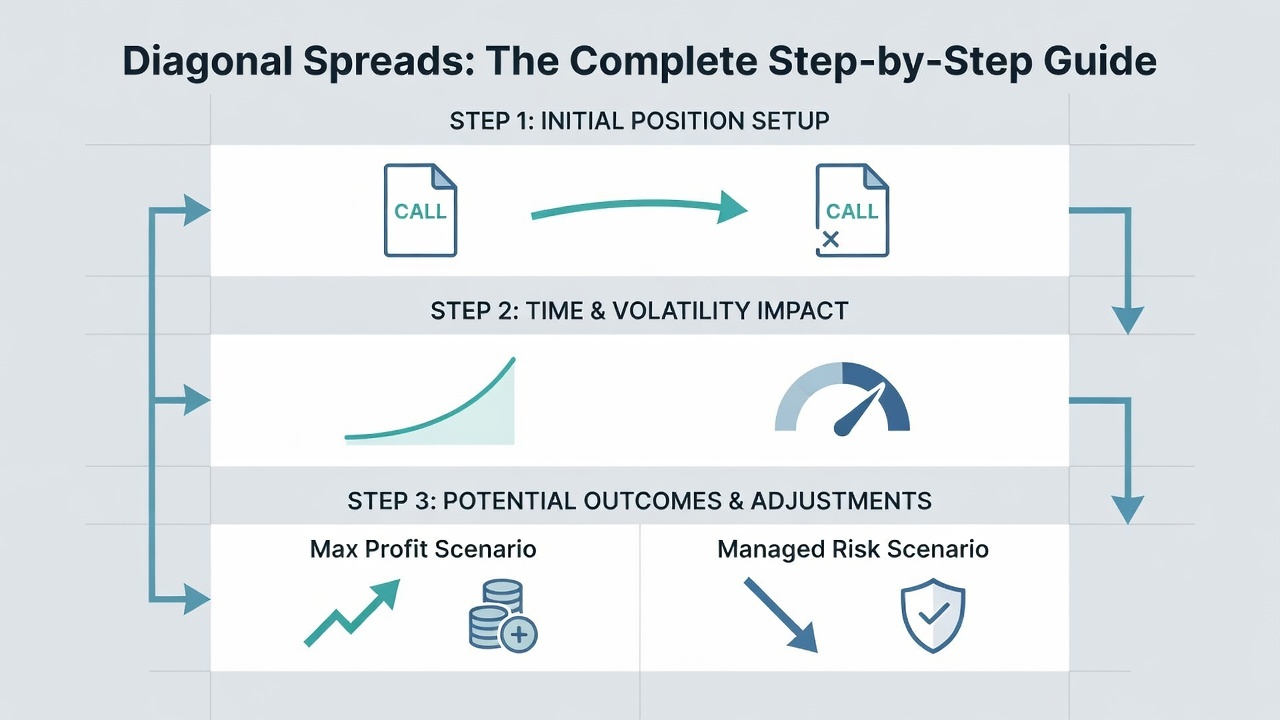
A diagonal spread is a two-legged trade that blends elements of a vertical spread and a calendar spread. You buy an option expiring further out in time, and you sell an option expiring much sooner at a different strike price.
Think of it like renting out rooms in an apartment building you leased for a full year. You hold the long-term master lease on the property, and you collect quick cash by sub-leasing rooms to short-term weekend travelers.
As long as those weekend guests move out without wrecking the place, you keep their money and can rent the room again next weekend. The long-dated contract acts as your property anchor, while the short-dated contract provides recurring rental income.
In Part 9 of this series, we covered calendar spreads, where both options share the exact same strike price. A diagonal changes the game by shifting that short strike higher or lower to match where you think the stock is headed.
This strike shift introduces directional delta to the position, meaning the trade benefits from both passing days and a steady move toward your target.
How a Bullish Call Diagonal Spread Works
A bullish call diagonal spread involves buying an in-the-money call option with a distant expiration date and selling an out-of-the-money call option with a near-term expiration date. Traders often call this setup the Poor Man’s Covered Call because it mimics stock ownership at a fraction of the cost.
Instead of purchasing 100 shares of stock to sell covered calls against, you use a deep in-the-money long call as your synthetic stock surrogate. That long call gives you strong positive delta, meaning its value moves almost dollar-for-dollar with the stock price.
Meanwhile, the out-of-the-money call you sell sits directly above the current share price at a resistance level you do not expect the stock to breach before the near-term expiration. This short contract loses value rapidly due to theta decay, which is the natural erosion of an option’s premium over time.
If the stock climbs gradually or drifts sideways, the short call expires worthless, leaving you with full ownership of the long call to sell another short contract against. If the stock rallies directly to your short strike, you capture maximum gains on the first cycle from both legs expanding in your favor.
The primary objective is generating repeat cash flow from short premium sales while holding long-term upside exposure on the underlying company.
Worked Example: Setting Up a Bullish Call Diagonal
Let us look at a concrete numerical setup to see how the numbers line up in real trading conditions. Suppose stock XYZ trades at $100 per share, and you hold a moderately bullish outlook for the next several months.
Instead of buying 100 shares for $10,000, you purchase a 90-day $90 call for $14.00, which costs $1,400 total. At the same time, you sell a 30-day $105 call for $2.00, collecting $200 in gross premium right away.
Your net debit to enter the trade is $12.00 per share, or $1,200 total ($1,400 spent minus $200 collected). That $1,200 represents your maximum risk on the trade if the stock drops to zero.
Now imagine 30 days pass, and stock XYZ rises gently to $104 per share at the first expiration date. The 30-day $105 call expires completely worthless, allowing you to pocket the entire $200 credit.
Meanwhile, because the stock rose from $100 to $104, your $90 call with 60 days remaining has increased significantly in value to roughly $16.50. You can now sell that long call for a $450 overall profit, or keep it open and sell another 30-day out-of-the-money call against it to bring in more cash.

How a Bearish Put Diagonal Spread Works
A bearish put diagonal spread flips the structure upside down by using puts to capitalize on a downward trending stock. In this setup, you purchase an in-the-money put with a long expiration date and sell an out-of-the-money put with an expiration date just a few weeks away.
This trade acts as a synthetic covered put, giving you downside participation without requiring you to borrow shares of stock to short. Borrowing shares creates open-ended risk and carries hard-to-borrow fees, whereas buying an in-the-money put creates strictly defined dollar risk from the outset.
The near-term put you sell sits lower down on the chart, beneath the current stock price near a major support floor. You collect cash up front from that short put, offsetting a portion of the premium spent on your back-month protective put.
If the stock declines at a steady, measured pace, your long put gains intrinsic value while the short put bleeds extrinsic value every day. Should the stock tumble directly to your short put strike at near expiration, you hit peak profitability for that initial cycle.
Just like the call version, if the short put expires worthless at support, you retain the long put and can sell another lower strike put for the next monthly cycle.
Worked Example: Setting Up a Bearish Put Diagonal
Let us look at a detailed downside example using clean, hypothetical numbers to trace the capital requirements. Imagine stock ABC is struggling under heavy distribution and trades at $80 per share.
You buy an 80-day $90 put for $13.00, investing $1,300 in total capital into the trade. Simultaneously, you sell a 20-day $75 put for $1.50, taking in a $150 cash credit on day one.
Your net capital outlay for this position is $11.50 per share, which comes out to $1,150 ($1,300 long put cost minus $150 short put credit). This initial debit is the absolute most money you can lose on the trade.
Fast-forward 20 days: stock ABC experiences a steady decline down to $76 per share as selling pressure continues. Because $76 is above your $75 short strike, the short put expires worthless, locking in your full $150 gain on that leg.
At the same time, your long $90 put now has 60 days left on the clock, and with the stock at $76, its price has climbed to roughly $16.00. Closing the entire spread leaves you with $1,600 from the long put against your initial $1,150 total cost, creating a net profit of $450.
From Find Better Trades
Consistent Income. Any Market Direction.
A low-risk debit spread every Thursday, built to make steady returns whether the market runs up, down, or sideways.
 → See Layered Options

Comparing Diagonals to Other Spread Strategies
Choosing between a diagonal spread, a vertical spread, and a standard calendar spread comes down to your expectations for speed, direction, and market volatility. Each structure solves a distinct problem on your trading desk.
Vertical spreads use the same expiration date for both strikes, which keeps risk capped but gives you only one single shot at being right on direction. Diagonal spreads allow you to sell multiple short cycles against a single long contract, producing several streams of premium over time.
Standard calendar spreads use the same strike price for both expirations, demanding that the stock stay anchored directly on that number. Diagonal spreads grant you directional leeway, allowing the stock to travel toward your profit target instead of standing completely still.
Here is how the key characteristics stack up across these common approaches:
| Strategy | Expirations | Strikes | Primary Driver |
|---|---|---|---|
| Vertical Spread | Same Expiration | Different Strikes | Directional price shift |
| Calendar Spread | Different Expirations | Same Strike | Time decay neutrality |
| Diagonal Spread | Different Expirations | Different Strikes | Directional decay blend |
A diagonal spread requires a bit more active oversight because you manage two moving parts across two distinct expiration cycles. However, the flexibility to reposition your short leg as market trends evolve makes it one of the most versatile tools available.
How to Manage and Exit a Diagonal Spread Trade
Managing a diagonal spread requires clear guidelines for handling early wins, expiration day decisions, and runaway market trends. Your primary focus must always remain on protecting the value of your expensive back-month contract.
When your short leg decays down to 80% or 90% of its initial value, close it early rather than squeezing out the last few cents. Spending a dime to buy back a sold option eliminates unexpected gap risk overnight and lets you roll into a fresh cycle sooner.
If the stock moves aggressively through your short strike, do not panic and freeze up. You can close the entire diagonal spread as a combined package for an overall profit, because your long in-the-money contract will have gained substantial intrinsic value along the way.
Never leave a deep in-the-money short call or put open into expiration Friday afternoon, because you face assignment risk. Always close or roll the expiring contract before market close to avoid an unintended stock position landing in your brokerage account over the weekend.
If the underlying stock moves violently against your long leg, cut the entire trade when your long contract drops below your personal pain threshold, typically around 50% of the debit paid.
Common Mistakes Beginners Make With This
Buying back-month options that are too cheap and out of the money is the single most common diagonal error. A successful diagonal requires a high-delta long option (typically 0.70 to 0.80 delta) so it moves reliably like stock; buying cheap out-of-the-money calls leaves both legs dying to time decay.
Placing the short strike too close to the current price often backfires when a moderate rally blows right past it. If the stock gaps violently beyond your short strike early in the trade life, the short leg gains extrinsic value fast, temporarily capping your trade before the long leg can overcome the spread width.
Ignoring earnings announcements and volatile corporate events is another expensive trap. If an earnings release occurs between your short and long expirations, unexpected volatility drops or massive overnight gaps can ruin the pricing relationship between the two option cycles.
Letting short options get assigned over expiration weekend catches many beginners off guard. If your short call finishes one penny in the money at Friday’s closing bell, your broker will exercise it, forcing you to short shares of stock you likely do not own.
Frequently Asked Questions About Diagonal Spreads
Can you lose more money than you pay for a diagonal spread? No, you cannot lose more than your initial net debit as long as the trade is structured as a debit spread with a fully funded long contract. Your maximum theoretical loss is strictly limited to the cash you spent to open the position on day one.
What delta should I choose for the long and short options? Most professional options traders look for a 0.70 to 0.80 delta on the long back-month option so that it behaves closely to the underlying stock. For the short front-month contract, aiming for a 0.20 to 0.30 delta provides a sensible balance between collecting decent premium and giving the stock room to move.
What happens if the stock blows past my short call strike? If the stock price shoots well past your short strike, your long call will gain significant intrinsic value while your short call caps your total upside. You will generally exit the entire position for a solid profit, though you will miss out on any runaway gains beyond the strike boundary.
How far apart should the two expiration dates be? A reliable standard setup is to buy a long option that has 60 to 90 days remaining until expiration while selling a short option with 20 to 35 days remaining. This timeline allows the front-month contract to capture the steepest part of the theta decay curve while leaving ample time on your anchor contract.
In Part 11, we are going to take this exact same time-decay machinery and apply it to both sides of the market simultaneously with the double diagonal spread.
📈 Want More? Join Our Free Trading Community
- Trading Strategy Guides Telegram — daily strategy tips and market insights
- Find Better Trades Telegram — free trade signals delivered to your phone
- Find Better Trades on YouTube — live trade breakdowns and tutorials
Lesson 61 of 63 in the free Options Trading Course.
← Previous: Calendar Spreads: Trading Time Decay Between Two Expirations
Next: Double Diagonal Spread: Range Income Step by Step →