Short Straddles and Strangles: The Real Risk Explained

📚 Options Strategies, Step by Step — Part 8 of 30
- Part 1: The Bull Call Spread: A Cheaper Way to Bet on a Rise
- Part 2: The Bear Put Spread: Profiting From a Drop With Defined Risk
- Part 3: Bull Put Credit Spreads: Getting Paid to Be Right on Direction
- Part 4: Bear Call Credit Spreads: Selling Premium Above Resistance
- Part 5: Managing Credit Spreads: Closing Early at 50% Profit
- Part 6: The Iron Butterfly: When You Expect a Stock to Pin a Price
- Part 7: The Reverse Iron Condor: Profiting From a Breakout
- Part 8: Short Straddles and Strangles: The Risk Nobody Explains (you are here)
⚡ Key Takeaways
- Short straddles and strangles generate upfront cash by selling both a call and a put, but they carry undefined risk because neither side has a protective long wing.
- A short straddle sells both options at the exact same strike price, whereas a short strangle sells an out-of-the-money call and an out-of-the-money put to widen your margin for error.
- The biggest danger is not expiration math; it is mid-trade margin expansion and volatility spikes that can force your broker to liquidate your account at the worst possible moment.
— Ben, Find Better Trades
Short straddles and strangles are options selling strategies where you collect cash upfront by shorting both a call and a put on the same underlying stock with the same expiration date. You win if the stock sits still, but you face mathematically unlimited risk to the upside and catastrophic risk to the downside if the stock makes a violent run.
The tool I use for this: Gravity Zone Indicator. Gravity Zone detects hidden institutional accumulation on TradingView — so you’re in the breakout while retail is still waiting for confirmation. See Gravity Zone In Action →
Welcome to Part 8 of our options strategies series. Earlier in the series, we focused on defined-risk structures like credit spreads and iron condors where you always buy insurance to cap your worst-case loss. Today, we are taking off that safety net to look at how professional market makers actually sell premium, and why retail traders frequently wipe out their balances doing it wrong.
What Is a Short Straddle and How Does It Work?
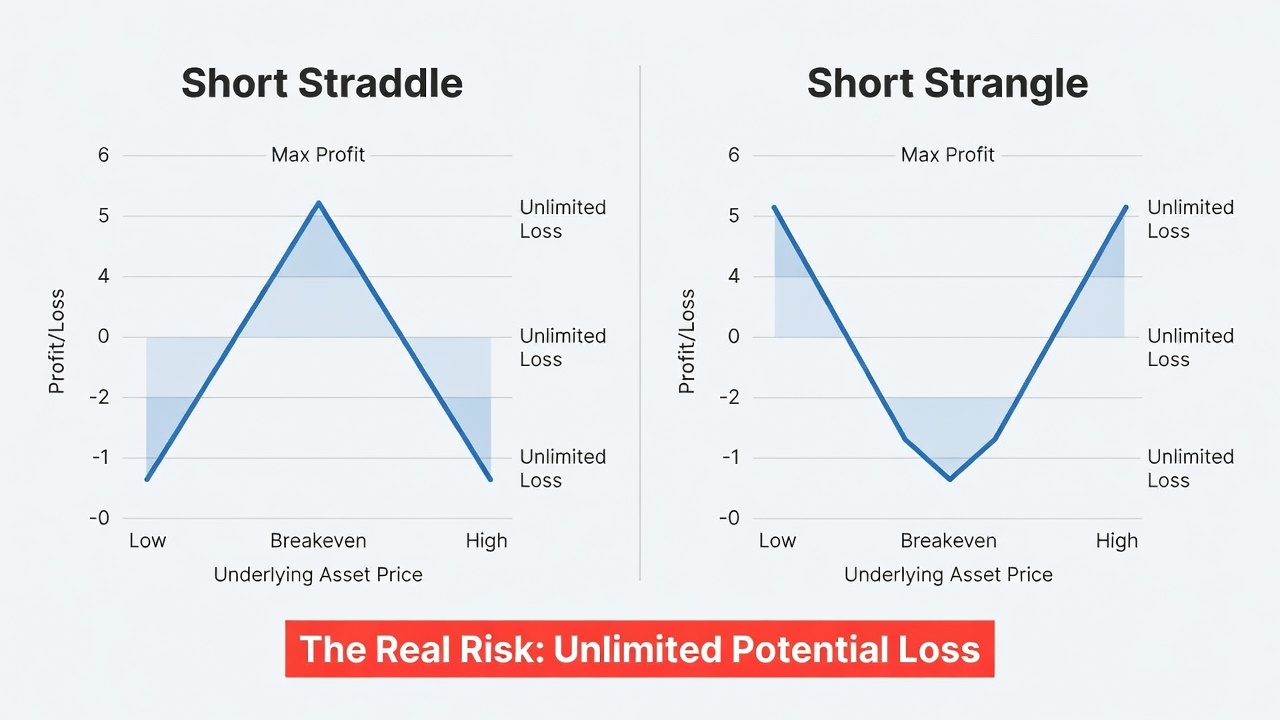
A short straddle is an options trading strategy created by selling an at-the-money call option and an at-the-money put option on the exact same stock with the same expiration date. When you sell both contracts, you collect the maximum possible upfront credit from the option buyer.
Think of a short straddle like selling two separate insurance policies to two different drivers on the same car. One driver pays you because they fear the car will speed up out of control, while the other pays you because they fear it will slide into a ditch. If the car stays parked right where it is, you pocket both payments and pay out nothing.
Because you sell both options right at the current stock price, the cash you collect is substantial. That combined premium forms a buffer zone on both sides of the market.
Your upside breakeven is the strike price plus the total credit collected. Your downside breakeven is the strike price minus the total credit collected.
If the stock finishes expiration anywhere between those two boundaries, you keep some or all of the initial cash. If the stock settles at the exact strike price, both options expire completely worthless and you capture the absolute maximum profit.
However, if the stock explodes higher or collapses lower past those breakeven points, your losses accumulate dollar-for-dollar without any ceiling. There is no purchased long option standing behind you to absorb the blow.
What Is a Short Strangle and How Is It Different?
A short strangle is an options strategy where you sell one out-of-the-money call option above the current stock price and one out-of-the-money put option below the current stock price with the same expiration cycle. Instead of clustering both contracts at one central price like a straddle, you split them apart to build a wider neutral channel.
I like to picture a short strangle as setting two boundary fences around a pasture. As long as the stock stays grazing between your upper fence and your lower fence, you walk away with the cash you took on day one.
Because both options sit out of the money when you open the trade, the credit you collect is significantly smaller than what you get from a straddle. You are intentionally accepting a smaller payout in exchange for a higher statistical probability of winning.
The mechanics of the breakeven points reflect that wider space. Your upside breakeven is your call strike plus the total credit, and your downside breakeven is your put strike minus the total credit.
The trade-off here catches many beginners off guard. While the probability of profit is higher on paper, the risk profile remains completely undefined on both sides of the tape.
A catastrophic market headline can blow through an out-of-the-money strike just as easily as an at-the-money strike. When that happens, the smaller credit you collected gives you less cushion to offset the runaway losses.
| Feature | Short Straddle | Short Strangle |
|---|---|---|
| Strike Placement | Same strike (At-the-Money) | Two different strikes (Out-of-the-Money) |
| Credit Collected | High | Moderate to Low |
| Breakeven Range | Narrower band around one strike | Wider band across two strikes |
| Probability of Profit | Lower (~50-55%) | Higher (~68-75%) |
| Maximum Loss | Theoretically Unlimited | Theoretically Unlimited |
The Math of a Short Straddle: A Worked Dollar Example
A worked short straddle example clarifies how cash inflows balance against widening market moves. Let us say hypothetical stock XYZ is trading at exactly $100 per share 45 days before expiration.
You sell one XYZ $100 call for $4.00 and you sell one XYZ $100 put for $4.00. Since each standard options contract controls 100 shares, you instantly collect $8.00 per share, which deposits $800 of cash directly into your account.
Now let us calculate your exact lines in the sand. Your upside breakeven sits at $108.00 ($100 strike plus $8.00 credit), and your downside breakeven sits at $92.00 ($100 strike minus $8.00 credit).
Consider three different settlement scenarios at expiration to see how your payout behaves:
| Stock Price at Expiration | Call Value / Put Value | Net Result |
|---|---|---|
| $100.00 (Perfect Pin) | Call expires $0.00 / Put expires $0.00 | +$800 Profit (Max Profit) |
| $105.00 (Inside Range) | Call costs $5.00 to close / Put expires $0.00 | +$300 Profit ($800 credit – $500 close) |
| $114.00 (Upside Blowout) | Call costs $14.00 to close / Put expires $0.00 | -$600 Loss ($800 credit – $1,400 close) |
| $85.00 (Downside Crash) | Call expires $0.00 / Put costs $15.00 to close | -$700 Loss ($800 credit – $1,500 close) |
Notice the asymmetry in the bad scenarios. If the stock drops to $85, the $15 intrinsic value of the put outstrips your initial $8 credit by $7 per share.
Worse, if XYZ gets caught in an unexpected buyout and leaps to $130, you must buy back that call for $30.00. That would turn your $800 upfront credit into a painful $2,200 net loss.

The Math of a Short Strangle: Wide Wings, Narrow Margins
A worked short strangle example demonstrates how moving your strikes away from the stock price alters your cash flow and risk exposure. Assume the same hypothetical stock XYZ is trading at $100 per share with 45 days until expiration.
Instead of the $100 strikes, you decide to give yourself room to breathe. You sell an out-of-the-money $105 call for $1.75 and an out-of-the-money $95 put for $1.75.
Your total credit received is $3.50 per share, or $350 total. That is less than half the credit generated by the straddle, but your profitable zone is far wider.
Your upside breakeven level becomes $108.50 ($105 call strike plus $3.50 credit). Your downside breakeven level becomes $91.50 ($95 put strike minus $3.50 credit).
If XYZ settles anywhere between $95.00 and $105.00 at expiration, both options expire totally worthless. You pocket the entire $350 credit without needing to pin a single exact price.
The danger surfaces when a sudden trend breaches your outer strikes. If XYZ drops to $85.00, your short put is now in the money by $10.00.
You must pay $1,000 to buy back that put, while your call expires for zero. Subtracting your original $350 credit leaves you with a net loss of $650, which is nearly double what you stood to make on the best day of the trade.
The Margin Shock: Why Brokers Liquidate Undefined Risk
A margin call is an urgent demand from your brokerage requiring you to deposit additional collateral to cover surging potential losses on open naked short options. When beginners look at straddles and strangles, they almost always evaluate the trade based on expiration math while completely ignoring how margin requirements behave in real time.
When you enter a naked short strangle on a $100 stock, your broker might initially require around $2,000 in buying power reduction to hold the position. That margin requirement is not a static number written in stone.
Options margin formulas rely on dynamic calculations tied directly to stock price movement and implied volatility. If XYZ suddenly plunges from $100 down to $88 overnight, two devastating things happen simultaneously.
First, the unrealized loss on your short put increases immediately. Second, because market sell-offs trigger sharp increases in implied volatility, your broker’s risk models will automatically hike the required margin on that open put contract.
That initial $2,000 margin requirement can instantly balloon to $4,500 or more in an hour of heavy trading. If your account does not have sufficient cash or equity to cover that sudden expansion, you face a forced liquidation.
Your broker does not call you to ask your opinion about where the stock is going next. Their automated risk engine simply closes your position at prevailing market prices, locking in a catastrophic loss right at the absolute bottom of the move.
From Find Better Trades
Consistent Income. Any Market Direction.
A low-risk debit spread every Thursday, built to make steady returns whether the market runs up, down, or sideways.
 → See Layered Options

Volatility Expansion: When Being Directionally Right Still Loses Money
Volatility expansion describes a scenario where the market’s expectation of future price swings spikes, causing option prices across all strikes to surge higher regardless of stock direction. This mechanic ruins more naked option sellers than bad directional predictions ever will.
In Part 6 and Part 7, we saw how volatility impacts spreads with long wings that absorb price shocks. In naked straddles and strangles, you have no long wings, meaning you hold massive net short vega.
Short vega means your position loses money whenever implied volatility rises. Imagine you sell a short strangle right before an earnings announcement or a major economic release.
Even if the stock barely moves from its current price, an unexpected surge in broad market panic can inflate the extrinsic value of both your call and your put. When both legs inflate simultaneously, the cost to buy back the spread skyrockets.
You can find yourself staring at an unrealized loss of several hundred dollars on a stock that has not moved an inch from your entry price. Traders who do not monitor implied volatility levels before opening naked trades walk straight into this trap.
This is why experienced naked sellers look for periods of extraordinarily high implied volatility rank to open trades. Selling when volatility is historically elevated gives you a tailwind, because any drop in volatility will deflate both contracts in your favor.
How to Manage and Defend Naked Premium Trades
Managing undefined risk trades requires proactive defense rules long before an option contract is threatened at expiration. If you wait until expiration day to figure out what to do with a breached short strangle, you are gambling with your trading account.
My primary rule for short straddles and strangles is to take profits early. I never hold these positions into expiration week to squeeze out the final nickels of profit.
I consistently set a good-til-canceled order to buy back the position when it hits 50% of maximum profit. If I collected $4.00, I buy it back the moment it can be closed for $2.00, which dramatically cuts down my time exposure to freak market shocks.
When a position goes against you and the stock tests one of your short strikes, you have three primary defensive moves. First, you can roll the untested side closer to the market price to collect extra credit and widen your breakeven on the tested side.
For example, if your short put is threatened because the stock fell, your short call is now deeply out of the money and almost worthless. You can buy that call back for pennies and sell a lower call strike closer to the stock to bring in more cash.
Second, you can roll the entire trade out in time to a future monthly expiration for a net credit, buying yourself more time for the stock to settle down. Third, if the trade violates your predefined loss limit, which should never exceed two times the credit received, you cut the trade and accept the loss without hesitation.
Common Mistakes Beginners Make With This
Beginners routinely make disastrous errors when transitioning from defined-risk spreads to undefined-risk straddles and strangles. Here are the most frequent mistakes I see traders make:
Oversizing because of high initial win rates: Because an out-of-the-money strangle has a 70% or higher chance of making money, beginners assume it is easy income and sell five or ten contracts instead of one. When a single unexpected black-swan event hits, that oversized position destroys months of accumulated profits in ten minutes.
Holding trades all the way through expiration: New traders try to capture 100% of the premium collected, leaving short options open during expiration week when gamma risk is at its absolute peak. A small late-day move in expiration week can swing an option from worthless to deeply in the money within an hour.
Selling naked premium right before earnings reports: Rookies see juicy options premiums before earnings announcements and sell straddles thinking the stock cannot possibly move beyond the breakeven points. Earnings gaps routinely shatter historical volatility boundaries, leaving unprotected sellers trapped in runaway losses before the market even opens.
Ignoring account-level buying power allocation: Untrained traders often use 60% or 70% of their total account buying power to margin naked strangles. When market volatility doubles during a correction, their required margin doubles as well, triggering immediate broker liquidations even if the underlying stocks never breached the breakeven strikes.
Short Straddles and Strangles FAQ
Can I trade short straddles and strangles in an IRA or cash account?
No, standard brokerage rules prohibit trading undefined-risk naked short options inside cash accounts and retirement accounts like IRAs. Regulators require a higher-tier margin approval because these strategies carry theoretical risk that exceeds the total value of your account balance.
What is the difference between a short straddle and an iron butterfly?
A short straddle consists of selling a naked call and a naked put at the exact same strike with no protective outer wings. An iron butterfly takes that exact short straddle and adds a long call above and a long put below, turning an undefined-risk trade into a capped, defined-risk structure.
Which strategy is safer: a short straddle or a short strangle?
Neither strategy is truly safe because both expose your account to unlimited upside and substantial downside losses. However, a short strangle provides a wider cushion for error because your short strikes begin out of the money, giving you more room to adjust before losses begin.
How much cash do I actually need to sell a short strangle?
Brokers typically require several thousand dollars in collateral per contract depending on the price of the underlying stock and its current volatility level. You should maintain at least twice the initial margin requirement in spare cash buffer to prevent forced liquidations during sudden volatility spikes.
In Part 9, we are looking at calendar spreads to discover how trading time decay across two different expiration dates lets you profit from patience without taking on naked blowup risk.
📈 Want More? Join Our Free Trading Community
- Trading Strategy Guides Telegram — daily strategy tips and market insights
- Find Better Trades Telegram — free trade signals delivered to your phone
- Find Better Trades on YouTube — live trade breakdowns and tutorials
Lesson 59 of 63 in the free Options Trading Course.
← Previous: Reverse Iron Condor: How to Profit From Stock Breakouts
Next: Calendar Spreads: Trading Time Decay Between Two Expirations →