Reverse Iron Condor: How to Profit From Stock Breakouts

📚 Options Strategies, Step by Step — Part 7 of 30
- Part 1: The Bull Call Spread: A Cheaper Way to Bet on a Rise
- Part 2: The Bear Put Spread: Profiting From a Drop With Defined Risk
- Part 3: Bull Put Credit Spreads: Getting Paid to Be Right on Direction
- Part 4: Bear Call Credit Spreads: Selling Premium Above Resistance
- Part 5: Managing Credit Spreads: Closing Early at 50% Profit
- Part 6: The Iron Butterfly: When You Expect a Stock to Pin a Price
- Part 7: The Reverse Iron Condor: Profiting From a Breakout (you are here)
⚡ Key Takeaways
- A reverse iron condor is a defined-risk debit strategy built to profit when a stock makes an explosive move in either direction.
- You build the trade by buying an out-of-the-money call debit spread and an out-of-the-money put debit spread at the same time.
- Your maximum loss is strictly capped at the net debit paid upfront, while your maximum profit is the spread width minus that debit.
— Ben, Find Better Trades
A reverse iron condor is a four-legged options strategy designed to make money when an underlying stock makes a massive move, regardless of whether that move is up or down. If you expect a violent price breakout but have zero conviction about the direction, this setup lets you take that shot without exposing your account to open-ended risk.
The tool I use for this: TriTrader+. Auto-maps ascending, descending, and symmetrical triangles with breakout alerts the moment price escapes the pattern. See TriTrader+ →
Welcome to Part 7 of our thirty-part series, Options Strategies, Step by Step. Today we are flipping the traditional range-bound play on its head so you can target outsized market surges with precision.
What Is a Reverse Iron Condor?
A reverse iron condor is a net debit options position created by combining a bull call debit spread with a bear put debit spread. You buy an out-of-the-money put, sell a further out-of-the-money put, buy an out-of-the-money call, and sell a further out-of-the-money call.
Earlier in this series, we covered the iron butterfly and individual credit spreads, which are strategies designed to make money when a stock stays quiet. The reverse iron condor does the exact opposite because it starves in quiet markets and thrives during chaos.
Think of this trade like setting two tripwires on opposite ends of a quiet street. You don’t care whether a car races away to the north or to the south, as long as it drives fast enough to trip one of the wires and clear the area.
Because you are buying options closer to the current share price and selling options further away, you pay money out of pocket to open the trade. That cash outlay represents your net debit, and it is the absolute most money you can lose if the stock refuses to move.
Your objective is simple: you want the stock price to blow clean past one of your long strikes before the contracts expire. If the underlying asset stays trapped between your inside strikes, both spreads expire worthless, and you lose your initial debit.
How a Reverse Iron Condor Actually Works
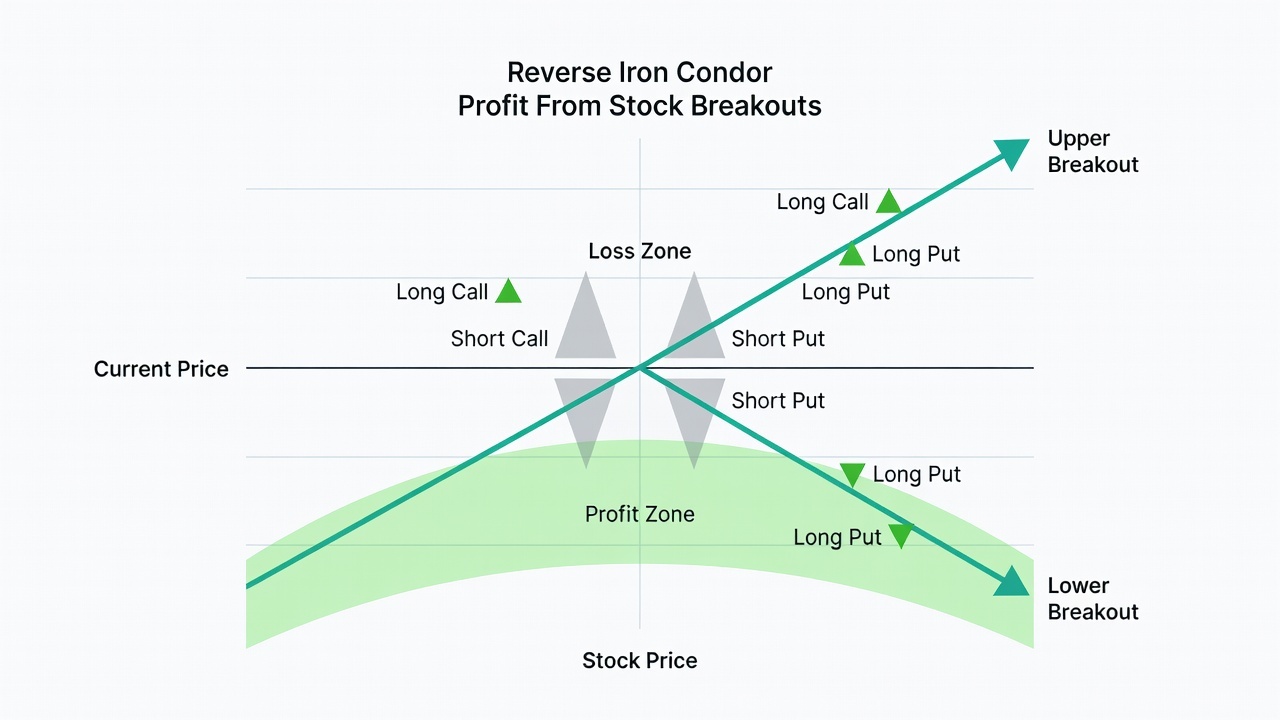
A reverse iron condor works by pairing two separate directional debit spreads on the exact same underlying asset and expiration date. The upside spread captures explosive bullish rallies, while the downside spread captures aggressive market crashes.
When you construct the position, you select four distinct strike prices arranged in a symmetrical order around the current market price. From lowest to highest, these strikes are: short put strike A, long put strike B, long call strike C, and short call strike D.
Notice that your long options are placed on the inside, sitting closer to the current stock price than your short options. This inside positioning is what makes the trade a debit strategy, meaning cash leaves your brokerage account on day one.
By selling the outer wings at strikes A and D, you bring in cash that offsets the expensive price of the long options at strikes B and C. That discount lowers your cost of entry, though it also puts a hard ceiling on how much money you can walk away with.
If the stock skyrockets above strike D, your call spread expands to its maximum theoretical value while your put spread expires worthless. Conversely, if the stock plunges below strike A, your put spread achieves maximum value while your call spread expires to zero.
A Step-by-Step Numeric Example: Setting Up the Trade
Let us look at a concrete example using clear numbers to see how the mathematics of a reverse iron condor play out in practice. Suppose company XYZ is trading at exactly $100 per share, and you anticipate an earnings announcement that will spark a dramatic price reaction.
To build your reverse iron condor with thirty days until expiration, you place the following four orders simultaneously as a single package:
- Buy 1 XYZ $105 Call for $2.50
- Sell 1 XYZ $110 Call for $1.00
- Buy 1 XYZ $95 Put for $2.50
- Sell 1 XYZ $90 Put for $1.00
The call spread costs you $1.50 per share because you paid $2.50 for the long call and collected $1.00 for the short call. The put spread also costs you $1.50 per share because you paid $2.50 for the long put and collected $1.00 for the short put.
Adding those two debit legs together produces a total initial cost of $3.00 per share, which equals $300 for a standard 100-share contract. This $300 debit represents your maximum risk on the trade, and you can never lose a penny more than that amount.
The width between each spread is $5.00, calculated as $110 minus $105 on the call side, and $95 minus $90 on the put side. Your maximum potential profit is the width of one spread minus your net debit, giving you $5.00 minus $3.00, or $2.00 per share ($200 total profit).
Your upper breakeven point is your long call strike plus the net debit ($105 + $3.00 = $108). Your lower breakeven point is your long put strike minus the net debit ($95 – $3.00 = $92).

Reverse Iron Condor vs. Long Straddle: The Key Trade-Off
A reverse iron condor serves a very similar purpose to a traditional long straddle, but it trades uncapped upside for a significantly lower upfront price tag. A straddle requires buying an at-the-money call and an at-the-money put with zero short options to help finance the purchase.
Because a long straddle has no short options capping its gains, your profit potential to the upside is technically infinite. However, financing two at-the-money options demands a massive cash outlay, which creates an enormous hurdle for the trade to break even.
When you buy a reverse iron condor, your short outer options act like shock absorbers that subsidize your purchase price. You pay far less out of pocket, which softens the blow of time decay while you wait for the stock to make its run.
| Feature | Reverse Iron Condor | Long Straddle |
|---|---|---|
| Upfront Capital | Low (Capped Net Debit) | High (Full Premium Paid) |
| Maximum Profit | Capped (Spread Width – Debit) | Unlimited to the Upside |
| Time Decay Exposure | Moderate | Aggressive |
| Breakeven Difficulty | Requires a Target Breakout | Requires Massive Extension |
I view the reverse iron condor as the practical trader’s alternative to a bare straddle or strangle. It allows you to participate in major volatility events while keeping your risk strictly contained to a modest, predetermined dollar figure.
When to Trade a Reverse Iron Condor (and When to Avoid It)
The ideal environment for a reverse iron condor is when a stock is consolidating tightly in a narrow range ahead of a known catalyst. You want to see historical volatility sitting at depressed levels while the market prepares for an event like an earnings release or regulatory ruling.
Entering the position when implied volatility is relatively low works heavily in your favor. If implied volatility surges alongside a sharp directional move, your long options gain value rapidly while expanding toward maximum profit.
Conversely, you should avoid opening a reverse iron condor immediately before an earnings announcement if implied volatility has already exploded through the roof. When options are already pricing in a historic move, you face an uphill battle against the post-announcement volatility crush.
You should also avoid this strategy if a stock is trending smoothly in a single predictable direction. If you already have strong evidence that a stock is heading higher, buying a simple bull call spread will offer better capital efficiency and higher returns.
Reserve this strategy strictly for binary setups where the market is clearly wound up like a spring. When a stock is coiling and you know an explosion is coming, this structure gives you a seat at the table without demanding that you guess the direction.
From Find Better Trades
Consistent Income. Any Market Direction.
A low-risk debit spread every Thursday, built to make steady returns whether the market runs up, down, or sideways.

Managing the Position: Profit Targets and Stop-Loss Rules
Managing a reverse iron condor requires taking profits proactively rather than holding on blindly until the final expiration bell rings. Because time decay accelerates rapidly in the final two weeks of an option’s life, staying in a winning trade too long can erode your gains.
My standard rule for this strategy is to look for an exit when the position reaches 60% to 75% of its maximum potential profit. If you paid $3.00 for a spread with a maximum value of $5.00, your theoretical max profit is $2.00, so taking off the trade at a $1.20 to $1.50 profit is sound trading.
Holding out for that final 25% of profit forces you to endure pin risk and rapid late-stage fluctuations that rarely justify the extra cash. Once the stock clears your long strike and provides a solid return, taking money off the table keeps your win rate healthy.
On the downside, you must establish an ironclad stop-loss based on time rather than price alone. If the catalyst passes and the stock barely reacts, your options will begin bleeding value every single day through theta decay.
If half of your trade duration has expired and the underlying stock remains stranded inside your long strikes, cut the position loose. Selling your spreads back to the market to recover 30% to 40% of your original debit is far better than watching the entire balance drop to zero.
Second Worked Example: Surviving an Earnings Breakout
Let us walk through another trade scenario to observe the management process during a high-stakes corporate event. Suppose shares of cloud company ABC are trading at $200, and the company is preparing to report quarterly earnings in three weeks.
You determine that the stock typically moves at least 10% after its financial updates, so you open a reverse iron condor with the following parameters:
- Buy 1 ABC $210 Call for $4.00
- Sell 1 ABC $220 Call for $1.50
- Buy 1 ABC $190 Put for $4.00
- Sell 1 ABC $180 Put for $1.50
Each spread costs you $2.50 per share, resulting in a total net debit of $5.00 per share, or $500 total risk. With $10 wide strike intervals, your maximum potential payout is $10.00 minus the $5.00 debit, yielding a maximum profit of $500.
Following the earnings report, ABC beats analyst estimates and the stock jumps violently overnight to $225 per share. Your $190/$180 put spread is rendered completely worthless, dropping to a value of $0.00.
However, your $210/$220 call spread is now deep in the money with both legs sitting beneath the current $225 stock price. With ten days still remaining until expiration, that call spread trades for $9.20 per share on the open market.
Rather than waiting ten more days to squeeze out the remaining $0.80 of value, you close the entire condor for $9.20. Subtracting your original $5.00 debit leaves you with a net profit of $4.20 per share ($420 total), securing an 84% return on invested capital.
Common Mistakes Beginners Make With This
The single most frequent mistake new traders make is paying far too much for the net debit when entering the trade. If you pay a $3.80 debit on a $5.00 wide spread, you are risking $380 to make a maximum of $120, which is an awful risk-to-reward ratio. You should aim to pay no more than 60% of the spread width so your reward justifies the difficulty of the breakout.
Another common blunder is buying strikes that sit way too far out of the money in an effort to make the position cheap. While buying extremely wide strikes costs very little upfront, the probability of the stock reaching those distant targets before expiration is minuscule. Cheap options that expire worthless every single month will quietly drain your trading account.
Traders also get caught flat-footed by ignoring the devastating impact of an implied volatility crush. If you buy your spreads when implied volatility is hovering at the 95th percentile, the post-catalyst drop in volatility can crush the value of your long options even if the stock moves in your direction. Always verify that implied volatility has room to expand rather than contract.
Finally, beginners routinely fail to close the trade early when a profitable breakout occurs. They watch their winning spread climb to 80% of its maximum value, get greedy waiting for the last pennies, and then watch the stock snap back into the middle range. When a breakout gives you your profit, take the money and move on to the next setup.
Reverse Iron Condor FAQs
What is the difference between an iron condor and a reverse iron condor?
A standard iron condor is a credit strategy that profits when the stock price stays flat within a quiet range. A reverse iron condor is a debit strategy that profits when the stock price breaks out sharply past your strikes in either direction.
Can you lose more money than your initial debit on a reverse iron condor?
No, your maximum loss is strictly limited to the amount of money you paid to enter the trade plus any commissions. Because every long option is paired with a short option of the same expiration, your risk cannot expand beyond that initial cost.
When is the best time to enter a reverse iron condor?
The best time to enter is when an underlying stock has entered a tight consolidation phase and implied volatility is relatively subdued ahead of a known market catalyst. This provides cheaper entry pricing and allows you to capitalize on both a directional move and an increase in implied volatility.
What happens if the stock price pins right between my long strikes at expiration?
If the underlying stock finishes between your inside long strikes at expiration, every single option in the structure expires completely worthless. In that worst-case scenario, you lose 100% of the debit you paid to enter the position.
Next up, we are tackling short straddles and strangles to uncover the hidden risks that blow up retail accounts when the market catches them off guard.
📈 Want More? Join Our Free Trading Community
- Trading Strategy Guides Telegram — daily strategy tips and market insights
- Find Better Trades Telegram — free trade signals delivered to your phone
- Find Better Trades on YouTube — live trade breakdowns and tutorials