Buying Weekly Options: Why It Destroys Retail Accounts


📊 October 6, 2026
- Buying weekly options is negative-sum gambling because exponential theta decay forces you to be right on direction, timing, and velocity at once.
- Retail traders consistently mistake a low dollar premium for low risk, ignoring that a cheap contract expiring in four days has an atrocious probability of profit.
- Trade contracts with 30 to 60 days until expiration or switch to vertical spreads so your technical analysis actually has room to breathe.
— Ben, Find Better Trades
Buying weekly options is the fastest way to turn a correct technical thesis into a realized loss. Retail traders treat weekly options like discount tickets to quick riches, but non-linear time decay guarantees that the dealer holds every statistical advantage. If you want to build consistent equity, you need to understand why this habit drains accounts and what you should trade instead.
The tool I use for this: Coiled Spring PRO. Coiled Spring PRO tracks institutional volume surges and extreme volatility compression — then prints a non-repainting arrow the exact moment a stock is ready to explode. See How The Arrow Works →
Why Everyone Gets This Wrong
Buying weekly options fails because traders confuse nominal premium price with genuine value. When you pull up an option chain and see an at-the-money call expiring this Friday priced at $1.10 while the 45-day call costs $4.80, your brain tricks you into thinking the weekly contract is a low-risk bargain. It is not cheap; it is depreciating at an exponential rate every single minute the market stays open.
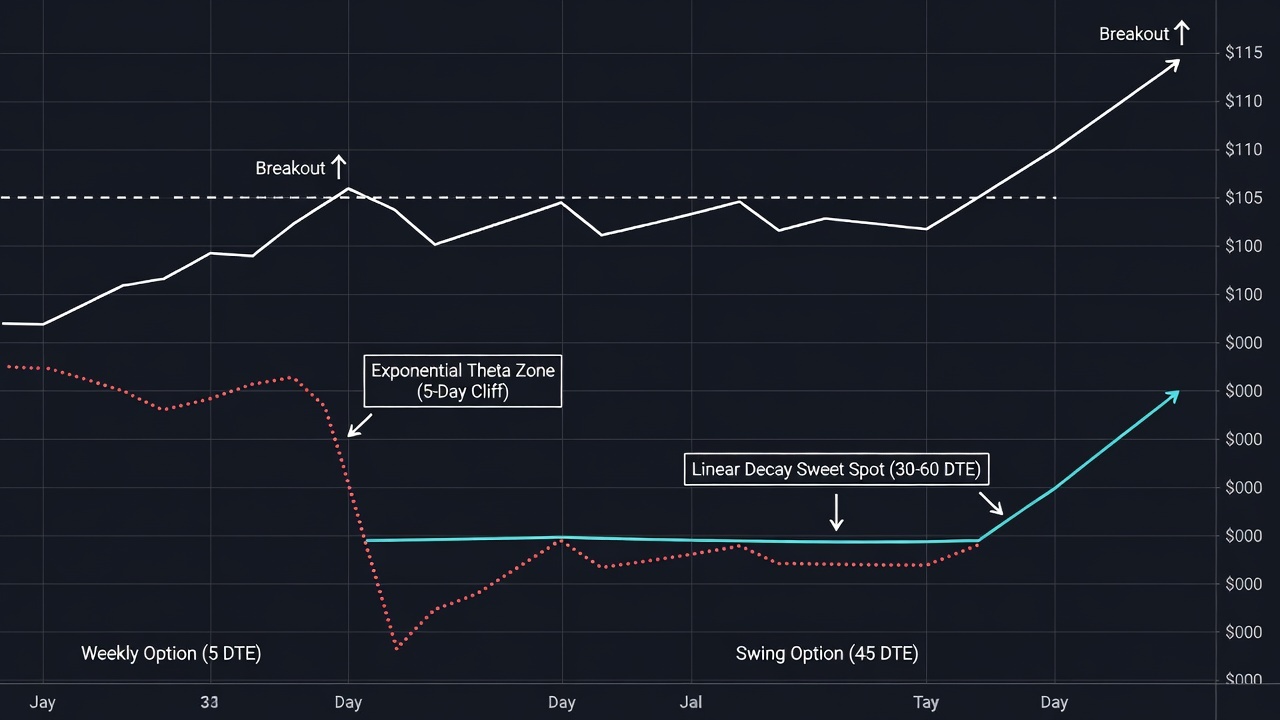
Theta decay is non-linear, meaning it accelerates aggressively during the final seven trading sessions before expiration. On a hypothetical $100 stock, that $1.10 weekly contract might lose $0.25 of extrinsic value between Tuesday open and Wednesday close even if the underlying asset does not budge. You are running up a descending escalator where standing still costs you a quarter of your total stake each day.
Consider what happens on the chart when you trade this way. Say a stock sets up a clean ascending triangle with resistance at $105, supported by a rising 20-period exponential moving average on the 4-hour chart. You buy a Friday-expiring $105 call on Tuesday morning right at the breakout.
Instead of ripping higher instantly, the stock breaks out to $105.80, pulls back to backtest the $105 breakout level over the next 48 hours, and consolidates. By Thursday afternoon, your chart thesis remains completely intact—support held, volume dried up on the pullback, and the 20 EMA is catching up to price. Yet your weekly call is down 65% purely from theta decay, and you panic-sell at the exact moment institutional buyers step in to run the real move on Friday afternoon.
| Contract Horizon | Daily Theta Impact | Room for Consolidation | Win Condition Needed |
|---|---|---|---|
| Weekly (3–5 DTE) | Severe (20% to 40% per day) | Zero tolerance for backtests | Instant explosive move |
| Swing (30–60 DTE) | Linear and slow (1% to 3% per day) | Multiple days of retesting | Directional move over time |
What Actually Works
Buying weekly options must be replaced with buying 30 to 60 days to expiration (DTE) contracts or using defined-risk vertical spreads. When I take a directional swing setup on a daily chart, I target contracts in the 45-DTE sweet spot with a delta between 0.60 and 0.70. This gives the position a high sensitivity to price movement while keeping daily theta decay small enough to ignore during a routine two-day pullback.
To execute this properly, you must adapt your risk management and technical rules:
- Entry rule: Enter only after price confirms above dynamic support, such as a daily candle close above the 20 EMA with expanding volume.
- Contract selection: Select expiration cycles between 35 and 50 DTE, picking the first in-the-money strike to minimize extrinsic premium drag.
- Stop-loss level: Anchor your stop to the underlying chart rather than the contract price. If the stock loses the swing low at $98 on a closing basis, cut the trade regardless of option contract value.
- Profit target: Take 50% profit when the underlying hits your measured-move resistance zone, leaving a runner with a breakeven stop.
If purchasing 45-DTE options requires too much buying power for your account size, trade vertical debit spreads instead of forcing weekly single legs. Buying a 40-DTE $100 call and selling a $105 call against it slashes your total capital outlay and offsets theta decay entirely. The short leg finances the long leg, which means you are no longer paying an exorbitant daily penalty while price develops.
Free For Traders
One Clear Arrow. Every High-Probability Setup. Free.
The Fusion Indicator combines multiple signals into a single buy/sell arrow on TradingView so you never miss a move.

When Buying Weekly Options Can Still Make Sense
Buying weekly options makes sense only for intra-day momentum scalpers who open and close positions within the same cash session. If you are trading high-volume breakouts on a 2-minute or 5-minute chart with an average hold time of twelve minutes, theta decay does not have time to ruin you.
In those intraday scalps, gamma is actually your ally because it accelerates your delta gains rapidly during an abrupt volume expansion. However, the rule here is absolute: you never, under any circumstance, hold a weekly long option overnight. The minute the 4:00 PM bell rings, overnight decay and morning bid-ask spread widening will strip away your technical edge.
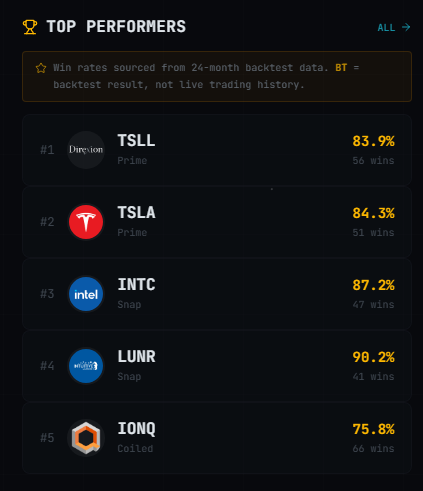
🎯 Want Setups Like These? The Big Dipper Does the Scanning For You.
Every morning the Big Dipper delivers curated DIP ZONE trade ideas — stocks already at high-probability entry levels, with targets pre-set. No guessing, no scanning. Just setups.

From Find Better Trades
Green Light Means GO. It’s That Simple.
Clear signals for directional options plays — momentum plus chain data tells you exactly which strike to buy.

Weekly Options Trading FAQ
Q: Why do weekly options lose value so fast?
A: Weekly options lose value quickly because the extrinsic value of an option decays at an accelerating exponential rate as expiration approaches. In the final five days of a contract, theta decay hits its steepest curve, consuming significant value every day regardless of market movement.
Q: What DTE is best for swing trading options?
A: The sweet spot for swing trading options is 30 to 60 days to expiration (DTE). This timeframe keeps daily theta decay minimal and linear, allowing your position to withstand multi-day technical consolidations and retests without suffering catastrophic capital erosion.
Q: Can retail traders make money buying weekly options?
A: Retail traders can profit from weekly options strictly as day traders scalping momentum during the cash session. Holding long weekly calls or puts overnight requires nearly impossible timing precision and destroys long-term profitability for the vast majority of traders.
📈 Want More? Join Our Free Trading Community
- Trading Strategy Guides Telegram — daily strategy tips and market insights
- Find Better Trades Telegram — free trade signals delivered to your phone
- Find Better Trades on YouTube — live trade breakdowns and tutorials