In the Money vs Out of the Money Options Explained

📚 Beginner’s Guide to Options — Part 6 of 51
- Part 1: What Is an Option? The Absolute Basics Explained
- Part 2: Calls vs. Puts: The Two Types of Options You Need to Know
- Part 3: Strike Price Explained: What It Actually Means for Your Trade
- Part 4: Expiration Date Explained: Why It Changes Everything
- Part 5: Premium Explained: What You’re Really Paying For
- Part 6: In the Money vs. Out of the Money: A Beginner’s Breakdown (you are here)
★ Key Takeaways
- In the money options have real, tangible value because the stock price has already crossed your strike price.
- Out of the money options consist entirely of hope and time, meaning they currently have no built-in value.
- Choose in the money options for a higher probability of winning, or out of the money options for cheap, high-risk leverage.
— Ben, Find Better Trades
When I was starting out, I remember looking at an options chain and feeling completely overwhelmed by all the shaded rows and columns. Welcome to Part 6 of our beginner’s series, where we are going to demystify two terms that seasoned traders throw around like second nature: “In the Money” and “Out of the Money.” If you want to survive as an options trader, you absolutely must master how these states of moneyness affect your risk and reward.
1. Understanding the Core Concept of Moneyness
Moneyness is just a fancy industry term that describes the relationship between a stock’s current price and the strike price of your option. In our earlier parts of this series, we covered how the strike price is your locked-in contract price, and now we are looking at how close the actual stock is to that line in the sand.
Think of it like buying a ticket to a sporting event where your payout depends on the final score. Moneyness tells you whether your ticket is currently a winner or a loser based on the live score of the game. It is a real-time status report of your trade’s health.
Every option you ever look at will fall into one of three buckets: in the money, out of the money, or right at the money. Your choice between these buckets determines how much you pay today and how likely you are to make a profit tomorrow.
I tell my traders to think of moneyness as a scale of intrinsic value. It is the core metric that dictates whether your option is a luxury asset with real value or a cheap lottery ticket built on pure speculation.
2. What Does In the Money Mean for Call Options?
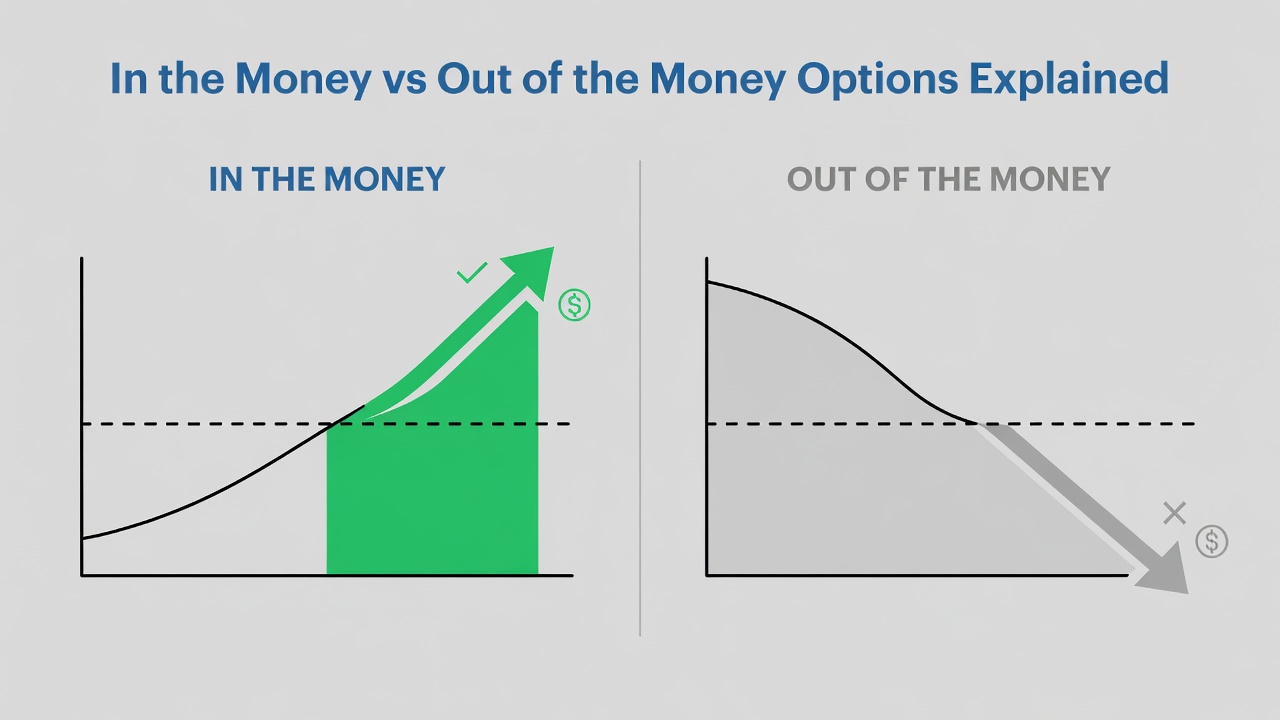
For a call option, in the money means the current stock price is higher than your strike price. Since a call option gives you the right to buy the stock, you want this strike price to be as low as possible compared to the market rate.
Let us look at a simple numeric example to make this concrete. Imagine XYZ stock is currently trading in the open market for $100 per share.
If you own an XYZ $90 call option, your option is in the money by exactly $10. This is because your contract grants you the right to buy those shares for $90, even though everyone else has to pay $100.
Because this option gives you an immediate $10 advantage, the seller of the option is going to charge you at least $10 just to buy it. It has what we call real, built-in value because you can instantly exercise it to buy cheap and sell dear.
🎯 Get High-Probability Trade Setups — Free
The Big Dipper Dashboard delivers curated trade ideas straight to your screen every morning. Know what to watch before the opening bell.

3. What Does Out of the Money Mean for Call Options?
For a call option, out of the money means the current stock price is lower than your strike price. You have the right to buy the stock at a price that is actually worse than the current market price.
Let us use our XYZ stock example again, assuming the stock is still trading at $100 per share. If you buy an XYZ $110 call option, you have the right to buy the stock at $110.
Naturally, nobody wants to pay $110 for a stock they can buy right now for $100. Because of this, your option is out of the money and has zero built-in, real-world value today.
These options are incredibly cheap because they rely entirely on the stock rising significantly before the expiration date arrives. If the stock does not move above $110 by expiration, your option will expire completely worthless, and you will lose whatever premium you paid.
I view these as speculative bets. You are paying a very small fee for the right to participate in a massive upward move, but the math is heavily stacked against you.

4. How Put Options Reverse the Entire Equation
Put options give you the right to sell a stock, which means the math for moneyness is completely flipped. When you want to sell something, you want your locked-in contract price to be as high as possible compared to the market.
Therefore, a put option is in the money when the stock price is below your strike price. If XYZ stock drops to $40 and you own a $50 put, you have the right to sell your shares for $50, making it highly valuable.
Conversely, a put option is out of the money when the stock price is above your strike price. If you own a $30 put while the stock is at $40, your option has no current value because you would not choose to sell at $30 when the market pays $40.
To help you visualize how this works for both sides, here is a quick breakdown table for easy reference:
| Option Type | In the Money (ITM) | Out of the Money (OTM) |
|---|---|---|
| Call Option | Stock Price > Strike Price | Stock Price < Strike Price |
| Put Option | Stock Price < Strike Price | Stock Price > Strike Price |
Understanding this table is critical because buying the wrong type of option for your market bias is one of the fastest ways to lose your entire trading account.
5. The Middle Ground: At the Money Options
There is a third state of moneyness that we should cover briefly, which is known as at the money. This occurs when the stock price and the strike price are virtually identical.
If ABC stock is trading at exactly $50.00, then the $50 call and the $50 put are both considered at the money. These options are highly sensitive to even the smallest movements in the stock price.
At the money options have no real, built-in value yet, but they are right on the cusp of gaining it. This makes them highly liquid and very popular among active day traders looking for short-term moves.
I like to think of at the money options as a balanced scale. The slightest breeze in either direction will tilt the option into being either a winner or a loser, which creates massive premium volatility.

6. The Trade-Off: Probability vs. Cost
Choosing between these states of moneyness is the ultimate balancing act of cost versus probability. In the money options are expensive but have a high probability of working out, while out of the money options are cheap but highly likely to fail.
If you buy an option that is deep in the money, you are paying a massive premium upfront. However, because the stock has already crossed your strike price, you have a huge head start and a much higher statistical chance of walking away with cash.
If you buy an option that is out of the money, you might only pay $50 for the entire contract. The catch is that the stock must make a massive, rapid move in your direction just for your option to avoid expiring worthless.
I always advise beginners to start on the conservative side. Buying cheap lottery tickets feels good because the entry fee is low, but losing 100% of your money ten times in a row will destroy your psychological capital.
7. How to Choose Which One to Trade
Your choice depends entirely on your strategy, your risk tolerance, and your outlook for the underlying stock. There is no single correct answer, only trade-offs that you must accept before placing the trade.
If you are highly confident that a stock is going to make a massive, explosive move very quickly, out of the money options can offer spectacular percentage returns. The leverage is unmatched because you are controlling a large block of shares for pennies on the dollar.
If you prefer a slower, more deliberate trading style where you want to mimic owning the actual stock, in the money options are your best friend. They behave much more like the underlying stock, rising and falling in a more predictable fashion.
Personally, I prefer to find a sweet spot just slightly out of the money or slightly in the money. This gives me a healthy balance of reasonable cost and realistic probability without leaning too far into outright gambling.
Common Mistakes Beginners Make With This
The single most common mistake I see beginners make is buying deep out of the money options simply because they are cheap. They see an option trading for $0.05 and buy fifty contracts, not realizing the stock needs to move 30% in three days for those options to ever have value.
Another frequent error is failing to realize that out of the money options lose value rapidly as expiration approaches. This decay acceleration can wipe out your position even if the stock is slowly creeping in your desired direction.
Traders also commonly confuse the math for puts, mistakenly buying out of the money puts when they actually intended to buy protected, in the money downside coverage. Always double-check your strike prices against the current stock price before hitting the buy button.
In the Money vs. Out of the Money FAQ
Why would anyone buy an out of the money option if it has no real value?
Traders buy them because they are highly leveraged and incredibly cheap to acquire. If the stock makes a massive, unexpected jump, an out of the money option can skyrocket in value by hundreds of percent in a matter of minutes.
Do in the money options automatically get exercised at expiration?
Yes, almost all brokerage firms will automatically exercise any option that is in the money by as little as $0.01 at the time of expiration. If you do not want to buy or sell the actual shares, you must close out your option position before the final bell rings.
Is it better to buy in the money or out of the money options?
Neither is objectively better, as it depends entirely on your specific risk tolerance and target. In the money options offer a much higher win rate but require a larger capital layout, while out of the money options are cheap high-risk, high-reward bets.
How does time decay affect these different types of options?
Time decay hurts out of the money options the most because they contain absolutely zero intrinsic value to protect them. As expiration day nears, the hope of the stock reaching your far-away strike price evaporates, dragging the option price to zero.
Now that you know how to identify the moneyness of a contract, we need to look under the hood to see what actually dictates these premium prices, which brings us to Part 7: “Intrinsic Value vs. Extrinsic Value: What Makes Up an Option’s Price.”
📈 Want More? Join Our Free Trading Community
- Trading Strategy Guides Telegram — daily strategy tips and market insights
- Find Better Trades Telegram — free trade signals delivered to your phone
- Find Better Trades on YouTube — live trade breakdowns and tutorials
Lesson 6 of 55 in the free Options Trading Course.
← Previous: Options Premium Explained: What You Are Really Paying For
Next: Intrinsic vs Extrinsic Value: Options Pricing Explained →