Options Premium Explained: What You Are Really Paying For

📚 Beginner’s Guide to Options — Part 5 of 51
- Part 1: What Is an Option? The Absolute Basics Explained
- Part 2: Calls vs. Puts: The Two Types of Options You Need to Know
- Part 3: Strike Price Explained: What It Actually Means for Your Trade
- Part 4: Expiration Date Explained: Why It Changes Everything
- Part 5: Premium Explained: What You’re Really Paying For (you are here)
☡ Key Takeaways
- Options premium is the non-refundable price you pay to buy an option or the cash you collect when you sell one.
- Premium is not a random number; it is the sum of an option’s real, immediate value and the time left until it expires.
- Always multiply the quoted premium by one hundred to calculate your actual total cash cost for a standard contract.
— Ben, Find Better Trades
When I was starting out, I remember looking at my broker screen and seeing a tiny number like two dollars next to an option. I thought I could buy it for the price of a cup of coffee, only to realize my account was actually charged two hundred dollars.
Welcome to Part 5 of our beginner’s options series, where we are going to demystify this exact cost, known as the options premium. Understanding how this price is built, calculated, and paid is the single biggest step you can take to protect your trading account from painful surprises.
1. What Exactly Is Options Premium?
In simple terms, the premium is the market price of the options contract. It is the amount of money a buyer pays to a seller to acquire the rights that we discussed in our earlier articles.
Think of it exactly like an insurance premium you pay for your car. You pay a set fee upfront to an insurance company to protect you against a bad event, and you never get that fee back whether you use the policy or not.
In the stock market, the option buyer pays this cash premium upfront to the option seller. The buyer gets the right to control shares, while the seller pockets the cash but takes on the obligation to deliver on the contract.
I want you to burn this into your brain: premium is a dynamic, constantly changing number. It fluctuates every second the stock market is open, based on how the underlying stock behaves and how much time is ticking away.
2. The Multiplier: Why Premium Is Not What It Looks Like
When you look at an options chain, the premium is always quoted on a per-share basis. Because one standard options contract controls one hundred shares of stock, you must always multiply the quoted price by one hundred.
Let us look at a quick numeric example to make this concrete. If you see a call option with a quoted premium of 1.50, you are not paying one dollar and fifty cents.
You multiply 1.50 by 100, which gives you an actual cash cost of 150.00 dollars. If you decide to buy three of these contracts, your total cash outlay is 450.00 dollars.
I have seen dozens of clean accounts wiped out because beginners did not understand this simple math. Always do the multiplier calculation in your head before you hit the submit button on any trade order.
🎯 Get High-Probability Trade Setups — Free
The Big Dipper Dashboard delivers curated trade ideas straight to your screen every morning. Know what to watch before the opening bell.

3. Intrinsic Value: The Real-World Worth Right Now
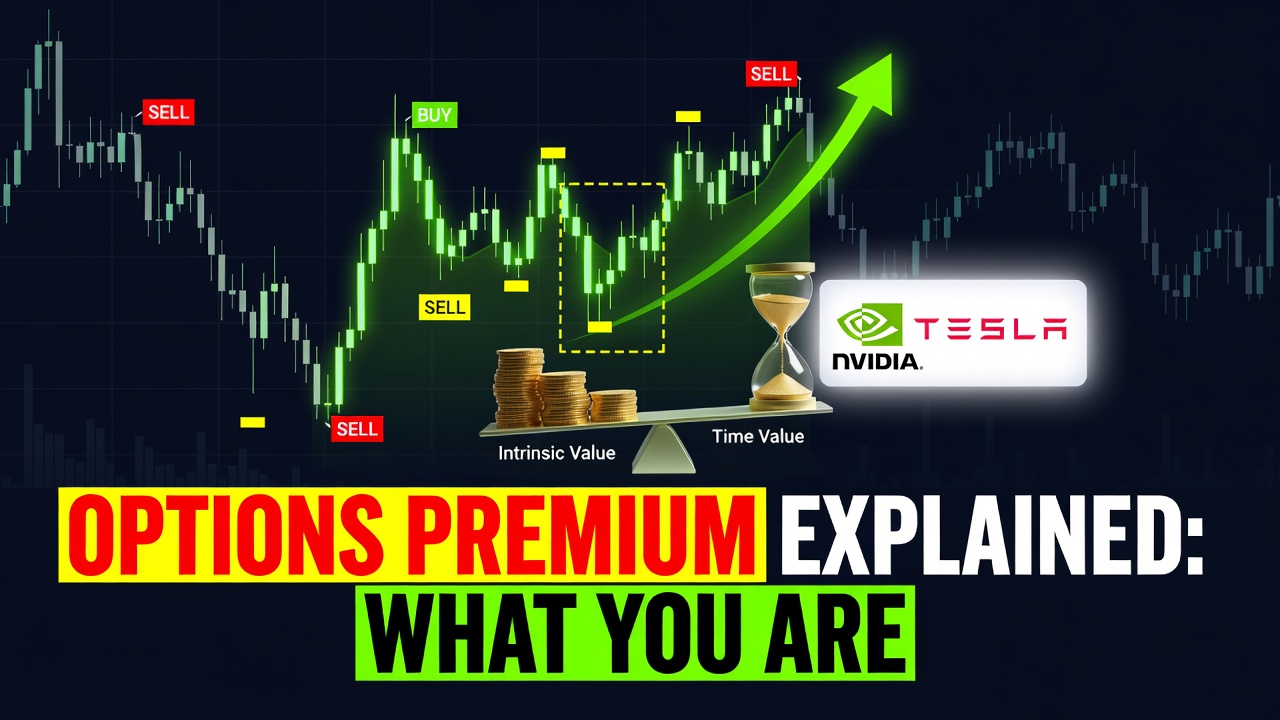
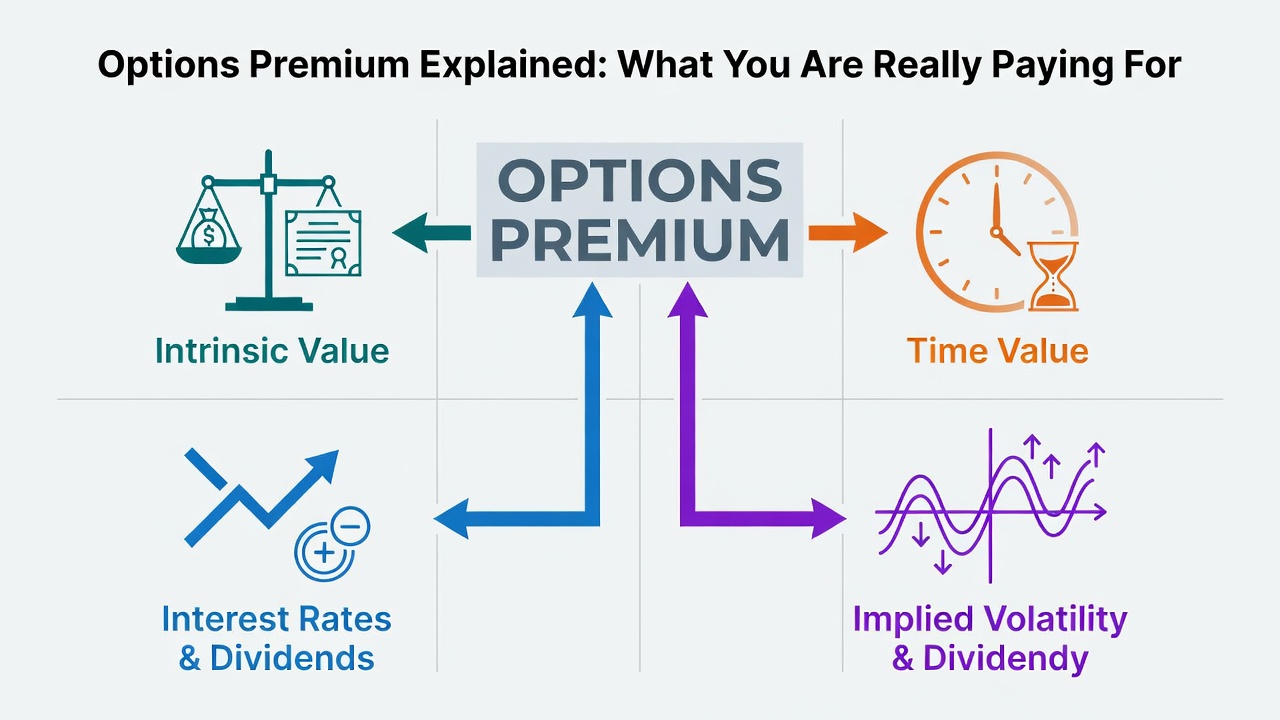
To understand premium, you must realize it is made of two distinct parts. The first part is called intrinsic value, which represents the real, tangible value of the contract if you exercised it right this second.
If you own a call option with a strike price of 50.00 dollars, and the stock is currently trading at 55.00 dollars, that contract has 5.00 dollars of intrinsic value. You have the right to buy a 55.00 dollar stock for only 50.00 dollars, which is an immediate 5.00 dollar discount.
If the stock is trading below your call option’s strike price, the intrinsic value is exactly zero. There is no such thing as negative intrinsic value, because you can simply choose not to exercise your option.
I find it helpful to think of intrinsic value as the “honest” portion of the premium. It is the absolute bare minimum value that the option must hold based on where the stock is currently trading today.

4. Extrinsic Value: Paying for Time and Volatility
The second part of the premium is called extrinsic value, which is also commonly referred to as “time value.” This is the portion of the price that represents the possibility of the stock moving in your favor before expiration.
Let us say a stock is trading at exactly 50.00 dollars, and you want to buy a call option with a 50.00 dollar strike price. The intrinsic value is zero, yet the market is charging you 2.50 dollars for the contract.
Why are you paying 2.50 dollars for something with zero real-world value right now? You are paying for the time left on the clock and the chance that the stock might climb to 60.00 dollars before the contract expires.
Extrinsic value is the premium you pay for hope, time, and expected market chaos. The more volatile the stock, and the more time left until expiration, the more expensive this extrinsic value becomes.
5. How the Two Parts Fit Together: A Detailed Breakdown
Every single options premium is simply these two components added together. The basic formula is: Total Premium equals Intrinsic Value plus Extrinsic Value.
Let us look at how this plays out in a realistic scenario for a hypothetical stock trading at 105.00 dollars. We will compare two different call options to see how the premium breakdown shifts based on the strike price.
| Strike Price | Stock Price | Total Quoted Premium | Intrinsic Value Component | Extrinsic Value Component |
|---|---|---|---|---|
| 100.00 Dollars | 105.00 Dollars | 7.00 Dollars | 5.00 Dollars | 2.00 Dollars |
| 110.00 Dollars | 105.00 Dollars | 1.50 Dollars | 0.00 Dollars | 1.50 Dollars |
Notice how the 100.00 dollar strike call has real value because the stock is already above the strike. The 110.00 dollar strike call is pure hope, meaning its entire 1.50 dollar price tag is made of extrinsic time value.
If the stock stays at exactly 105.00 dollars until expiration, that 110.00 dollar strike option will expire worthless. The buyer loses the entire 1.50 dollar premium, while the seller keeps it as pure profit.

6. The Silent Killer: Time Decay Explained
If you buy an option, time is your ultimate enemy because of a concept called time decay. Every day that passes reduces the extrinsic value of your option, even if the stock price does not move a single penny.
I tell my traders to think of an option like a melting ice cube in the summer sun. The closer you get to the expiration date, the faster the ice melts, until there is nothing left but water.
This decay is not linear; it actually accelerates as the expiration date approaches. The loss of premium speeds up dramatically in the final thirty days before the contract expires.
This is why option buyers want quick, decisive moves in the underlying stock. If the stock just sits there doing nothing, time decay will slowly eat away at your premium until your contract is worth zero.
7. Supply, Demand, and the Volatility Factor
Time is not the only force that shapes the premium you pay. Market demand and expected volatility play massive roles in determining how expensive an option is.
If an earnings report is coming up, or if there is major political uncertainty, traders expect the stock to make massive moves. Because of this high uncertainty, sellers demand a much higher premium to take on the risk.
When demand for options spikes, the implied volatility rises, inflating the extrinsic value of all contracts. This means you might pay an inflated premium for an option simply because the market is scared of an upcoming event.
Once the event passes and the uncertainty is resolved, that extra volatility premium evaporates instantly. I have seen traders guess the stock direction perfectly but still lose money because the premium deflated after earnings.
Common Mistakes Beginners Make With This
The single most common mistake I see is beginners buying cheap options simply because the premium is low. They buy a contract for 0.05 dollars thinking it is a bargain, without realizing it has a 99 percent chance of expiring worthless because it has zero intrinsic value and almost no time left.
Another massive error is failing to calculate the multiplier when managing risk. A trader might buy ten contracts of a 2.00 dollar option thinking they are risking twenty dollars, only to find out they actually put two thousand dollars of hard-earned cash on the line.
Beginners also constantly ignore the impact of time decay on their long positions. They hold onto a losing option week after week, hoping for a miracle recovery, while the daily decay eats the remaining premium down to nothing.
Finally, new traders often buy options right before major earnings announcements when premiums are artificially inflated. They do not realize they are buying at the absolute peak of volatility, setting themselves up for an immediate loss when the premium collapses post-earnings.
Options Premium Explained FAQ
Why does my option lose value when the stock does not move?
Your option loses value due to time decay, which constantly reduces the extrinsic value of the contract. Since options have a fixed lifespan, the probability of a big stock move decreases every day, making the contract less valuable to the market.
Can I lose more than the premium I paid when buying an option?
No, when you are a buyer of a call or a put option, your absolute maximum risk is limited to the premium you paid upfront. If the trade goes completely against you, the option simply expires worthless, and you lose only that initial cash investment.
Who decides what the options premium should be?
The premium is determined by the open market through the forces of supply and demand, just like stock prices. Buyers and sellers place bids and offers, and the premium is the price where those two sides agree to make a transaction.
How do I collect premium instead of paying it?
You can collect premium by becoming an option seller, which is also known as writing an option. In this role, you receive the cash premium upfront into your account, but you take on the legal obligation to buy or sell the stock if the buyer chooses to exercise.
Now that you know how premium is calculated and why it decays, you are ready to learn how to categorize these contracts based on where the stock price sits relative to your strike price, which we will break down in our next part: “In the Money vs. Out of the Money: A Beginner’s Breakdown.”
📈 Want More? Join Our Free Trading Community
- Trading Strategy Guides Telegram — daily strategy tips and market insights
- Find Better Trades Telegram — free trade signals delivered to your phone
- Find Better Trades on YouTube — live trade breakdowns and tutorials
Lesson 5 of 55 in the free Options Trading Course.
← Previous: Options Expiration Date Explained: A Beginner’s Guide
Next: In the Money vs Out of the Money Options Explained →