Managing Credit Spreads: Closing Early at 50% Profit

📚 Options Strategies, Step by Step — Part 5 of 30
- Part 1: The Bull Call Spread: A Cheaper Way to Bet on a Rise
- Part 2: The Bear Put Spread: Profiting From a Drop With Defined Risk
- Part 3: Bull Put Credit Spreads: Getting Paid to Be Right on Direction
- Part 4: Bear Call Credit Spreads: Selling Premium Above Resistance
- Part 5: Managing Credit Spreads: Closing Early at 50% Profit (you are here)
⚡ Key Takeaways
- Closing credit spreads at 50% profit eliminates the dangerous tail risk that builds up near expiration.
- Exiting trades early frees up your trading capital so you can redeploy it into new high-probability setups.
- Placing a Good-Til-Canceled limit order immediately after entry automates your discipline and removes emotional guesswork.
— Ben, Find Better Trades
Closing an options trade early feels counterintuitive when you are first starting out. Most beginners believe they should hold on until the final bell rings just to squeeze out every single cent of profit.
The tool I use for this: Coiled Spring PRO. Coiled Spring PRO tracks institutional volume surges and extreme volatility compression — then prints a non-repainting arrow the exact moment a stock is ready to explode. See How The Arrow Works →
In Part 5 of our series, I am going to show you why taking your money off the table at 50% of max profit is the single best habit you can build. We covered how to construct bull put spreads and bear call spreads earlier in the series, so today we are focusing entirely on how to manage them like a pro.
What is the 50% profit rule for credit spreads?
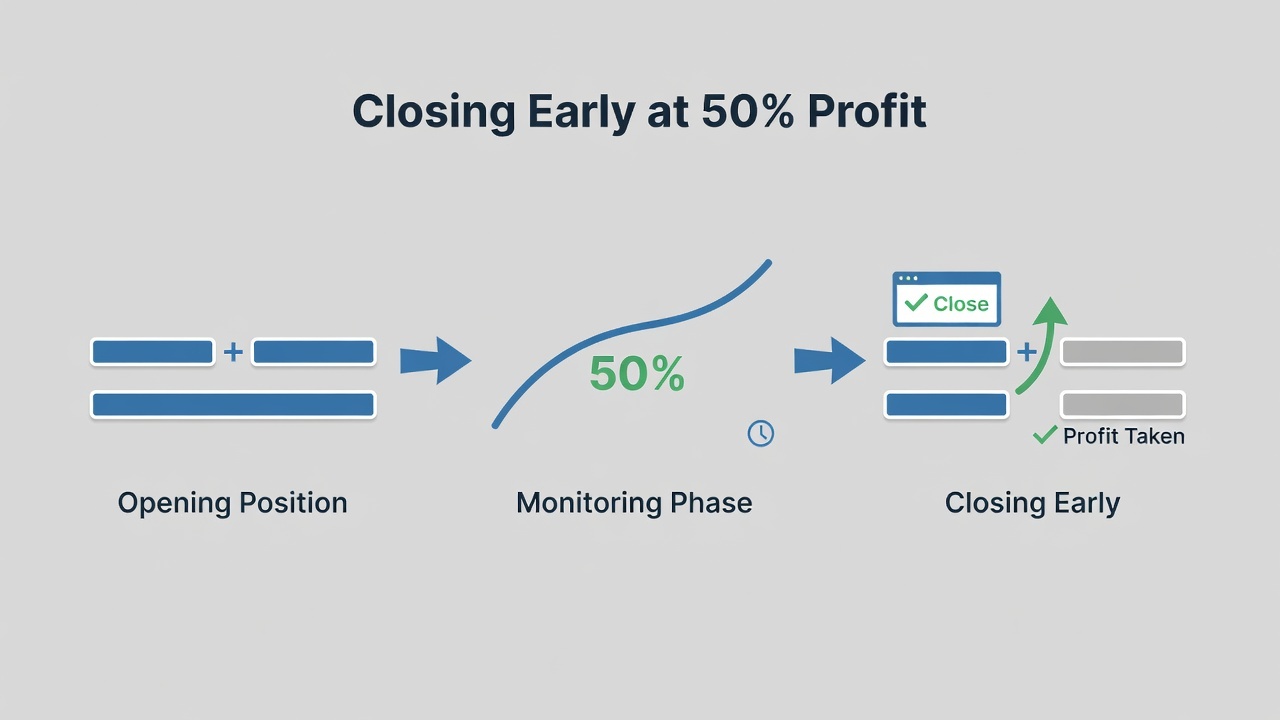
The 50% profit rule for credit spreads is a trade management guideline where you buy back a short spread once it declines to half of the original credit you collected. Rather than waiting for the options to expire worthless at zero, you exit the position early and bank your gain.
When you sell a credit spread, your broker deposits money into your account upfront. That upfront cash is called a net credit, and it represents the absolute most money you can ever make on the trade.
To make 100% of that credit, you have to hold the position until the final minute of the expiration date. That means your money remains locked up, and your account remains exposed to wild market swings for weeks.
By closing the trade when the spread’s market value drops by 50%, you secure half of that maximum possible gain in a fraction of the time. You give up the remaining half of the profit in exchange for removing 100% of your remaining market risk.
Think of it like renting out a vacation home for the summer. If a tenant offers to pay you half your seasonal rate for just two weeks of use, taking the deal lets you collect quick cash and rent it out again right away.
Why taking 50% profit beats holding to expiration
Taking 50% profit beats holding credit spreads to expiration because the risk-to-reward ratio gets progressively worse the longer you stay in the trade. As your spread drops in value, you are risking an entire maximum loss just to collect the small amount of credit left on the table.
Imagine you sold a spread for a $2.00 credit with a total collateral risk of $300. After two weeks of favorable price movement, that spread is now trading for just $0.20.
If you hold the trade to expiration, the most you can gain is an extra $20. Yet, to make that final $20, you are still risking the exact same $300 if the stock suddenly gaps through your strikes overnight.
Risking $300 to make $20 is a terrible wager that no experienced trader would take on purpose. Yet traders take that exact bet every single week simply by refusing to close their positions early.
Closing at 50% profit also protects you from gamma risk, which is the acceleration of an option’s price sensitivity as expiration approaches. In the final days before expiration, even tiny moves in the underlying stock can trigger violent swings in your spread’s value.
Free For Traders
The Options Cheat Sheet Thousands Of Traders Swear By
Calls, puts, spreads — one free download tells you the right options strategy for every market condition.
 → Download The Free Cheat Sheet
Worked example of closing a bull put spread at 50%
A bull put spread closed at 50% profit captures half of the entry credit by buying back the short put and selling the long put in a single closing transaction. This combined exit trade is called a buy to close order, and it requires you to pay a small debit to exit.
Let’s say stock XYZ is trading at $100 per share, and you decide to sell a bull put spread with 45 days until expiration. You sell the $95 strike put and simultaneously buy the $90 strike put for protection.
For opening this trade, your broker credits your account with $2.00 per share, which equals $200 in total cash for one contract. Because the difference between the strikes is $5.00, your maximum risk is $3.00 per share, or $300 total.
Your profit target under the 50% rule is exactly half of the credit you collected. Half of $2.00 is $1.00, meaning you want to buy the spread back whenever its market price drops to $1.00 or lower.
Twelve days into the trade, XYZ stock rises to $103, causing the options you sold to lose value rapidly. The $95/$90 put spread is now trading in the open market for exactly $1.00.
You immediately place an order to buy to close the spread for $1.00. You subtract your $100 exit cost from your original $200 credit, leaving you with a clean, realized profit of $100 in just twelve days.
| Stage of Trade | Spread Value | Cash Flow | Total Profit / Loss |
|---|---|---|---|
| Open Position | $2.00 | +$200 (Credit) | $0 |
| Exit at 50% Target | $1.00 | -$100 (Debit) | +$100 Realized |
| Hold to Expiration (Full Win) | $0.00 | $0.00 | +$200 Realized |

The math behind theta decay and late-stage risk
Theta decay measures the daily rate at which an option’s extrinsic value erodes simply because the clock is ticking down toward expiration. When you sell credit spreads, theta is your friend because it drains value from the contracts you sold short.
However, the decay curve does not reward credit spread sellers evenly throughout the life of the trade. While out-of-the-money single options lose value faster near expiration, credit spreads behave very differently.
Because a spread contains both a long and a short option, their decay rates partially cancel each other out. You often capture the bulk of your profit during the middle phase of the trade when the stock makes an initial move away from your strikes.
Once a spread reaches 50% profit, time decay slows down substantially relative to the risk you are carrying. It might take only 15 days to capture the first 50% of your credit, but another 30 days to squeeze out the remaining 50%.
Spending twice as long in the trade just to collect the second half of the money is inefficient. You are leaving your capital hostage to unexpected earnings surprises, macroeconomic announcements, and sudden market crashes.
How capital velocity improves your overall trading returns
Capital velocity is the speed at which you can deploy, exit, and redeploy your trading funds to compound gains over time. Maximizing capital velocity is how professional options traders generate consistent income without taking reckless risks.
Whenever you open a credit spread, your broker sets aside collateral from your account to cover the maximum risk of the trade. That collateral is completely frozen and cannot be used for any other investment while the position remains open.
If you hold a trade for the full 45-day duration to make $200, your money is tied up for a month and a half. That works out to roughly $4.44 in profit per day of capital exposure.
Now consider what happens if you close that trade on day 15 for a 50% gain of $100. That works out to $6.67 in profit per day, which is a significantly higher rate of return on your time.
Even better, your frozen collateral is returned to your account on day 15 instead of day 45. You can immediately use those exact same dollars to enter a brand-new trade on another stock with a fresh 45-day cycle.
By turning your money over three times in the same 45-day window, you can potentially earn three separate $100 wins. That results in $300 of total profit using the exact same collateral, easily beating the $200 you would have made by holding on stubbornly.
From Find Better Trades
Consistent Income. Any Market Direction.
A low-risk debit spread every Thursday, built to make steady returns whether the market runs up, down, or sideways.
 → See Layered Options

Worked example of closing a bear call spread at 50%
Managing a bear call spread at 50% profit uses the exact same mechanics as put spreads, shielding your account against late-stage market rallies. You capture your profit by buying the spread back at half its entry value when the underlying stock drops or stays flat.
Let’s walk through an example where stock ABC is trading at $50 per share. You have a neutral-to-bearish outlook, so you decide to sell an out-of-the-money bear call spread expiring in 45 days.
You sell the $55 strike call and purchase the $60 strike call for protection. For selling this spread, you receive a net credit of $1.50 per share, which deposits $150 of cash into your account.
Your strike distance is $5.00, meaning your maximum loss is calculated by subtracting your $1.50 credit from the $5.00 width. That leaves you with $3.50 per share, or $350 in total defined risk.
To calculate your exit target, simply divide your $1.50 credit in half. Your target buyback price is $0.75 per share, representing a total debit of $75.
Two weeks later, company ABC releases a mediocre product update, and the stock drifts down to $48. Because the stock moved away from your short call strike, the market price of your spread falls to $0.75.
You enter a buy-to-close limit order at $0.75, which executes immediately. You keep the difference between your initial $150 credit and your $75 exit cost, securing a realized profit of $75.
| Bear Call Spread Leg | Entry Price | Exit Price (50% Target) | Net Result |
|---|---|---|---|
| Sell 1 ABC $55 Call | +$2.20 | -$1.05 | +$1.15 Gain |
| Buy 1 ABC $60 Call | -$0.70 | +$0.30 | -$0.40 Loss |
| Total Spread Value | +$1.50 Credit | -$0.75 Debit | +$0.75 Profit ($75) |
How to automate your exit with a Good-Til-Canceled limit order
Automating your exit with a Good-Til-Canceled limit order guarantees that your 50% profit target is captured without requiring you to stare at price charts all day. A Good-Til-Canceled order, commonly called a GTC order, stays active in your broker’s system until it fills or until you manually cancel it.
The ideal moment to set your exit order is within sixty seconds of opening your credit spread. As soon as your entry order fills, calculate 50% of the collected credit and place your buy-to-close order immediately.
If you sold a spread for $1.80, you immediately route a GTC limit buy order at $0.90. That order sits quietly on the exchange books, waiting for the price to drop to your exact target.
Markets frequently experience temporary intraday dips or spikes that cause spread prices to touch your profit target for just a few minutes. If you are away from your desk during that moment, manual traders miss the fill completely.
An automated GTC order takes advantage of those fleeting price anomalies by executing the fill automatically. You can log into your account at the end of the day and find a completed trade waiting for you.
Common Mistakes Beginners Make With This
The most frequent error new traders make is holding out for the final 10% to 20% of the credit because the trade looks safe. When a stock is far away from your strikes, it feels like free money to leave the trade open. However, unexpected earnings warnings or geopolitical headlines can wipe out weeks of gains in an instant.
Another common misstep is canceling your GTC profit target when a position is winning quickly. Traders see a stock moving in their favor on day three and decide to let it ride to expiration for maximum gain. Removing your target replaces a disciplined system with pure greed, which usually ends in painful reversals.
Many beginners also forget to place their closing limit order right after entering the position. They tell themselves they will monitor the spread manually each morning, but life inevitably gets in the way. Without a pending limit order, you miss favorable midday price spikes that could have taken you out with a win.
Finally, some traders panic when a credit spread experiences minor fluctuations during the first week. An option spread will often show a small paper loss early in the trade due to the bid-ask spread or short-term volatility bumps. If your strikes have not been breached, you must give the trade time to work toward your 50% goal.
Credit Spread 50% Profit Rule FAQ
Why should I take 50% profit instead of waiting for 100%?
Closing at 50% profit cuts your time in the trade significantly while eliminating tail risk and gamma risk. Squeezing out the second half of the profit requires disproportionate time and exposes your capital to sudden market reversals.
What should I do if my spread hits 50% profit in just two days?
Take the profit off the table immediately without hesitation. Capturing half of your expected 45-day profit in 48 hours is an exceptional outcome that dramatically accelerates your annual rate of return.
Does closing at 50% profit mean I should set my stop loss at 50% too?
No, credit spreads need room to breathe because short-term market noise can temporarily inflate option prices. Most experienced traders set their stop loss around two to three times the credit received rather than mirroring the 50% profit target.
Will paying extra commissions to close early eat up all my profits?
Modern broker commissions on options are low enough that paying a modest fee to close early is well worth the protection. Spending a dollar or two on contract fees is a tiny price to pay for freeing up thousands in collateral and removing downside risk.
In Part 6, we will explore the Iron Butterfly strategy, showing you exactly how to trade a stock when you expect price action to stay completely glued to a single strike.
📈 Want More? Join Our Free Trading Community
- Trading Strategy Guides Telegram — daily strategy tips and market insights
- Find Better Trades Telegram — free trade signals delivered to your phone
- Find Better Trades on YouTube — live trade breakdowns and tutorials
Lesson 56 of 56 in the free Options Trading Course.
← Previous: Bear Call Credit Spreads: How to Sell Above ResistanceYou have reached the latest lesson. New lessons are added every week.