Bull Put Credit Spreads: How to Trade Them Step by Step

📚 Options Strategies, Step by Step — Part 3 of 30
- Part 1: The Bull Call Spread: A Cheaper Way to Bet on a Rise
- Part 2: The Bear Put Spread: Profiting From a Drop With Defined Risk
- Part 3: Bull Put Credit Spreads: Getting Paid to Be Right on Direction (you are here)
⚡ Key Takeaways
- A bull put credit spread is a two-leg options strategy where you sell an out-of-the-money put and buy a lower put to collect upfront cash while capping downside risk.
- You profit if the stock rises, stays completely flat, or even drifts slightly downward without touching your short strike.
- Your maximum gain is the initial net credit received, and your maximum loss is strictly capped at the spread width minus that credit.
— Ben, Find Better Trades
A bull put credit spread is an options trade that pays you money upfront for picking a price level the stock will stay above before expiration. Most retail traders lose money because they demand explosive moves from every directional bet. In Part 3 of our 30-part series, we flip that dynamic by letting time decay and sideways trading work in our favor.
The tool I use for this: Magnizone Indicator. Auto-plots institutional support & resistance zones from pure price action — no more guessing at levels. See Magnizone →
What Is a Bull Put Credit Spread?
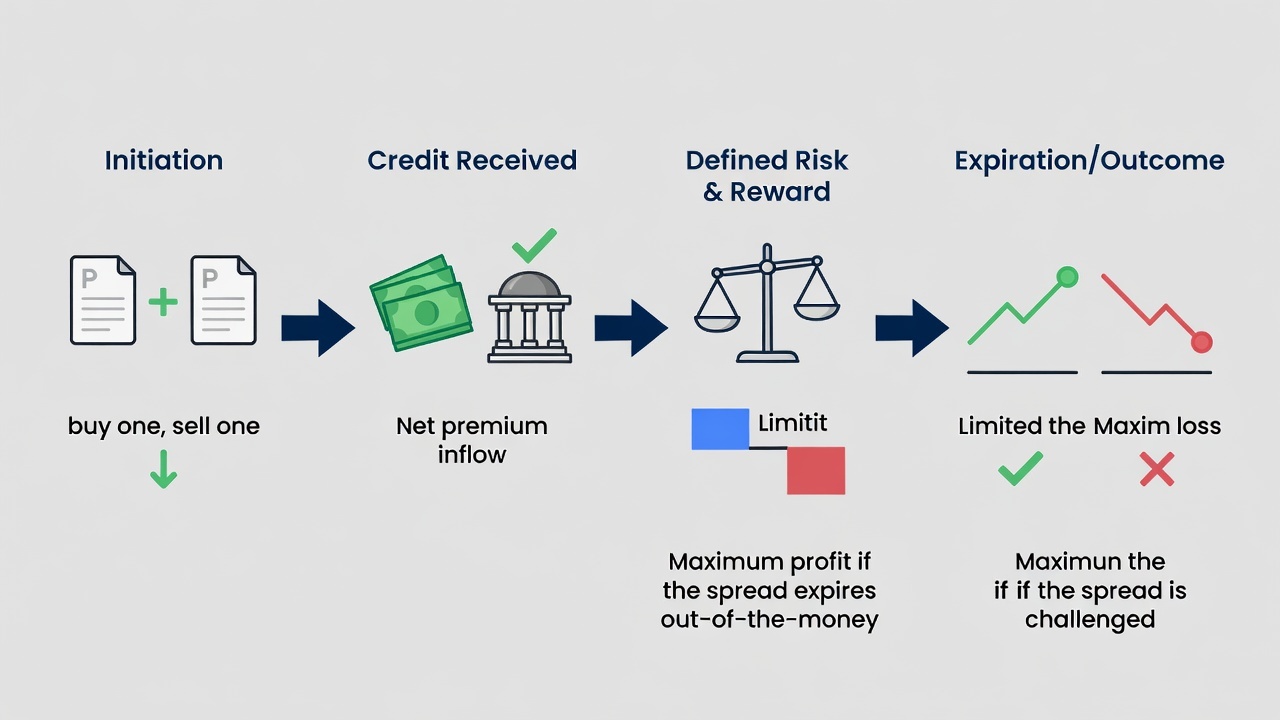
A bull put credit spread is a defined-risk, bullish options position created by selling one put option and simultaneously buying another put option at a lower strike price with the same expiration date.
Because you sell an option that is closer to the current stock price, it carries a higher premium than the cheaper option you buy further away. The difference between those two premiums lands in your brokerage balance immediately as a net credit.
Think of this trade as selling insurance with a backstop. When you sell an expensive insurance policy to someone else, you assume a liability. To ensure that liability cannot wipe out your account, you buy a cheaper reinsurance policy lower down on the price ladder.
You do not need the underlying stock to explode higher to produce a full profit. As long as the stock stays comfortably above your short put strike until the contracts expire, both options expire worthless, and you keep every penny of that upfront payment.
This structure gives you a cushion that single-leg options simply cannot match. You can be moderately right, entirely right, or even slightly wrong on direction and still walk away with a winning trade.
Debit Spreads vs. Credit Spreads: Why Get Paid Upfront?
Bull put credit spreads generate an upfront cash credit, whereas the bull call spreads we covered earlier in the series require paying cash out of pocket on day one.
When you pay a net debit for a call spread, time decay works against you every single afternoon the stock rests. If the market takes a nap or drifts sideways, your debit spread gradually bleeds value toward zero.
A credit spread turns the tables on time decay. The passing days actively increase the profitability of your trade because the options you sold are wasting away faster than the safety hedge you bought.
With a credit spread, you have three distinct paths to winning: the stock can rally, the stock can trade sideways, or the stock can drop slightly without breaching your strike. When you buy a debit spread, the stock generally must move upward just to overcome the drag of paid premium.
Here is how the mechanics compare across market movements:
| Market Behavior | Bull Call Debit Spread | Bull Put Credit Spread |
|---|---|---|
| Stock Rallies Hard | Full Maximum Profit | Full Maximum Profit |
| Stock Drifts Up Slowly | Partial or Full Profit | Full Maximum Profit |
| Stock Sits Flat | Slow Loss to Time Decay | Full Maximum Profit |
| Stock Drops Slightly | Total Loss of Debit | Full Maximum Profit (Above Short Strike) |
| Stock Crashes | Total Loss of Debit | Total Loss (Capped at Spread Width) |
Free For Traders
The Options Cheat Sheet Thousands Of Traders Swear By
Calls, puts, spreads — one free download tells you the right options strategy for every market condition.
 → Download The Free Cheat Sheet
How to Set Up a Bull Put Spread Step by Step
Setting up a bull put spread starts with establishing a technical support level on the daily stock chart where buyers have consistently shown up in the past. Your entire strategy hinges on finding a floor you do not expect the market to break over the next month.
Let us say XYZ stock is trading at $100 per share, and you notice strong support around $92. You choose an expiration date roughly 30 to 45 days out to give time decay enough velocity to work efficiently without exposing you to months of unpredictable macro news.
Step one is to sell a put option below the current market price, right at or beneath that support level. For XYZ, you sell the $90 put for a premium of $2.20 per share ($220 total per contract).
Step two is to buy a lower-strike put with the exact same expiration date to establish your safety net. You buy the $85 put for $0.70 per share ($70 total per contract).
When your broker executes these two orders simultaneously as a package, you collect the difference between the two prices. You sold for $2.20 and bought for $0.70, giving you an immediate net credit of $1.50 per share, or $150 in cash.
That $1.50 credit is yours to keep in full if XYZ closes anywhere at or above $90 when expiration day arrives. The math is simple, straightforward, and defined down to the penny before you ever hit the submit button.

The Math: Maximum Profit, Maximum Loss, and Breakeven
Calculating the risk and reward of a bull put credit spread requires only basic arithmetic, which removes all guesswork from your position sizing.
Your maximum profit is always equal to the net credit you collected when opening the trade. In our XYZ example, the absolute most you can earn on the trade is the $150 initial credit.
Your maximum loss is calculated by taking the width between the two strike prices and subtracting your net credit. The width between the $90 strike and the $85 strike is $5.00 ($500 per contract).
Subtract the $1.50 credit from the $5.00 width, and you get a maximum risk of $3.50 per share, or $350 per contract. No matter how violently XYZ stock drops—even if the company goes to zero overnight—you cannot lose more than $350.
Your breakeven price sits exactly at your short strike minus your net credit collected. For XYZ, you take the $90 short strike and subtract the $1.50 credit to find a breakeven point of $88.50.
Below $88.50 at expiration, your trade begins losing money dollar for dollar until it hits the long strike of $85. Below $85, the loss freezes completely because your long put increases in value dollar for dollar against the short put.
| XYZ Stock Price at Expiration | Short $90 Put Value | Long $85 Put Value | Net Position Outcome |
|---|---|---|---|
| $105.00 | Expires Worthless ($0.00) | Expires Worthless ($0.00) | +$150 Profit (Max Gain) |
| $95.00 | Expires Worthless ($0.00) | Expires Worthless ($0.00) | +$150 Profit (Max Gain) |
| $90.00 | Expires Worthless ($0.00) | Expires Worthless ($0.00) | +$150 Profit (Max Gain) |
| $88.50 (Breakeven) | Costs $1.50 to Close | Expires Worthless ($0.00) | $0.00 (Breakeven) |
| $87.00 | Costs $3.00 to Close | Expires Worthless ($0.00) | -$150 Loss |
| $80.00 | Costs $10.00 to Close | Worth $5.00 to Exercise | -$350 Loss (Max Loss) |
How Time Decay and Implied Volatility Impact Your Spread
Time decay, measured by the Greek letter Theta, is the primary engine generating profit in a bull put credit spread. Every day the calendar advances without the stock dropping, the market value of your short put decays faster than the value of your long put.
Because you are net short premium, you want the total price of the spread to collapse toward zero so you can buy it back for pennies or let it vanish at expiration. A trade that is sitting completely still technically gains profit every single morning simply because the clock ticked forward 24 hours.
Implied volatility, measured by Vega, acts as the atmospheric pressure on your options prices. When market fear spikes, options premiums inflate across the board; when the market calms down, options premiums deflate.
This means you ideally want to open bull put spreads when implied volatility is elevated, such as after a pullback into major support. Entering during high volatility allows you to sell puts for richer premiums further away from current prices.
As volatility cools down following the bounce, the spread deflates rapidly from both the directional recovery and the volatility crush combined. That double tailwind creates an accelerated exit opportunity long before the final expiration calendar arrives.
From Find Better Trades
Consistent Income. Any Market Direction.
The Income Project’s low-risk debit spread system generates steady returns whether the market runs up, down, or sideways.
 → See The Income Project

Managing the Trade: When to Take Profit and When to Cut Losses
Managing a bull put credit spread efficiently means having mechanical rules for your exit instead of praying for the best on expiration Friday.
When I trade this strategy, I never hold all the way to expiration just to squeeze out the final 10% of profit. Holding an almost worthless spread exposes your capital to sudden black-swan events for pennies of remaining reward.
A reliable standard is to place a good-til-cancelled limit order to buy back the spread once it captures 50% to 75% of the initial credit. If you sold the XYZ spread for $1.50, you enter a closing order to buy it back at $0.50, banking a clean $1.00 profit ($100 per contract) and freeing up your collateral.
On the downside, your stop loss should trigger well before the trade reaches its maximum possible loss. A standard defensive benchmark is to close the position if the spread cost doubles your initial credit, representing a loss equal to 1x your target profit.
If XYZ begins breaking support and the spread you sold for $1.50 rises to $3.00 on your screen, you close the trade immediately for a $1.50 loss. Cutting the loss there protects you from swallowing the full $3.50 disaster scenario.
When to Use a Bull Put Spread (and When to Avoid It)
A bull put credit spread works best in sideways-to-moderately bullish market conditions where price action is stable and orderly. It is the perfect tool when you believe a stock has found a solid floor but lacks the explosive momentum required for long call buying.
Look for assets bouncing off major multi-week support levels, upward-sloping moving averages, or post-earnings consolidation patterns. These environments offer clear technical markers where you can hide your short strikes out of harm’s way.
Conversely, you should avoid bull put spreads right before binary events like quarterly earnings announcements or major regulatory decisions. An unexpected earnings collapse can blow through your short and long strikes in seconds during after-hours trading.
You should also avoid selling put spreads in aggressively falling markets or during steep downtrends where support levels are slicing open like paper. Selling puts during an active waterfall decline is picking up pennies in front of a steamroller.
Finally, avoid underlying stocks with low liquidity and wide bid-ask spreads. If the spread between the bid and ask on the option chain is wider than ten cents, transaction friction will eat away your profit before you ever get a chance to manage the trade.
Common Mistakes Beginners Make With This
Beginners frequently choose short strikes that sit entirely too close to the current stock price in an attempt to collect huge credits. While selling an at-the-money put offers an attractive payout, it destroys your probability of profit and leaves you zero room for error on standard market pullbacks.
Another frequent error is holding losing spreads all the way through expiration in the stubborn hope of a last-minute miracle bounce. Options that finish even one cent in the money create real assignment risks and can leave you long 100 shares over the weekend on margin.
Traders also run into trouble by sizing positions based on the small credit received rather than the full spread width. Selling ten spreads to collect $1,500 sounds great until a bad headline hits, turning that position into an immediate $3,500 realized loss that wipes out months of hard work.
Finally, beginners often neglect liquidity on the individual option contracts they trade. When you trade low-volume contracts with penny-pinching market makers, getting filled at fair prices during a rapid market exit becomes nearly impossible.
Bull Put Credit Spread FAQ
What happens if the stock finishes right between my two strike prices at expiration?
If the stock finishes between your strikes, your short put expires in the money while your long protective put expires worthless. Your broker will automatically assign the short put, requiring you to buy 100 shares per contract at the short strike price unless you close the position before the final bell.
Can I lose more money than my initial collateral on a bull put credit spread?
No, you cannot lose more than the spread width minus your net credit, provided you close or let the position settle cleanly. The long put acts as a hard floor that guarantees your maximum risk is capped at all times, preventing catastrophic margin calls.
How far out in expiration should I sell a bull put spread?
The standard sweet spot for selling credit spreads is between 30 and 45 days until expiration. This window provides the ideal balance between rich premium collection and accelerated time decay, allowing you to hit your 50% profit target within two to three weeks.
Is a bull put credit spread better than buying shares of stock?
A bull put spread requires far less capital than purchasing 100 shares outright and still generates a profit even if the stock goes nowhere or drops slightly. However, your upside is strictly capped at the credit collected, whereas owning actual stock provides unlimited profit potential on massive rallies.
Next up, we are flipping to the short side of the market in Part 4: Bear Call Credit Spreads: Selling Premium Above Resistance.
📈 Want More? Join Our Free Trading Community
- Trading Strategy Guides Telegram — daily strategy tips and market insights
- Find Better Trades Telegram — free trade signals delivered to your phone
- Find Better Trades on YouTube — live trade breakdowns and tutorials
Lesson 54 of 55 in the free Options Trading Course.
← Previous: Bear Put Spread Strategy: How to Profit When Stocks Drop
Next: Bear Call Credit Spreads: How to Sell Above Resistance →