Why Stop Losses on Options Destroy Accounts

📊 October 29, 2026
- Placing a hard stop loss order on an option contract is the fastest way to get chopped out of winning trades.
- Option stop losses fail because market-maker bid-ask spreads, implied volatility collapse, and non-linear delta trigger fills that have zero correlation to price support.
- Anchor your exit criteria exclusively to technical levels on the underlying stock chart, or treat the entire premium paid as your pre-sized maximum risk.
— Ben, Find Better Trades
A stop loss on options is not a safety net; it is an automatic donation to market makers. When you attach a fixed percentage stop order directly to an option contract, you are applying linear equity mechanics to a multidimensional instrument. I see retail traders get liquidated on morning bid-ask spread expansions while the underlying stock is sitting comfortably inside textbook technical support.
The tool I use for this: Layered Options Alerts. A low-risk debit spread every Thursday, built to make steady returns whether the market runs up, down, or sideways. See Layered Options →
Stop losses on options fail because derivative pricing does not track price alone. An option contract derives its value from five moving parts simultaneously: underlying asset price, strike distance, time until expiration, implied volatility, and interest rates. Slapping a static exit price on a derivative that fluctuates based on implied volatility crush and rapid weekend theta decay guarantees you will trigger premature exits on trades where your directional thesis is completely right.
Why Everyone Gets This Wrong
Most traders take the risk rules they learned trading common stock and copy-paste them onto call and put contracts. In equity trading, a 2% drop in stock price equals a 2% drawdown in equity. In options trading, a 1% dip in the underlying asset can translate into a 15%, 35%, or 60% collapse in the contract price depending on the strike delta and time to expiration.
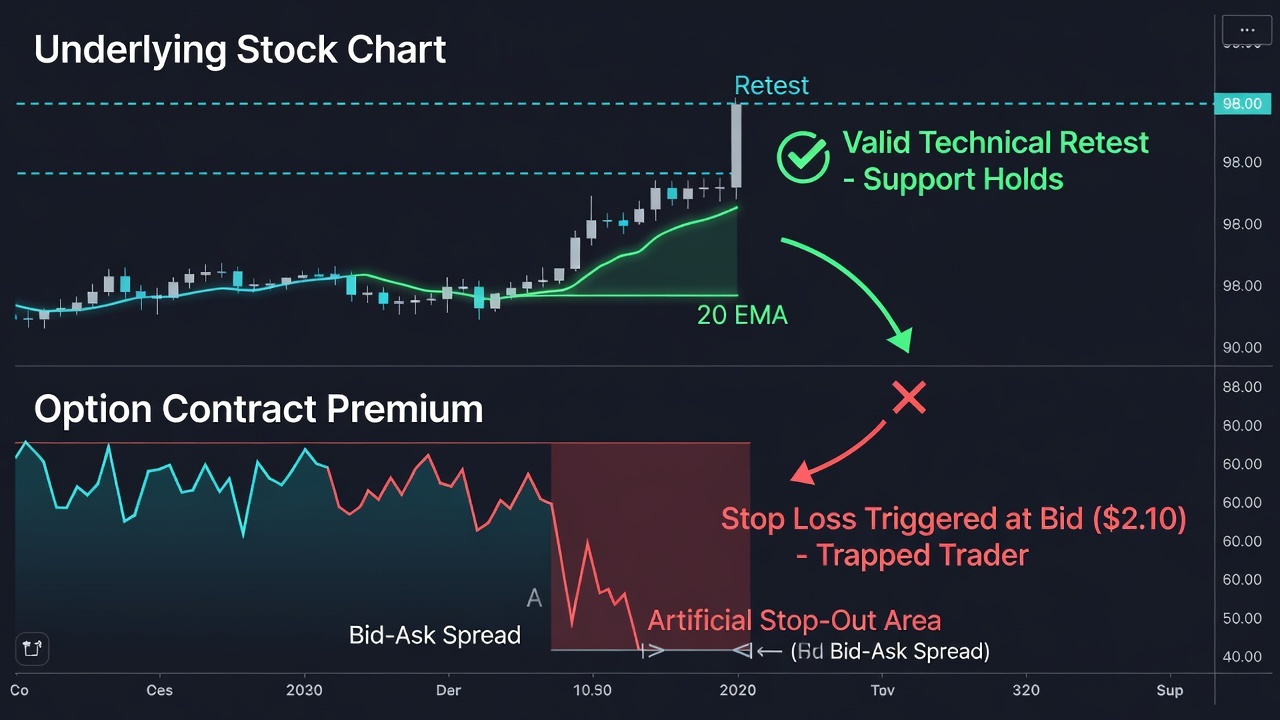
Say a stock trades at $100 and breaks above a key horizontal resistance level at $98. You buy a 30-day $100 strike call for $3.00, and you set a standard 25% stop loss at $2.25 on the contract. Two days later, the stock pulls back to $98.50 to retest the 20-period exponential moving average and prior resistance. In technical analysis, that is a textbook, constructive bullish backtest where you should actually be looking to add size.
Here is what happens behind the screen while that healthy pullback occurs. As the stock drifts down to $98.50, delta drops, implied volatility dips following the initial breakout, and market makers widen the bid-ask spread from $2.15 bid to $2.55 ask. A temporary print hits the tape at $2.20, your stop triggers as a market order, and your broker fills your exit at $2.10. You take a $90 loss per contract on a textbook trade setup.
An hour later, the stock bounces off the $98.00 support shelf and surges to $106.00. The call you dumped for $2.10 runs straight to $7.50. You were dead right on the market direction, but your derivative stop loss kicked you out of the trade before the move even started.
What Actually Works
To survive options trading, you must separate your technical thesis from your trade execution. You trade the underlying stock chart, not the derivative option chain. That means every stop decision you make must be calculated against key price levels of the underlying stock, never the arbitrary ticks of an option premium.
When I enter an option position, I map my exit to a specific candlestick close on the underlying asset. If I buy calls on a breakout above $98 support, my rule is simple: if the underlying stock closes a 15-minute candle below $97.80, I manually close the option contract at market. If the stock stays above $97.80, the position stays open regardless of what implied volatility or theta does to the premium in the interim.
The second alternative is sizing the contract premium as your absolute stop. If your risk management framework dictates a maximum allowable loss of $300 on a trade setup, you do not buy a $1,500 call and hope a 20% stop loss triggers cleanly. You buy a contract worth exactly $300, or you construct a vertical debit spread with a maximum loss capped at $300, and you accept that zero is your mechanical worst-case outcome.
| Feature | Contract-Level Stop Loss | Underlying Chart Stop |
|---|---|---|
| Execution Trigger | Contract premium tick (fluctuates with IV) | Underlying price bar close (pure price action) |
| Spread Risk | Extreme (widening spreads trigger market orders) | Zero (orders only trigger after confirmed break) |
| Noise Sensitivity | High (theta decay and IV crush cause false exits) | Low (ignores Greeks; focuses on technical levels) |
This approach eliminates the noise of Greek decay from your exit decisions. By letting position sizing define your capital exposure, you give the stock the breathing room it needs to complete its technical patterns without market-maker slippage knocking you out.
When Contract-Based Stops Can Still Make Sense
There is one narrow scenario where setting an automated stop order directly on an option contract is defensible: deep in-the-money options on ultra-liquid megacap assets. If you are trading SPY, QQQ, or Apple with options sporting a delta above 0.85, the contract behaves almost like a synthetic share of stock.
In those specific instruments, the bid-ask spread remains tight at one or two cents wide throughout the trading day, and extrinsic value represents a negligible percentage of the total contract price. Even then, you must use a stop-limit order rather than a stop-market order, ensuring an opening tick anomaly or sudden spread flash does not fill your exit at a devastating price.
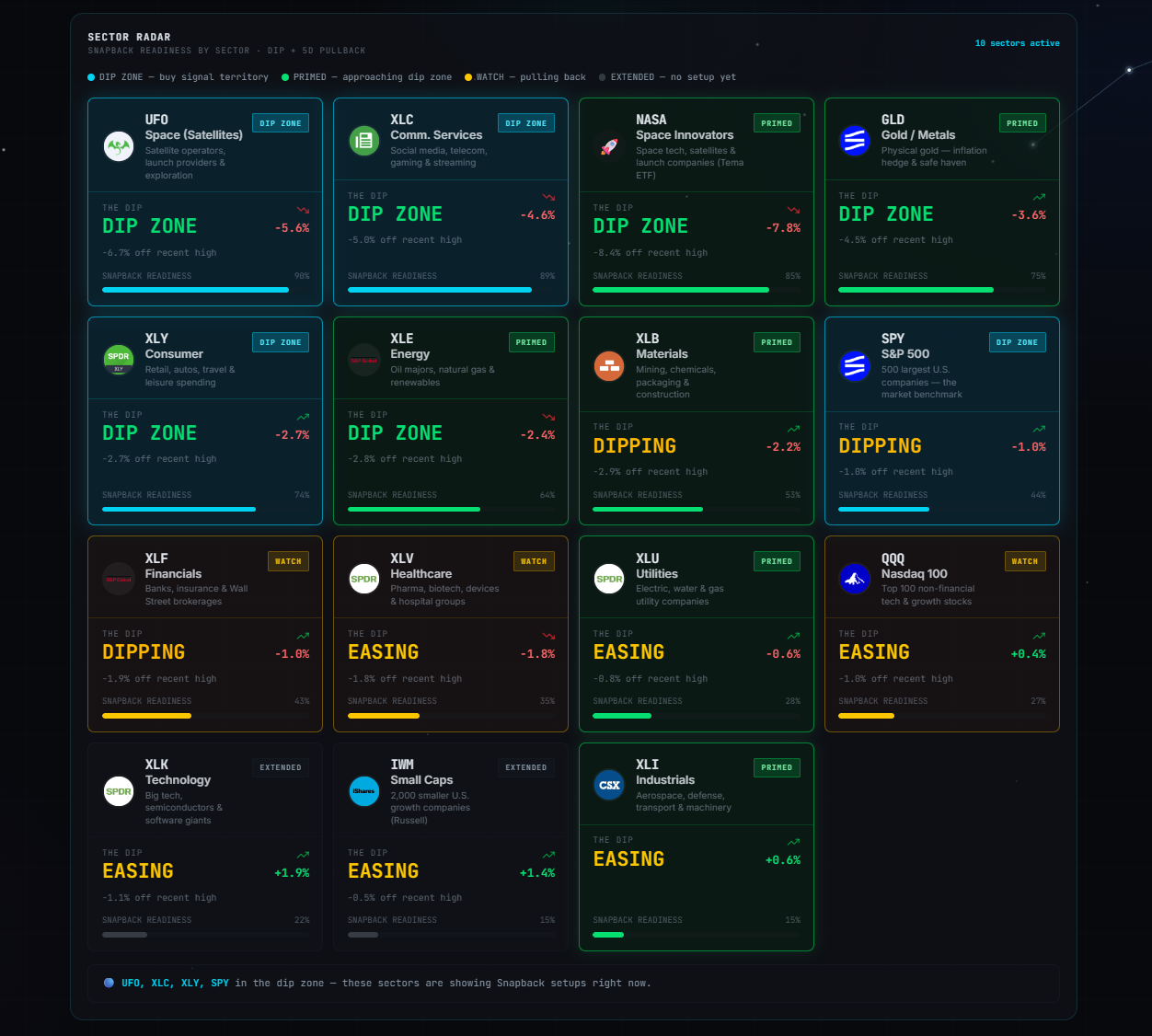
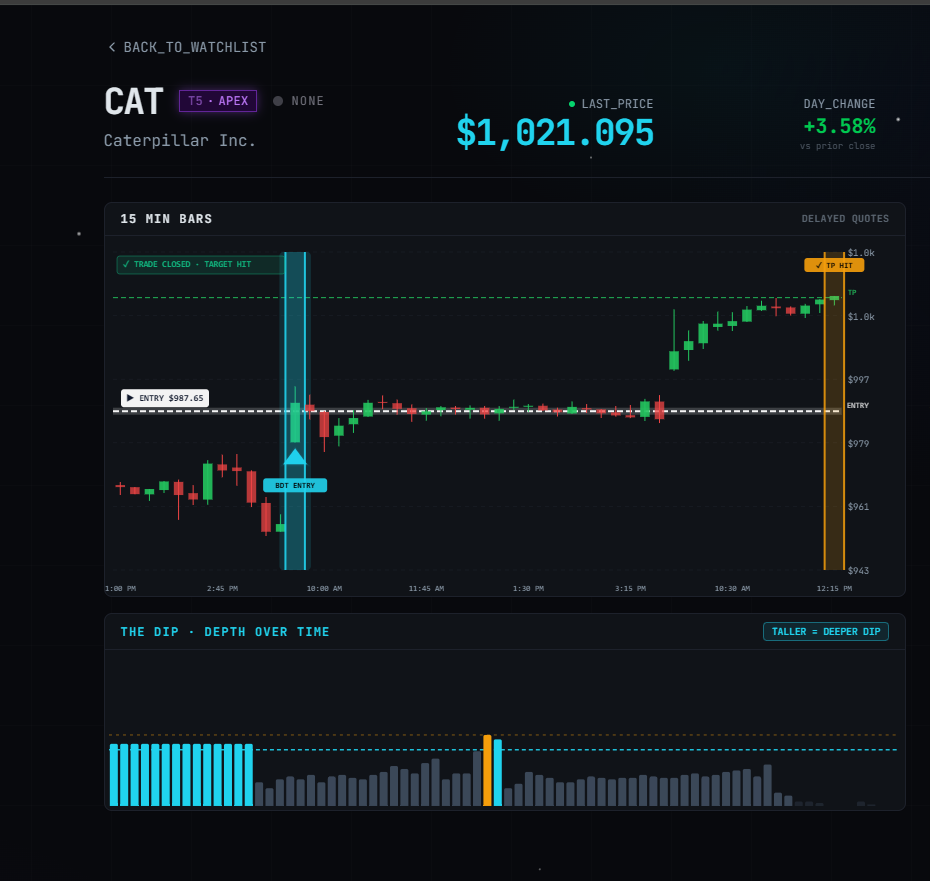
🎯 Want Setups Like These? The Big Dipper Does the Scanning For You.
Every morning the Big Dipper delivers curated DIP ZONE trade ideas — stocks already at high-probability entry levels, with targets pre-set. No guessing, no scanning. Just setups.
From Find Better Trades
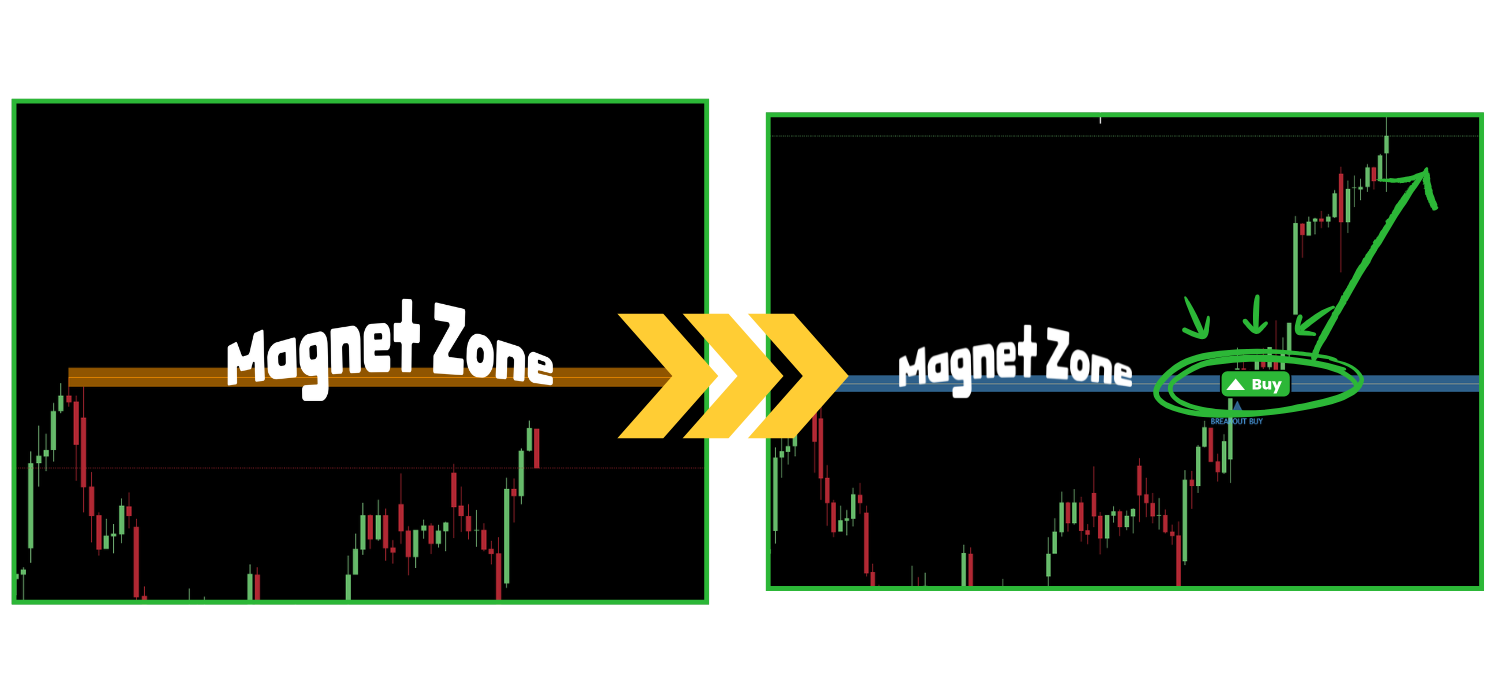
Know Exactly Where The Big Money Steps In
Auto-plots institutional support & resistance zones from pure price action — no more guessing at levels.
Options Stop Loss FAQ
Q: Can I use a trailing stop on an option contract?
A: Trailing stops on options are disastrous because contract volatility regularly swings 20% to 40% on normal intra-day noise. A trailing stop will almost always execute at the bottom of a temporary intraday dip rather than letting the underlying trend run.
Q: Why did my option stop loss trigger when the stock price did not move?
A: Your stop triggered due to implied volatility contraction, time decay over a weekend, or an abrupt widening of the bid-ask spread at market open. When market makers widen bids, your broker reads the dropping bid price as a triggered stop order even if the underlying stock has not moved a cent.
Q: How do institutional traders manage losses on options?
A: Institutional desks do not use retail hard stops on individual contracts; they define risk through position sizing, defined-risk spreads, or active delta hedging. They treat the total debit paid for long options as the defined maximum risk and set automated alerts on the underlying security instead.
📈 Want More? Join Our Free Trading Community
- Trading Strategy Guides Telegram — daily strategy tips and market insights
- Find Better Trades Telegram — free trade signals delivered to your phone
- Find Better Trades on YouTube — live trade breakdowns and tutorials