Why You Must Take Profits on Options Faster Than Stocks


📊 October 27, 2026
- Options are perishable, decaying instruments that punish patience and reward aggressive profit-taking.
- The single biggest flaw in retail trading is applying equity-style “let your winners run” mantras to long calls and puts.
- Take profits into the initial momentum burst at predetermined technical levels rather than waiting for trend exhaustion.
— Ben, Find Better Trades
Taking profits on options faster than on stocks is a strict requirement if you want your trading account to survive over the long haul. Stock traders can afford to sit through weeks of sideways consolidation because common shares do not come stamped with an expiration date. When you hold long options, time is an active adversary that steals your equity every single day the market hesitates.
The tool I use for this: TriTrader+. Auto-maps ascending, descending, and symmetrical triangles with breakout alerts the moment price escapes the pattern. See TriTrader+ →
If you treat a long call or put like a stock position, you will consistently turn triple-digit percentage winners into frustrating breakeven trades or outright losses. You cannot “marry” an options trade or give it limitless room to breathe. When the market hands you a fast gain on a derivative contract, you take the money and walk away.
Why Everyone Gets This Wrong
Retail traders get burned on options because standard trading literature teaches everyone to let winners run. That advice works fine when you own an equity index or physical shares of a company, but applying it to derivative contracts ignores basic physics. Options do not move in a straight linear relationship with price, and their value degrades the longer you hold them.
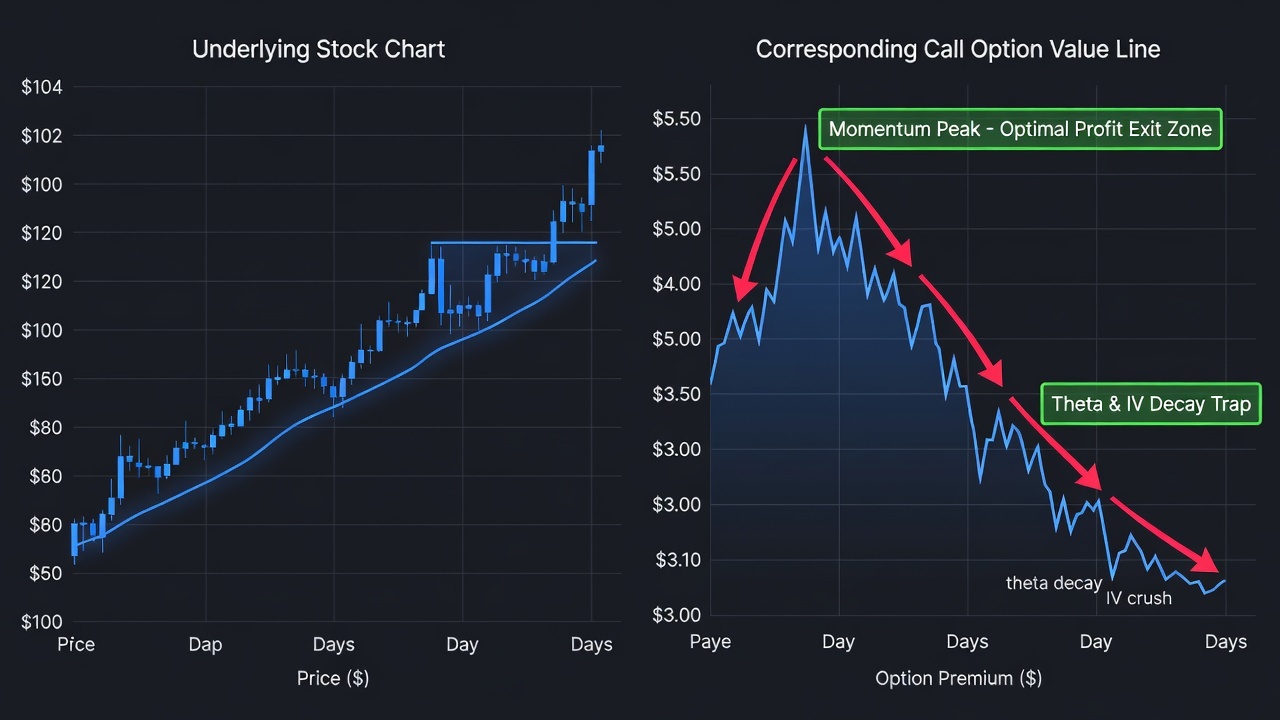
Say a stock is trading at $100 and breaks out above a clearly defined 20-day horizontal resistance level. You buy a 30-day $100 strike call option for $3.00. Over the next two trading sessions, the stock surges from $100 to $104, pushing your call option up to $5.50 for an 83% gain.
A typical stock trader looks at that daily chart and rightly says the stock is in a solid upward trend, so they hold through the first shallow pullback toward the 9-day exponential moving average. The stock consolidates sideways between $103 and $104 for the next four sessions, maintaining pristine market structure and holding above prior resistance. For a stock trader, that consolidation is completely harmless.
For your option contract, that four-day pause is catastrophic. Theta decay accelerates with every passing session, and the sudden post-breakout drop in implied volatility sucks another chunk of premium out of the contract. By the end of those four quiet sessions, the stock is still trading comfortably at $103.50, but your $5.50 option contract has deflated back down to $3.10, completely wiping out your profit while the underlying chart looks entirely bullish.
What Actually Works
Taking profits on options requires you to sell into momentum surges rather than waiting for trend reversals. In stock trading, you can trail your stop loss behind swing lows or key moving averages until the trend officially breaks. In options trading, if you wait for a technical trend reversal on the underlying chart, the combination of delta contraction and theta decay will already have stripped away half your peak profits.
I manage options trades by setting hard profit targets anchored to momentum milestones rather than open-ended trend expectations. When the underlying stock hits an immediate resistance target, reaches the 2.0 ATR upper band, or pushes the 14-period RSI above 70 on the intraday chart, I scale out immediately. You want to sell your contracts at the exact moment implied volatility is inflating and buyer demand is frantic, not when price stalls and buyers lose interest.
| Trade Metric | Stock Positions | Long Options Positions |
|---|---|---|
| Time Impact | Neutral; shares never expire | Negative; theta decay burns value daily |
| Volatility Impact | None; price is purely directional | Severe; IV crush can destroy green trades |
| Exit Strategy | Trail stops below structural swing points | Scale out into momentum extensions and IV spikes |
| Profit Target Expectation | Hold through healthy consolidations | Take 40% to 60% gains without hesitation |
Here is my exact baseline rule for managing directional single-leg options: if a contract hits a 40% to 50% gain inside the first three days of the trade, I sell half the position immediately to de-risk the principal. For the second half of the position, I pull my stop up to the entry price on the contract and look to dump the remainder at the very first sign of price hesitation at technical resistance. I never let a 50% option gain rotate back into a red trade.
Furthermore, keep a close eye on the expiration calendar. Once an option contract dips below 21 days to expiration, theta decay enters its steepest, most punishing curve. If an underlying stock has not made its directional move by that point, the contract has to be closed, regardless of what your chart hopes might say.
When Holding Options for Huge Runners Can Still Make Sense
Holding options longer can make sense under one specific condition: when you are trading deep in-the-money LEAPS with six to twelve months until expiration. On a LEAPS contract with a 0.85 delta, the daily theta decay is minimal compared to the price movement of the underlying equity, meaning the contract behaves much more like common stock and can survive a multi-week consolidation without falling apart.
Holding for a moonshot can also work if you actively roll your long calls into a vertical spread once the position moves in your favor. If you buy a $100 call for $3.00, see the stock hit $105, and then sell the $110 call against it for $2.50, you have essentially financed your position and neutralized future theta decay. Outside of those two mechanics, holding an open single-leg option through a prolonged consolidation is just handing your profits back to the market makers.
🎯 Want Setups Like These? The Big Dipper Does the Scanning For You.
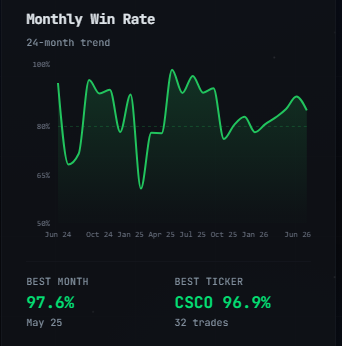
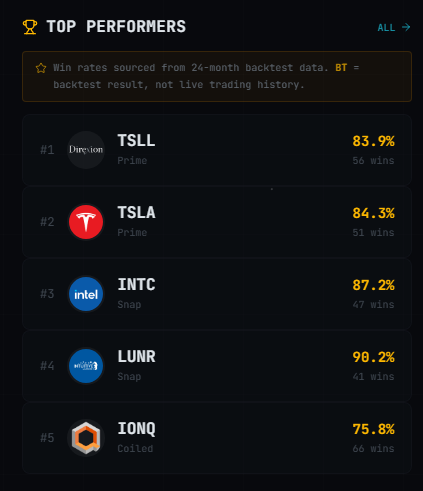
Every morning the Big Dipper delivers curated DIP ZONE trade ideas — stocks already at high-probability entry levels, with targets pre-set. No guessing, no scanning. Just setups.
From Find Better Trades
Know Exactly Where The Big Money Steps In
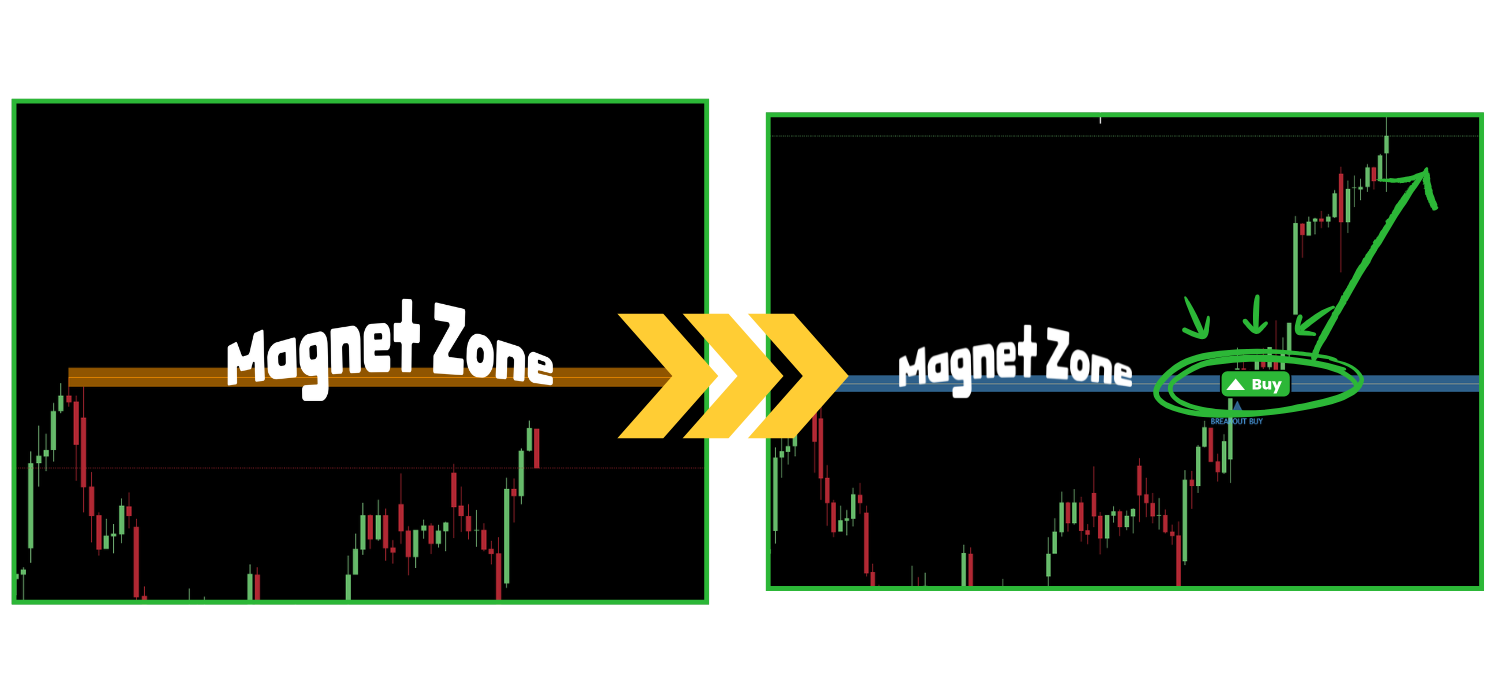
Auto-plots institutional support & resistance zones from pure price action — no more guessing at levels.
Options Profit-Taking Strategy FAQ
Q: At what profit percentage should you take profits on options?
A: Taking profits on options between 40% and 50% on your initial tranche is the most reliable target for directional trades. Locking in gains at this level avoids the sharp pullbacks that typically follow short-term momentum bursts.
Q: Why do options lose value even when the underlying stock goes up?
A: Options lose value during upward moves when daily theta decay or implied volatility drops exceed the gains generated by delta. If the stock does not rise fast enough to offset the ticking clock, the contract still bleeds cash.
Q: Is it better to sell the entire option position or scale out?
A: Scaling out by closing half your contracts at a target gain and trailing the rest with a breakeven stop is the best way to balance profit protection with upside exposure.
📈 Want More? Join Our Free Trading Community
- Trading Strategy Guides Telegram — daily strategy tips and market insights
- Find Better Trades Telegram — free trade signals delivered to your phone
- Find Better Trades on YouTube — live trade breakdowns and tutorials