Options Expiration Date Explained: A Beginner’s Guide

📚 Beginner’s Guide to Options — Part 4 of 51
- Part 1: What Is an Option? The Absolute Basics Explained
- Part 2: Calls vs. Puts: The Two Types of Options You Need to Know
- Part 3: Strike Price Explained: What It Actually Means for Your Trade
- Part 4: Expiration Date Explained: Why It Changes Everything (you are here)
⚡ Key Takeaways
- An options contract is a temporary deal that completely disappears on its set expiration date.
- Time is a wasting asset in options trading, meaning your contract loses value every single day it gets closer to expiring.
- Choosing the right expiration date depends entirely on giving your market theory enough time to play out.
— Ben, Find Better Trades
When I first started trading, I treated options like regular stocks, thinking I could just hold onto them forever until they eventually went up. That was a painful mistake that cost me a lot of money because I did not understand that options have a hard shelf life. This is Part 4 of our 51-part beginner series, and today we are tackling the exact mechanic that makes options so different from stocks: the expiration date.
1. What Exactly Is an Options Expiration Date?
An options contract is not a permanent asset like a share of stock that you can pass down to your grandkids. It is a temporary legal agreement between a buyer and a seller that exists for a strictly limited window of time.
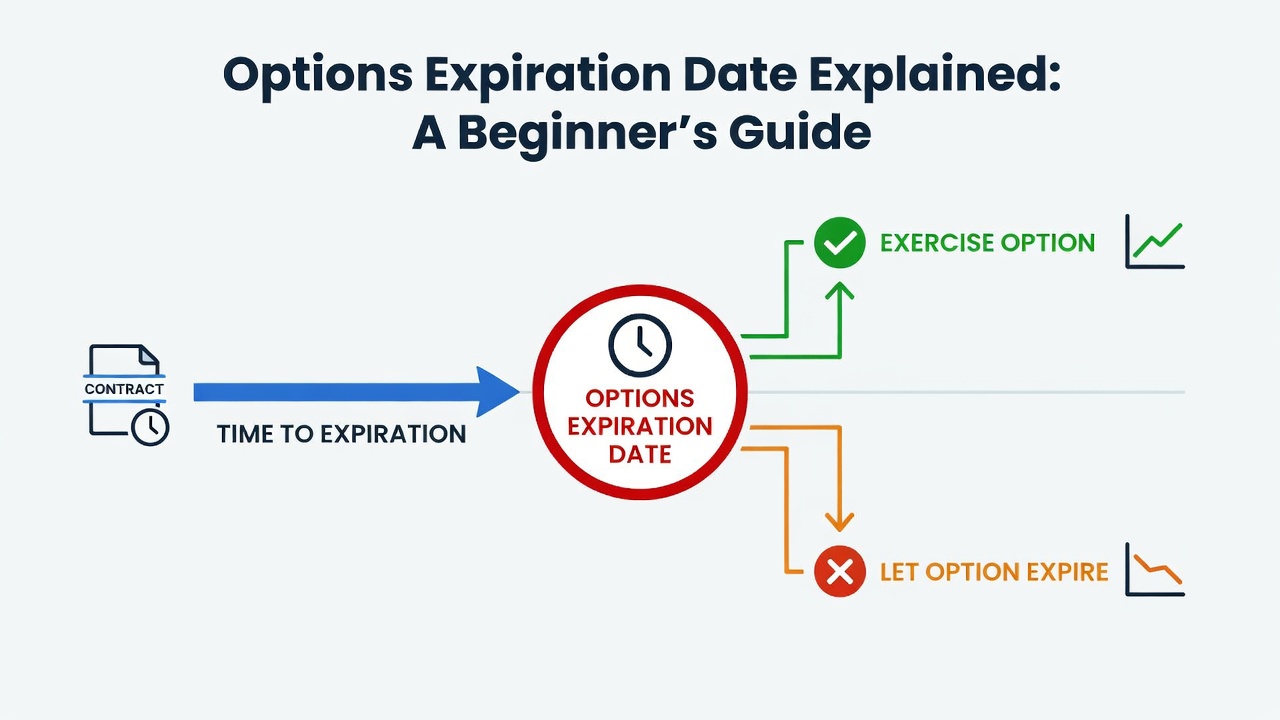
The expiration date is the absolute final day that the owner of the option has the right to exercise their contract. Once that specific date and time pass, the contract instantly ceases to exist, turning into nothing more than digital dust.
Think of it like a movie ticket or a coupon for a free car wash. If you do not use that coupon before the date printed on the back, the business will not honor it, and it becomes completely worthless.
In the financial markets, most standard stock options expire on the third Friday of the month, though many popular stocks now offer weekly expirations as well. As a trader, you must choose this date upfront the moment you buy or sell your contract.
2. The Real-World Analogy: Rental Agreements
To really grab how expiration works, let us look at a simple real-world analogy involving a rental property. Imagine you want to buy a house, but you need three months to get your financing in order.
You pay the owner a fee for an option to buy the house for $300,000 at any point during the next ninety days. This ninety-day window is your expiration period, and the final day of that agreement is your expiration date.
If ninety days pass and you have not bought the house, your contract expires. The homeowner keeps your non-refundable fee, and you walk away with absolutely nothing to show for it.
The same thing happens in stock trading. You are paying a premium for a temporary right, and if the stock does not move how you want before the clock runs out, your deal is officially over.
🎯 Get High-Probability Trade Setups — Free
The Big Dipper Dashboard delivers curated trade ideas straight to your screen every morning. Know what to watch before the opening bell.

3. How Expiration Dates Affect Option Prices
Every option contract has two types of value built into its price: intrinsic value and extrinsic value. Extrinsic value is mostly made up of time value, which represents the probability that the stock will move before expiration.
The more time left on an option contract, the more expensive that option will be to buy. This is because more time gives the stock more opportunities to make a massive move in your favor.
Let us look at a numeric example to see how this works in the real market. Imagine XYZ stock is currently trading at $100 per share, and you want to buy a call option with a strike price of $105.
A call option that expires in just three days might only cost you $0.50 because there is very little time for the stock to jump five dollars. However, a call option with the exact same strike price that expires in six months might cost you $6.00 because of that massive window of opportunity.
| Expiration Term | Strike Price | XYZ Stock Price | Hypothetical Option Price |
|---|---|---|---|
| 3 Days | $105.00 | $100.00 | $0.50 |
| 30 Days | $105.00 | $100.00 | $2.10 |
| 180 Days | $105.00 | $100.00 | $6.00 |

4. Understanding Time Decay (Theta)
In our earlier parts of this series, we talked about how options are priced, but now we need to focus on their worst enemy. That enemy is a concept called time decay, which traders formally refer to as theta.
Time decay is the constant, daily reduction in the value of an option contract as it gets closer to its expiration date. Every single night while you are sleeping, your option loses a tiny sliver of its value simply because one less day remains on the clock.
This decay is not a straight, predictable line from start to finish. Instead, time decay behaves like a snowball rolling down a steep hill, picking up speed as it gets closer to the bottom.
When an option has nine months left, the daily decay is barely noticeable, often costing you just fractions of a penny per day. But when you get within thirty days of expiration, the speed of decay accelerates rapidly, eating away at your contract value at an alarming pace.
5. What Actually Happens On Expiration Day?
Many beginners panic because they do not know what happens when the final hour of expiration day actually arrives. You essentially have two choices before the closing bell rings on that fateful Friday.
Your first and most common choice is to close your position before the market closes. If you bought an option, you can simply sell it back to the market to lock in your profits or cut your losses.
Your second choice is to do nothing and let the contract go through the automatic settlement process. If your option is in-the-money by even one single penny at the close, your broker will automatically exercise it for you.
Let us look at a second numeric example to clarify this settlement process. Suppose you own a call option with a strike price of $50, and the stock closes at $52 on expiration day.
Because your option is in-the-money, your broker will automatically buy 100 shares of the stock at your $50 strike price, costing you $5,000. If you do not have $5,000 cash in your account, your broker may liquidate the position on your behalf, so you must manage this before the final bell.

6. Choosing the Right Expiration Date for Your Trade
When you open your trading platform, you will be confronted with an option chain showing dozens of different expiration dates. Selecting the right one is a balancing act between cost and time.
If you choose an expiration date that is too close, say next week, the option will be very cheap, but you will have almost no room for error. If the stock takes two weeks to make its move, you will lose 100% of your investment even though your market theory was ultimately correct.
If you choose an expiration date that is too far out, like one year from now, you give yourself plenty of time to be right. However, you will pay a massive premium for that extra time, meaning the stock has to move significantly just for you to break even.
I generally recommend that beginners look at expirations between 30 and 60 days out. This window offers a sweet spot where the options are reasonably priced, but the daily time decay has not yet entered its rapid, destructive phase.
7. Weekly vs. Monthly Expirations
In the early days of options trading, contracts only expired once a month, specifically on the third Friday. Today, major stocks and index funds offer weekly options that expire every single week, sometimes even daily.
Weekly options are highly attractive to retail traders because they are incredibly cheap and offer quick action. You can risk a tiny amount of money to potentially make a large percentage gain if the stock moves violently overnight.
However, I strongly warn beginners to stay away from weekly contracts when they are still learning the ropes. The extremely fast pace of time decay on weekly options means you can lose your entire investment in a matter of hours if the stock sits still.
Monthly options remain the benchmark for a reason because they have higher trading volume and more stable pricing. They give you the breathing room needed to manage your positions professionally without constantly staring at your screen in a panic.
Common Mistakes Beginners Make With This
The single biggest mistake I see beginners make is buying options that expire in less than a week because they look incredibly cheap. They do not realize that these contracts are cheap for a reason: the probability of them expiring worthless is extremely high, and the rapid time decay will destroy their value almost instantly.
Another common error is holding onto a losing option all the way until the absolute final day of expiration hoping for a last-minute miracle. In my experience, waiting for a miracle usually results in losing 100% of your premium, whereas cutting your losses a week early preserves valuable trading capital.
Lastly, many traders completely forget to check their accounts on Friday afternoon and get hit with unexpected stock assignments. If you do not have the cash to buy the underlying shares, letting an in-the-money option expire can result in your broker buying thousands of dollars of stock on margin, creating a massive overnight risk.
Options Expiration Frequently Asked Questions
Can I sell my option before the expiration date?
Yes, you can sell your option contract back to the market at any point during normal trading hours before the expiration date. You are never obligated to hold an option until the final day, and most professional traders close their positions early to lock in profits or limit losses.
What happens if my option expires out-of-the-money?
If your option is out-of-the-money on expiration day, it simply expires completely worthless and disappears from your account. The seller of the option keeps the entire premium you paid, and you do not owe any further money or shares to anyone.
What time of day do options actually expire?
While options technically expire on the weekend, the practical deadline for trading them is 4:00 PM Eastern Time on the expiration Friday. Your broker will typically require you to submit any exercise instructions or close your positions slightly before this official market close.
Does time decay happen on weekends and holidays?
Yes, time decay operates continuously, meaning your options will lose value over weekends and market holidays. The market prices this decay in ahead of time, so you will often see the drop reflected in the option price as the Friday close approaches or immediately on Monday morning.
Now that you understand how the ticking clock of expiration impacts your trades, we need to look at how these elements combine to create the actual price you pay, which is why you cannot miss our next part where we explain option premium in detail.
📈 Want More? Join Our Free Trading Community
- Trading Strategy Guides Telegram — daily strategy tips and market insights
- Find Better Trades Telegram — free trade signals delivered to your phone
- Find Better Trades on YouTube — live trade breakdowns and tutorials
Lesson 4 of 55 in the free Options Trading Course.
← Previous: Strike Price Explained: Option Strike Price Guide for Beginners
Next: Options Premium Explained: What You Are Really Paying For →