Strike Price Explained: Option Strike Price Guide for Beginners

📚 Beginner’s Guide to Options — Part 3 of 51
- Part 1: What Is an Option? The Absolute Basics Explained
- Part 2: Calls vs. Puts: The Two Types of Options You Need to Know
- Part 3: Strike Price Explained: What It Actually Means for Your Trade (you are here)
☑ Key Takeaways
- The strike price is the set, locked-in price at which you have the right to buy or sell the underlying stock.
- It acts as your line in the sand, determining whether your option contract finishes the trade as a winner or a loser.
- Choosing the right strike price directly controls your probability of winning and how much your option contract costs.
— Ben, Find Better Trades
When I was first starting out in the markets, I remember looking at an option chain and feeling completely overwhelmed by the rows of different numbers. In Part 1 and Part 2 of this series, we covered what an option is and how calls and puts differ. Today, in Part 3, we are going to demystify the single most important number on that screen: the strike price.
What Is a Strike Price and Why Does It Exist?
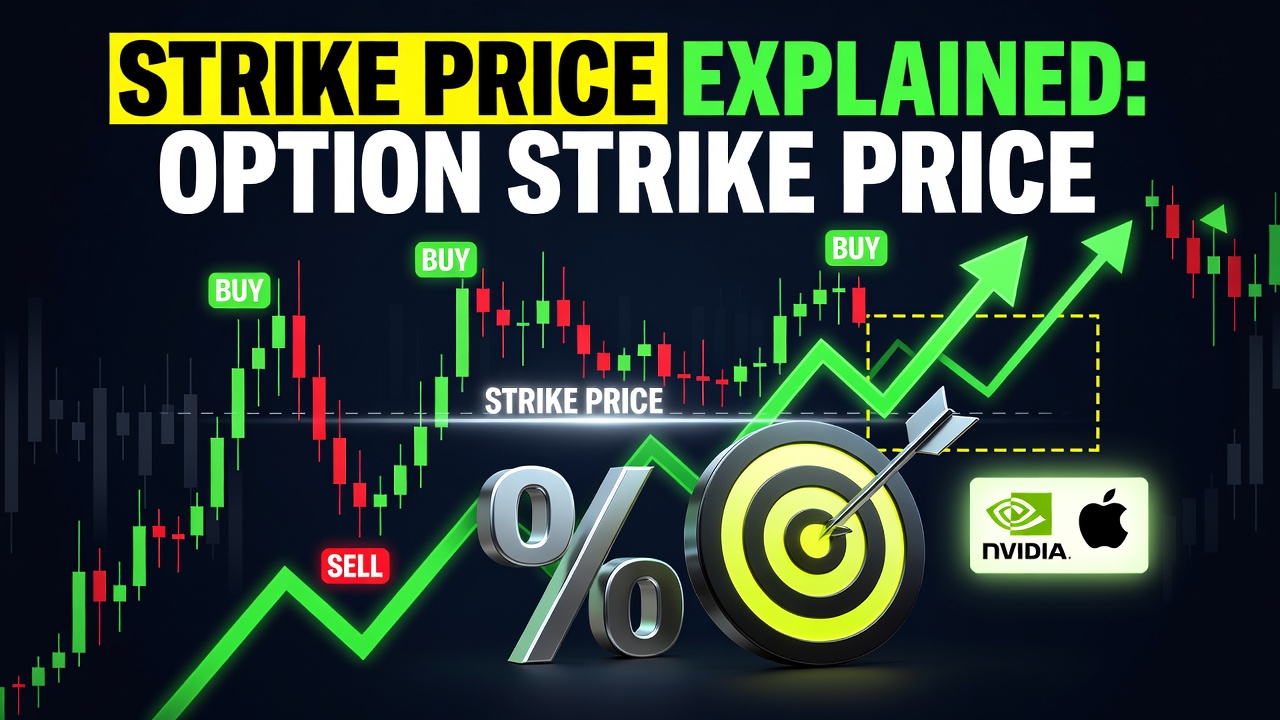
The strike price is the predetermined, locked-in price at which an option contract allows you to buy or sell a specific stock. It is the absolute core of your option contract, acting as a binding agreement that does not change, no matter how wild the stock market gets.
Think of it as a guaranteed rate locked in writing. If you hold a contract with a specific strike, the actual market price of the stock can fly to the moon or crash to zero, but your right to transact at that exact strike price remains completely frozen in place.
Without a strike price, an options contract would have no starting point and no destination. It defines the exact boundary where your financial bet begins to make sense or fails completely.
For every stock, there are dozens of different strike prices available for you to choose from. When you buy an option, you are not just betting that a stock goes up or down; you are selecting the exact target price where you want your rights to kick in.
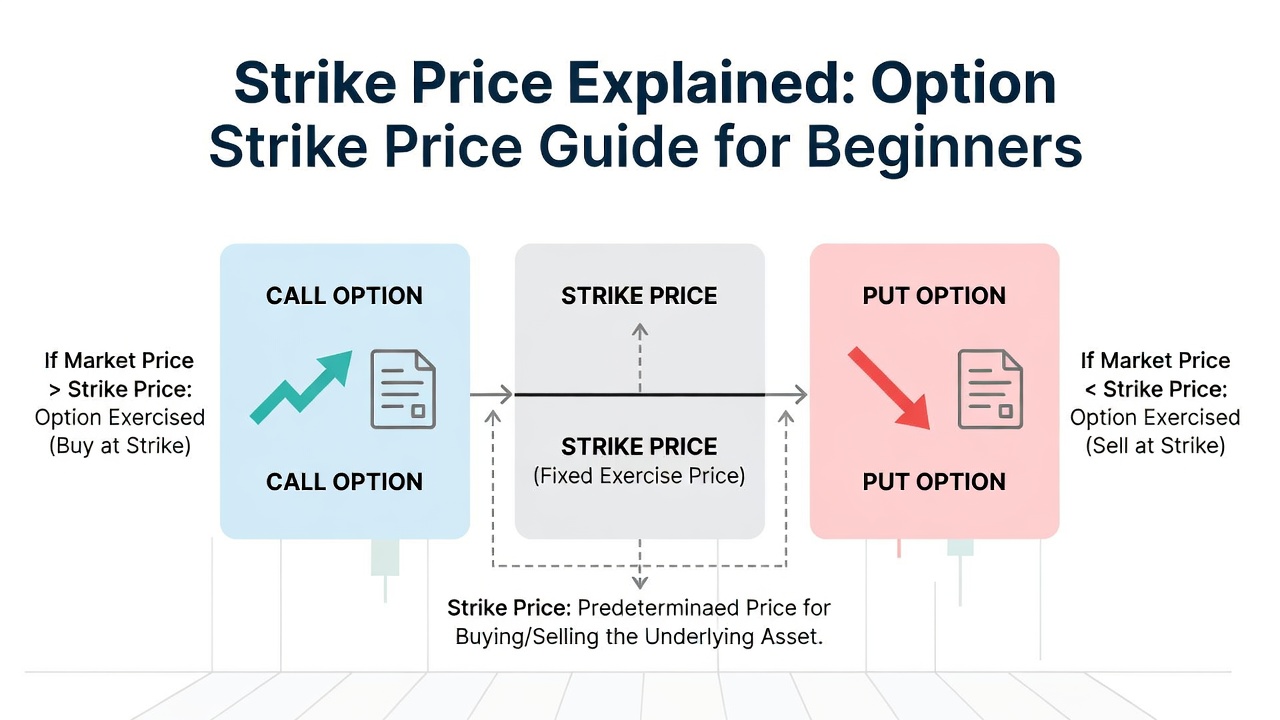
The Line in the Sand Analogy
To make this concrete, let us use a simple real-world analogy. Imagine you are looking to buy a house, and the seller gives you a written agreement allowing you to purchase that house for exactly $300,000 at any point over the next six months.
In this scenario, that $300,000 figure is your strike price. It is your line in the sand, completely independent of what happens to the neighborhood housing market over those six months.
If a new highway is built nearby and the market value of the house spikes to $400,000, your agreement still lets you buy it for $300,000. You instantly gain $100,000 in value because your locked-in price stayed put while the real world changed.
Conversely, if a toxic waste dump opens next door and the house value plunges to $150,000, you simply walk away. Your strike price of $300,000 is now useless, so you let the agreement expire and only lose the small fee you paid to secure the contract.
🎯 Get High-Probability Trade Setups — Free
The Big Dipper Dashboard delivers curated trade ideas straight to your screen every morning. Know what to watch before the opening bell.

How the Strike Price Works for Call Options
As we established earlier in our series, a call option gives you the right to buy a stock. Therefore, when you buy a call option, you want the actual stock price to rise as far above your strike price as possible.
Let us look at a real numeric example to show how this math works. Imagine stock XYZ is currently trading in the open market at $100 per share, and you decide to buy a call option with a $105 strike price.
If the stock climbs to $120 by the time the contract expires, your option gives you the right to buy those shares for just $105. You can immediately turn around and sell them on the open market for $120, pocketing a clean $15 per share difference.
If the stock fails to reach your target and finishes at $98, your right to buy at $105 is completely worthless. Nobody would pay $105 to buy a stock they can grab on the open market for $98, so the contract expires with a value of zero.
The relationship between your strike price and the market price determines the value of your call. The higher the stock climbs above your strike, the more valuable your contract becomes.

How the Strike Price Works for Put Options
A put option is the exact opposite of a call option, giving you the right to sell a stock at your chosen strike price. Because you are selling, you want the actual stock price to crash as far below your strike price as possible.
Let us walk through another numeric example. Suppose stock ABC is trading at $50 per share, and you purchase a put option with a $45 strike price because you expect the company to report terrible earnings.
If the company reports bad news and the stock price drops to $30, your contract still allows you to sell shares at your locked-in $45 strike. You can buy the cheap shares on the market for $30 and instantly sell them for $45, securing a $15 profit per share.
However, if the stock goes up to $55 instead, your contract to sell at $45 has no value. There is no logical reason to sell your shares for $45 when you can sell them on the open market for $55, so your put option expires worthless.
With puts, your strike price acts as a floor. The deeper the stock falls beneath that floor, the more money your contract is worth to you or another trader.
Comparing Calls and Puts Across Different Strikes
To help you visualize how these mechanics play out side by side, it is helpful to look at how different market scenarios affect your contracts. Your strike price remains fixed, while the market fluctuates around it.
Here is a simple breakdown of how call and put options behave based on where the stock price ends up relative to your chosen strike price.
| Option Type | Strike Price | Stock Price at Expiry | Contract Value Status | Action Taken |
|---|---|---|---|---|
| Call Option | $100 | $115 | In the Money (Value: $15) | Exercise right to buy cheap |
| Call Option | $100 | $85 | Out of the Money (Value: $0) | Let the option expire worthless |
| Put Option | $50 | $35 | In the Money (Value: $15) | Exercise right to sell high |
| Put Option | $50 | $65 | Out of the Money (Value: $0) | Let the option expire worthless |
This table demonstrates that the profitability of your trade is entirely dependent on the gap between your strike price and the final stock price. Choosing the correct gap is the primary decision you must make as a trader.

The Trade-Off: Probability vs. Cost
A major concept that trips up beginners is the relationship between the strike price and the upfront cost of the option, which is called the premium. You cannot get a high probability of success and a cheap contract at the same time.
If you choose a strike price that is very easy for the stock to reach, the contract will be highly expensive. Sellers are not foolish; they demand a high price to take on a bet that is highly likely to lose them money.
If you choose a strike price that is incredibly far away from the current stock price, the contract will be incredibly cheap. While this sounds appealing, it is cheap because the market knows it has a very low probability of actually working out.
I tell my students to view this as a balancing scale. You must constantly weigh the cheap cost of far-away strikes against the realistic probability that the stock can actually move far enough to cross your line in the sand.
How to Select Your First Strike Price
When you are preparing to place your first trade, do not just guess or pick the cheapest strike price on the list. You need to align your strike price directly with your actual outlook for the underlying stock.
If you expect a stock to make a massive, violent move upwards very quickly, you can afford to buy a strike price that is slightly above the current market price. This keeps your entry cost low while preserving massive upside potential if you are correct.
If you expect a very slow, grinding move upward, you should select a strike price that is already below the current stock price. This costs more upfront, but it gives you a much higher safety margin if the stock does not move as fast as you hoped.
Always ask yourself where you realistically expect the stock to stand on expiration day. Your strike price should reflect a target that is backed by your chart analysis, not just wishful thinking.
Common Mistakes Beginners Make With This
The single most common mistake I see new traders make is buying the cheapest strike prices available because they require the least amount of capital. These cheap options are far out of the money and almost always expire completely worthless, slowly draining your account through a thousand tiny cuts.
Another frequent error is failing to realize that your trade needs to cover the cost of the premium to actually make money. If you buy a $100 strike call for a $5 premium, the stock does not just need to pass $100; it must get above $105 for you to show a net profit at expiration.
I also see beginners confuse the stock price with the strike price when entering their order tickets. Accidentally mixing up these numbers can lead to buying the completely wrong contract and risking capital on a setup you never intended to trade.
Finally, many beginners hold onto losing strike prices all the way to expiration, hoping for a miracle save. If the stock is nowhere near your strike price as expiration approaches, it is usually wiser to cut the trade early and salvage whatever remaining value is left in the contract.
Strike Price Frequently Asked Questions
Can I change my strike price after I buy the option?
No, you cannot alter the strike price of an option contract once you have purchased it. The strike price is a legally binding, permanent part of the contract structure. If you realize you selected the wrong strike, you must sell your current contract back to the market and buy a completely new one with your desired strike.
Why are some strike prices spaced by $1 and others by $5?
Exchanges determine the spacing of strike prices based on trading volume and the price of the underlying stock. Highly active, liquid stocks like Apple or Tesla will have strikes spaced very closely together, sometimes just fifty cents apart, to give retail traders maximum flexibility. Less active or lower-priced stocks usually have their strikes spaced much wider apart to concentrate trading volume.
What does it mean when a strike price is in the money?
An option is in the money when the stock price has crossed your strike price in a favorable direction. For a call option, this means the stock price is higher than your strike price. For a put option, this means the stock price is lower than your strike price, giving the contract intrinsic value.
Is a lower strike price always better for a call option?
A lower strike price is safer for a call option because it gives you a higher probability of finishing in the money, but it is not always better. Lower strikes cost significantly more money to buy, which means you have more capital at risk if the trade goes completely wrong. You must always balance the safety of a lower strike against the lower cost and higher leverage of a higher strike.
Now that you understand how to choose your target price, the next critical step is mastering the ticking clock attached to every single trade, which is why you need to read Part 4 of our series: “Expiration Date Explained: Why It Changes Everything.”
📈 Want More? Join Our Free Trading Community
- Trading Strategy Guides Telegram — daily strategy tips and market insights
- Find Better Trades Telegram — free trade signals delivered to your phone
- Find Better Trades on YouTube — live trade breakdowns and tutorials
Lesson 3 of 55 in the free Options Trading Course.
← Previous: Calls vs Puts: The Two Types of Options Explained Simply
Next: Options Expiration Date Explained: A Beginner’s Guide →