Calls vs Puts: The Two Types of Options Explained Simply

📚 Beginner’s Guide to Options — Part 2 of 51
- Part 1: What Is an Option? The Absolute Basics Explained
- Part 2: Calls vs. Puts: The Two Types of Options You Need to Know (you are here)
⚡ Key Takeaways
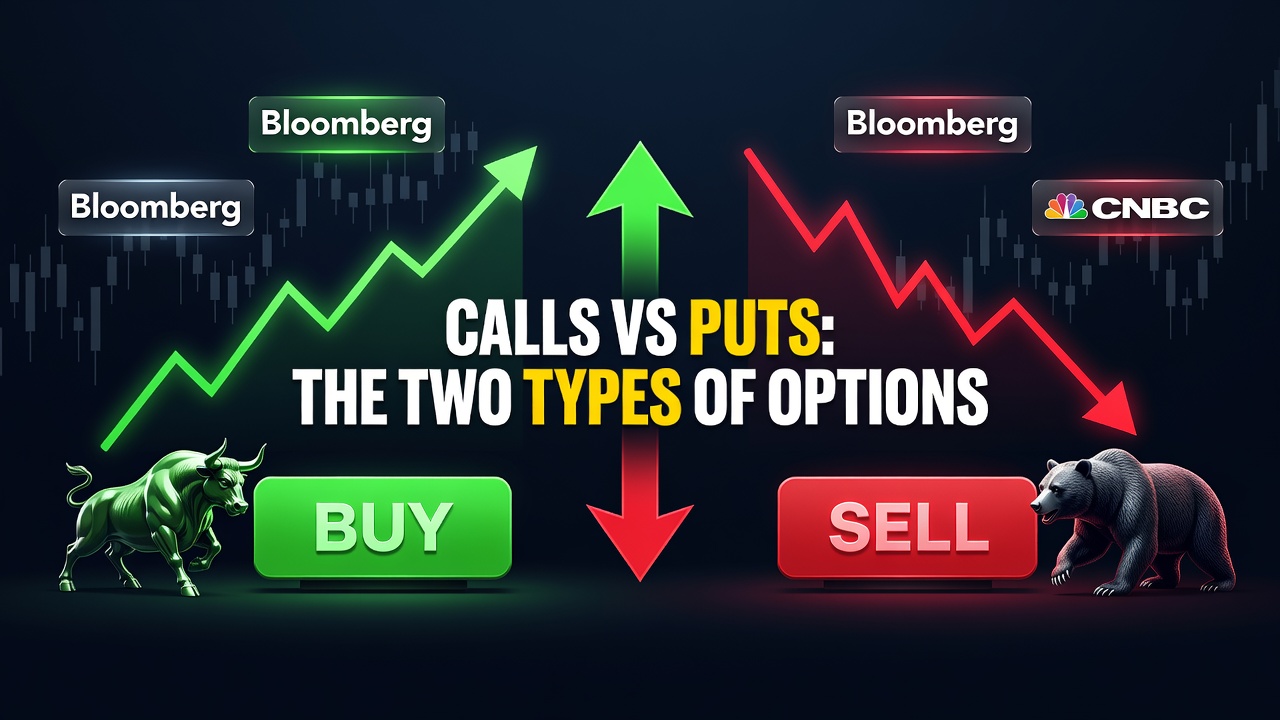
- A call option gives you the right to buy a stock, while a put option gives you the right to sell a stock.
- Buyers pay a non-refundable fee called a premium to own these rights, while sellers collect this fee and take on the obligation.
- You use calls when you expect a stock price to rise and puts when you expect a stock price to fall.
— Ben, Find Better Trades
When I was first starting out in trading, I remember staring at an options chain and feeling completely overwhelmed by the rows of numbers. It felt like trying to read a foreign language without a dictionary. Today, we are breaking down the absolute foundation of everything you will do in this market: the difference between calls and puts.
This is Part 2 of our 51-part beginner’s guide to options. If you missed our introduction, we covered the absolute basics of what an option is in Part 1, but today we are going to get highly specific about the only two tools you will ever trade.
1. The Call Option: Your Right to Buy
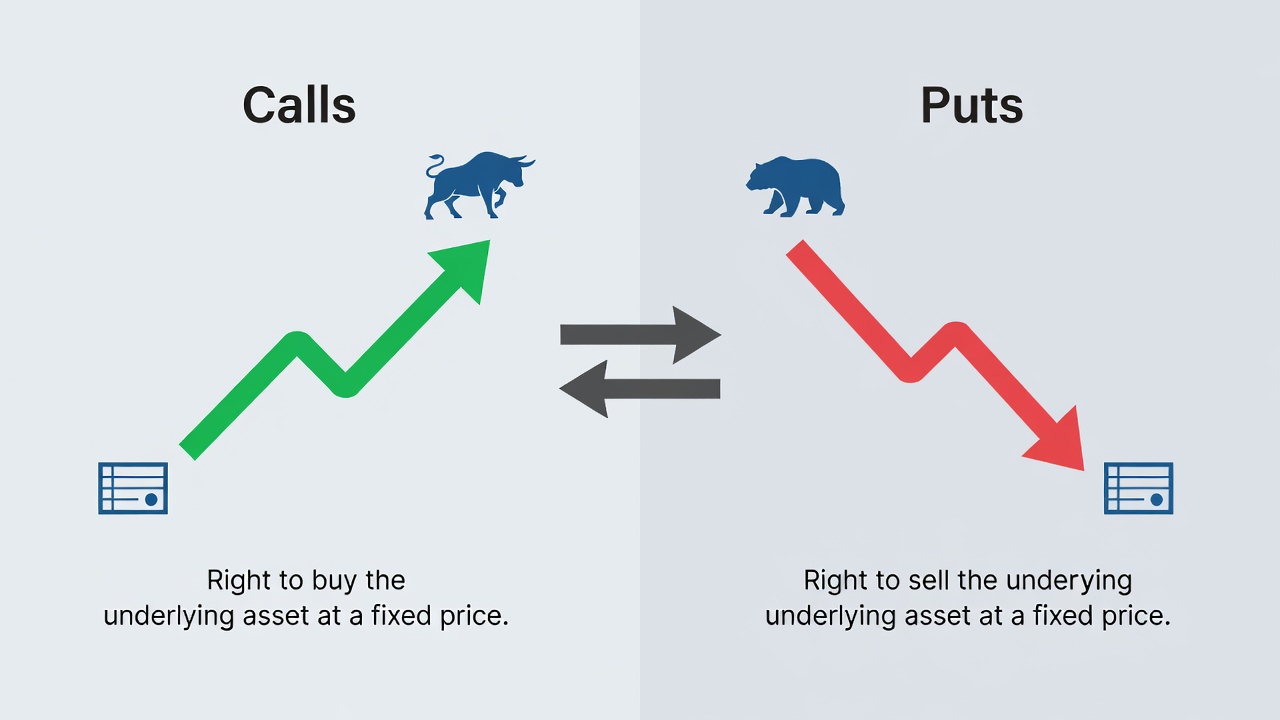
Let us start with the first of the two types of options you need to know. A call option is a financial contract that gives you the right, but not the obligation, to buy a specific stock at a set price within a specific timeframe.
Think of a call option as a voucher that locks in a purchase price for you. If the stock price goes up, your voucher becomes highly valuable because you can still buy the stock at the older, cheaper price.
If you purchase a call option, you are a “buyer” or “holder” of that contract. You pay an upfront fee to the seller of the option to secure this right, and this fee is known in the trading world as the premium.
I like to think of this premium as a non-refundable deposit. You pay it to secure a locked-in price, and the most money you can ever lose on a long call trade is this initial deposit.
As a call buyer, your main goal is for the stock price to climb far above your locked-in price before the contract expires. If that happens, you can buy the expensive stock at a discount or simply sell your option contract to another trader for a profit.
2. A Real-World Analogy for Call Options
To make this concrete, let us look at a real-world scenario outside of the stock market. Imagine you want to buy a rare, vintage watch that is currently worth $10,000, but you do not have the cash ready today.
You go to the dealer and offer him $500 today to hold that watch for you at the $10,000 price tag for the next three months. The dealer agrees, pockets your $500, and writes up a contract.
🎯 Get High-Probability Trade Setups — Free
The Big Dipper Dashboard delivers curated trade ideas straight to your screen every morning. Know what to watch before the opening bell.

Two months later, a famous celebrity wears that exact watch model on television, and the market value of the watch instantly skyrockets to $15,000. Because you bought that contract, you still have the legal right to buy it for $10,000.
You can execute your contract, buy the watch for $10,000, and immediately sell it on the open market for $15,000. After subtracting your $500 contract fee, you walked away with a clean $4,500 profit.
If the watch had crashed in value to $5,000 instead, you would simply walk away from the deal. You would lose your $500 deposit, but you would not be forced to buy a declining watch for $10,000.
3. The Put Option: Your Right to Sell
Now let us look at the exact opposite tool in your trading shed. A put option is a contract that gives you the right, but not the obligation, to sell a specific stock at a set price within a specific timeframe.
This is where many beginners get tripped up because we are not used to locking in a selling price in our daily lives. A put option is essentially an insurance policy for your portfolio.
If you own a stock and you are worried the market might crash, you can buy a put option. This contract guarantees that no matter how low the stock drops, someone else must buy it from you at your set price.
Just like with the call option, you have to pay an upfront premium to buy this right. If the stock stays stable or goes up, your insurance contract expires worthless, and you lose the premium you paid.
But if the stock collapses, your put option gains massive value. You now hold the right to sell a stock at a high price when everyone else is forced to sell it at a massive discount.

4. A Real-World Analogy for Put Options
The easiest way to understand a put option is to look at your car insurance policy. When you buy car insurance, you are paying an annual premium to an insurance company.
Let us say your car is worth $20,000, and you pay $1,000 a year for comprehensive coverage. If you get into a major accident and wreck the car, the insurance company pays you the value of the car.
In this scenario, the insurance company acts as the seller of a put option, and you are the buyer. You paid a premium to lock in the right to sell your wrecked car to them for its original pre-crash value.
If you drive safely all year and never get into an accident, the insurance company keeps your $1,000 premium. You do not get that money back, but you had peace of mind for twelve months.
This is exactly how professional traders use put options to protect their stock portfolios from market crashes. They pay a small premium to protect themselves against a massive downside move.
5. Buying vs. Selling Calls and Puts
For every buyer of an option contract, there must be a seller on the other side of the trade. This means there are actually four basic positions you can take in the options market.
You can buy a call (bullish), sell a call (bearish/neutral), buy a put (bearish), or sell a put (bullish/neutral). Sellers are often referred to as “writers” of options.
When you buy an option, you have rights but no obligations, meaning you control the action. When you sell an option, you take on obligations in exchange for collecting the buyer’s premium upfront.
If you sell a call option, you are obligated to sell the stock if the buyer decides to exercise their right. If you sell a put option, you are obligated to buy the stock if the put buyer decides to sell it to you.
This dynamic is why selling options carries higher risk than buying options. As a buyer, your risk is strictly capped at the premium you paid, while sellers can face massive, sometimes unlimited, risk.

6. Side-by-Side Comparison of Calls and Puts
To help you visualize how these two contracts work, I have created a simple breakdown of the mechanics. It helps to see them side-by-side so you can quickly reference them during your trading day.
Keep this table handy as you start analyzing charts and planning your first basic trades. It will prevent you from accidentally buying a put when you meant to buy a call.
| Option Type | Market Outlook | Buyer’s Right | Seller’s Obligation |
|---|---|---|---|
| Call Option | Bullish (Expects Price to Rise) | Right to BUY stock | Obligation to SELL stock |
| Put Option | Bearish (Expects Price to Fall) | Right to SELL stock | Obligation to BUY stock |
As you can see, the system is perfectly symmetrical. One person’s right is another person’s obligation, and the entire ecosystem is held together by the payment of the premium.
7. Step-by-Step Numeric Example of Both Trades
Let us run through two clear math examples using a hypothetical stock we will call ABC, which is currently trading at $100 per share.
In our first scenario, you believe ABC is going to launch a great new product, so you buy a $105 Call Option for a premium of $3. Since one contract represents 100 shares, you pay a total of $300.
If ABC stock climbs to $115, your option allows you to buy shares at $105. You can buy 100 shares for $10,500 and instantly sell them for $11,500, making a $1,000 profit minus your $300 premium, leaving you with $700 net gain.
In our second scenario, you think ABC stock is heading down, so you buy a $95 Put Option for a premium of $3, costing you $300 total. If the stock crashes to $80, your put gives you the right to sell shares at $95.
You can buy 100 shares on the open market for $8,000 and use your put option to force someone to buy them from you for $9,500. This trade generates $1,500 in gross profit, which leaves you with a $1,200 net profit after subtracting your $300 premium.
Common Mistakes Beginners Make With This
The most common mistake I see new traders make is buying calls simply because a stock has fallen deep into “cheap” territory. Just because a stock dropped does not mean it has to go back up, and your call options can easily expire completely worthless if the stock flatlines.
Another major trap is failing to understand that options have an expiration date, unlike regular shares of stock. Beginners will buy a put option expecting a crash, but if that crash happens even one day after expiration, they still lose 100% of their money.
Finally, many beginners sell call options without owning the underlying stock because they want to collect “free” premium. This is known as selling naked calls, and it exposes you to unlimited risk if the stock suddenly gaps up on unexpected buyout news.
Calls vs Puts FAQ
Can I lose more money than I invest when buying calls or puts?
When you are strictly a buyer of call or put options, your risk is absolutely limited to the premium you paid upfront. If the trade does not go your way, you can simply let the contract expire worthless, and you will never owe another dime.
Do I have to actually buy or sell the physical shares to profit?
No, you do not need to trade the physical shares of stock to make money with options. Most retail traders simply sell their options contracts back to the market before expiration to lock in their profits or cut their losses.
Why would someone sell a put option instead of buying a call?
Traders sell put options because they want to collect the premium upfront and are happy to buy the stock at a lower price if it falls. It is a highly popular strategy used to generate consistent income or acquire high-quality stocks at a discount.
How does time decay affect my call and put options?
Options are wasting assets, which means they lose value every single day they get closer to their expiration date. This process is called time decay, and it hurts buyers of both calls and puts while benefiting the sellers who collected the premium.
In the next part of our series, we are going to dive deep into the heart of every option contract and explain the strike price so you know exactly how to choose the right target for your trades.
📈 Want More? Join Our Free Trading Community
- Trading Strategy Guides Telegram — daily strategy tips and market insights
- Find Better Trades Telegram — free trade signals delivered to your phone
- Find Better Trades on YouTube — live trade breakdowns and tutorials
Lesson 2 of 55 in the free Options Trading Course.
← Previous: What Is an Option? A Simple Beginner’s Guide
Next: Strike Price Explained: Option Strike Price Guide for Beginners →