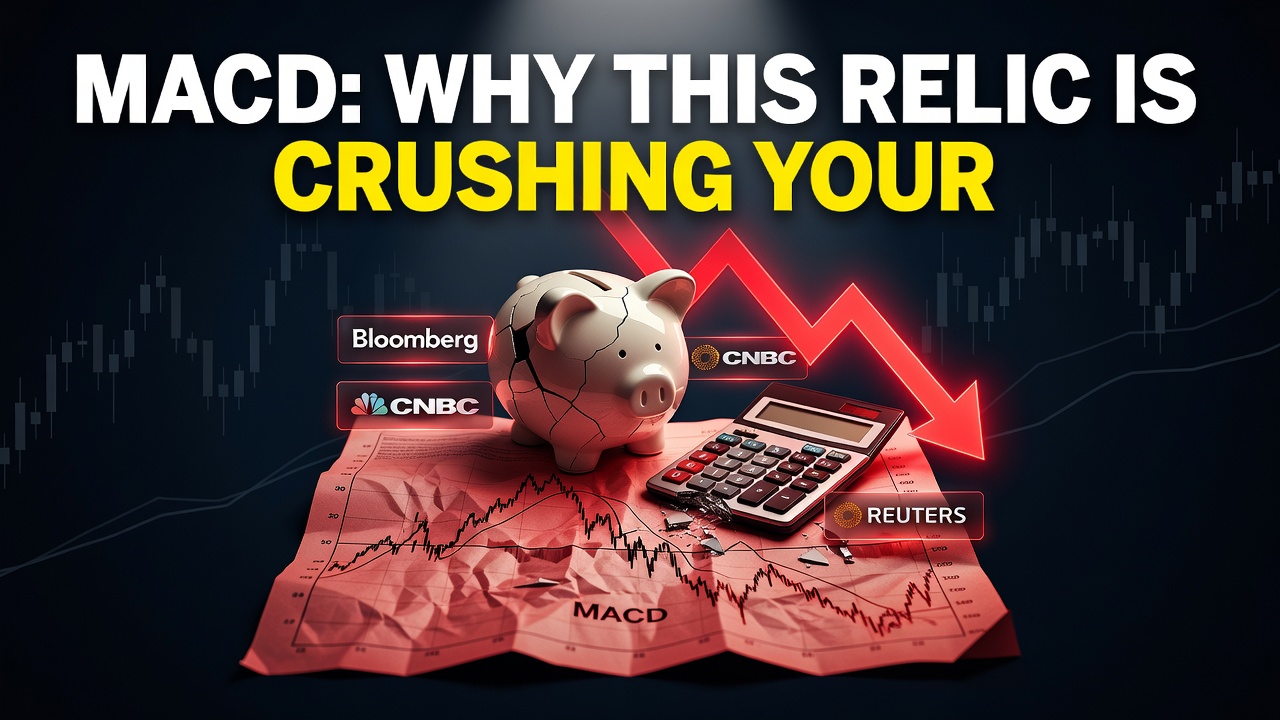
MACD: Why This Relic Is Crushing Your Trading Account

📊 July 9, 2026
- MACD is a lagging indicator that is fundamentally ill-suited for the rapid, high-frequency nature of modern markets.
- The biggest flaw is relying on MACD crossovers for trade entry, which consistently generate late and unprofitable signals in volatile conditions.
- Instead, focus on price action and volatility-adjusted indicators that provide real-time insights for timely decisions.
— Bennett, Find Better Trades
Let’s be blunt: if you’re still religiously using the Moving Average Convergence Divergence (MACD) indicator as your primary trading signal, you’re not just behind the curve – you’re actively setting yourself up for failure.
I’ve seen too many good traders get chewed up by relying on this outdated tool, and frankly, it’s time someone called it out for what it is: a relic that’s destroying retail accounts.
Why Everyone Gets This Wrong
The conventional wisdom is simple: buy when the MACD line crosses above the signal line, sell when it crosses below. It’s taught in every beginner’s guide, plastered across forums, and endlessly backtested on historical data that bears little resemblance to today’s market.
Here’s the problem: those crossovers are built on moving averages, which by their very nature, lag price action. In markets driven by algorithms and instantaneous information, waiting for a MACD crossover is like waiting for a handwritten letter in the age of instant messaging.
Imagine a stock that drops sharply on news, then bounces quickly. MACD will still be showing bearish momentum for a while after the bounce starts, trapping you in a short or preventing a profitable long entry. Then, as price consolidates, the MACD might finally cross up, only for the real move to have already happened or for the stock to resume its downward trend.
This lag makes MACD particularly dangerous in volatile, choppy markets where whipsaws are common. You’ll get countless false signals, buying the top of a dead cat bounce or selling the absolute bottom right before a reversal, bleeding your account dry with unnecessary commissions and losing trades.
What Actually Works
Instead of chasing lagging indicators, you need to focus on what’s actually happening right now: price action. Learn to read candlesticks, understand support and resistance zones, and identify demand and supply imbalances in real-time.
Complement this with indicators that are more responsive to current market conditions. For example, I prefer using volume profile to identify significant price levels where large institutions have accumulated or distributed shares, giving you a clearer picture of potential turning points.
Another powerful tool is a volatility-adjusted momentum indicator, like the Average True Range (ATR) applied to price swings. This helps you gauge the true strength of a move relative to its recent volatility, rather than just its raw direction, which can be misleading.
By combining direct price observation with these more dynamic indicators, you’re making decisions based on current reality, not on a delayed echo of past price movements. This approach allows for quicker entries, tighter stops, and a much better probability of capturing meaningful moves.
When MACD Can Still Help
While I wouldn’t touch MACD for primary trade signals, it isn’t entirely useless. It can occasionally serve as a very broad, higher-timeframe confirmation of trend direction, but only after price action has already established that trend.
You might glance at it on a weekly chart to get a general sense of macro momentum if you’re a long-term investor, but even then, I’d rely more on higher-timeframe price structure. For day trading or swing trading, which is what most of you are doing, its utility is virtually nonexistent.
Frequently Asked Questions
Q: Is MACD divergence still useful for predicting reversals?
A: Not reliably in modern markets. While divergence occasionally precedes a reversal, it often appears too early or too late, leading to premature entries or missed opportunities; focus on price action confirmation instead.
Q: What’s a better momentum indicator than MACD for short-term trading?
A: For short-term momentum, I prefer using a combination of fast stochastic oscillators and direct observation of price acceleration or deceleration within specific price ranges, often paired with volume analysis.
🎯 Get High-Probability Trade Setups — Free
The Big Dipper Dashboard delivers curated trade ideas straight to your screen every morning. Know what to watch before the opening bell.

📈 Want More? Join Our Free Trading Community
- Trading Strategy Guides Telegram — daily strategy tips and market insights
- Find Better Trades Telegram — free trade signals delivered to your phone
- Find Better Trades on YouTube — live trade breakdowns and tutorials