QQQ Broke Its 200-Day. Here’s How Option Traders Actually Think About It

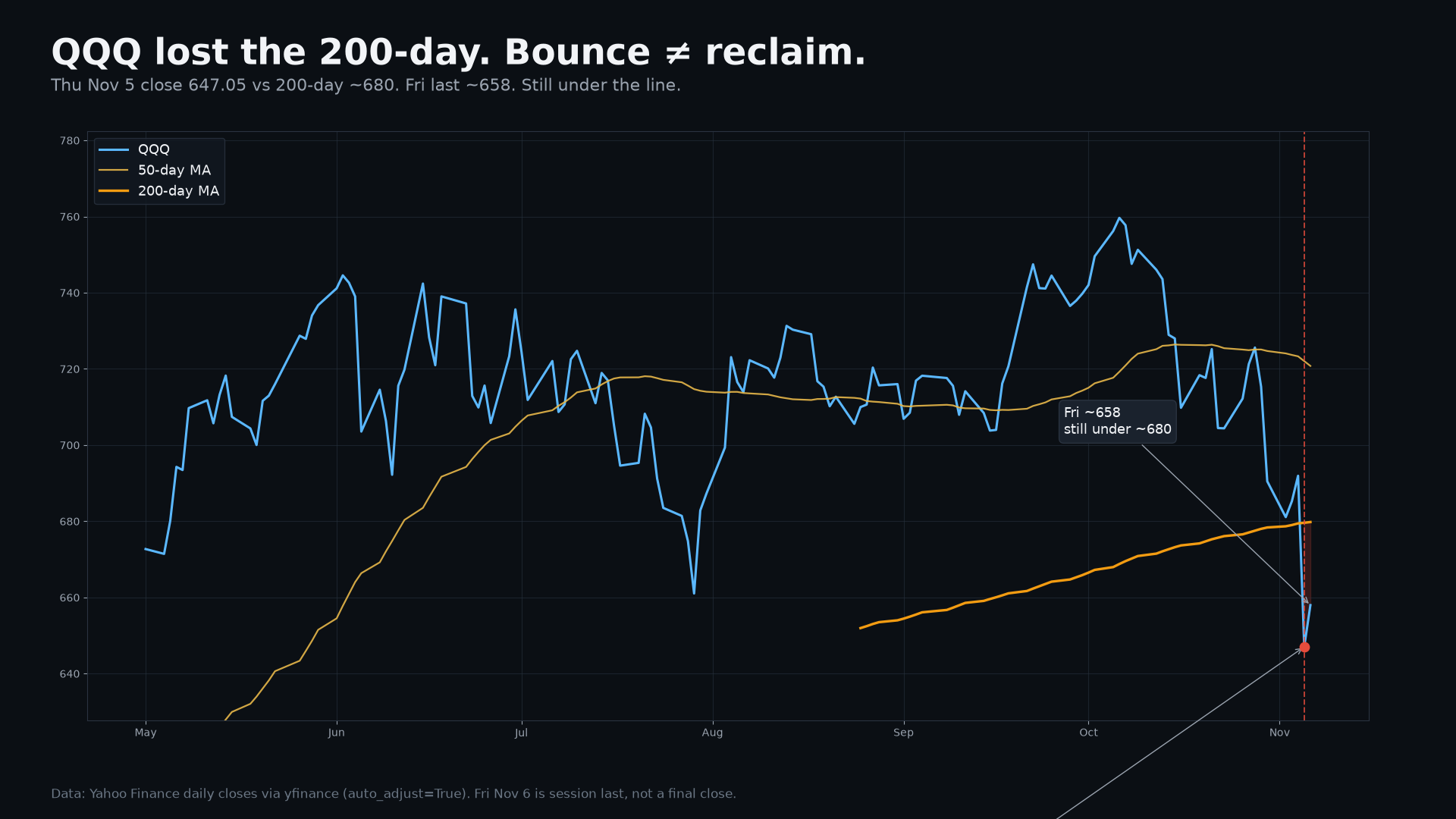
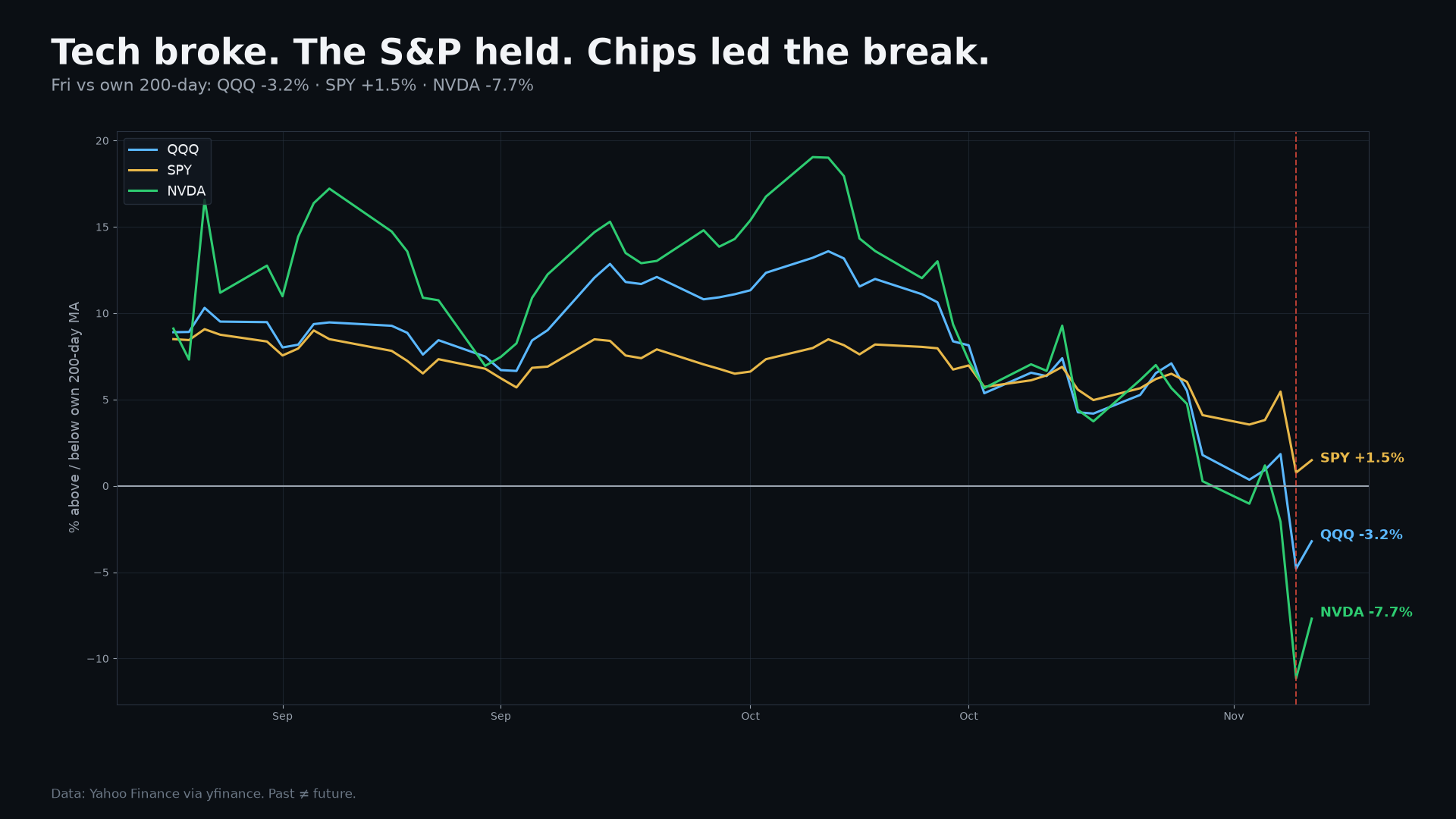
Thursday punched a hole in the Nasdaq. QQQ closed 647.05, down 6.49%, and printed its first close under the 200-day (~679.61) since April. Almost 5% under the line. Not a tag. Not a wick. A close.
Friday morning bounced — QQQ last near ~658, VIX easing from 28.18 toward ~24. That’s real. It’s also still under the 200. Bounce and reclaim are different animals. The price-action history lives in our TSG piece on the QQQ 200-day break. This one is the options read: what the break does to vol, expected moves, and how I’d actually think about size from here.
What just happened on the options tape
Numbers first. Yahoo Finance closes for Thu Nov 5, then Friday session lasts as of ~10:43 AM ET:
- QQQ closed 647.05 (−6.49%) — first close under the 200-day (~679.61) since April. About −4.8% vs the MA. Friday last ~658 — bounce, still ~3% under.
- SPY closed 733.00 (−4.41%) — still slightly above its own 200 (~727). Broader market held. Tech didn’t.
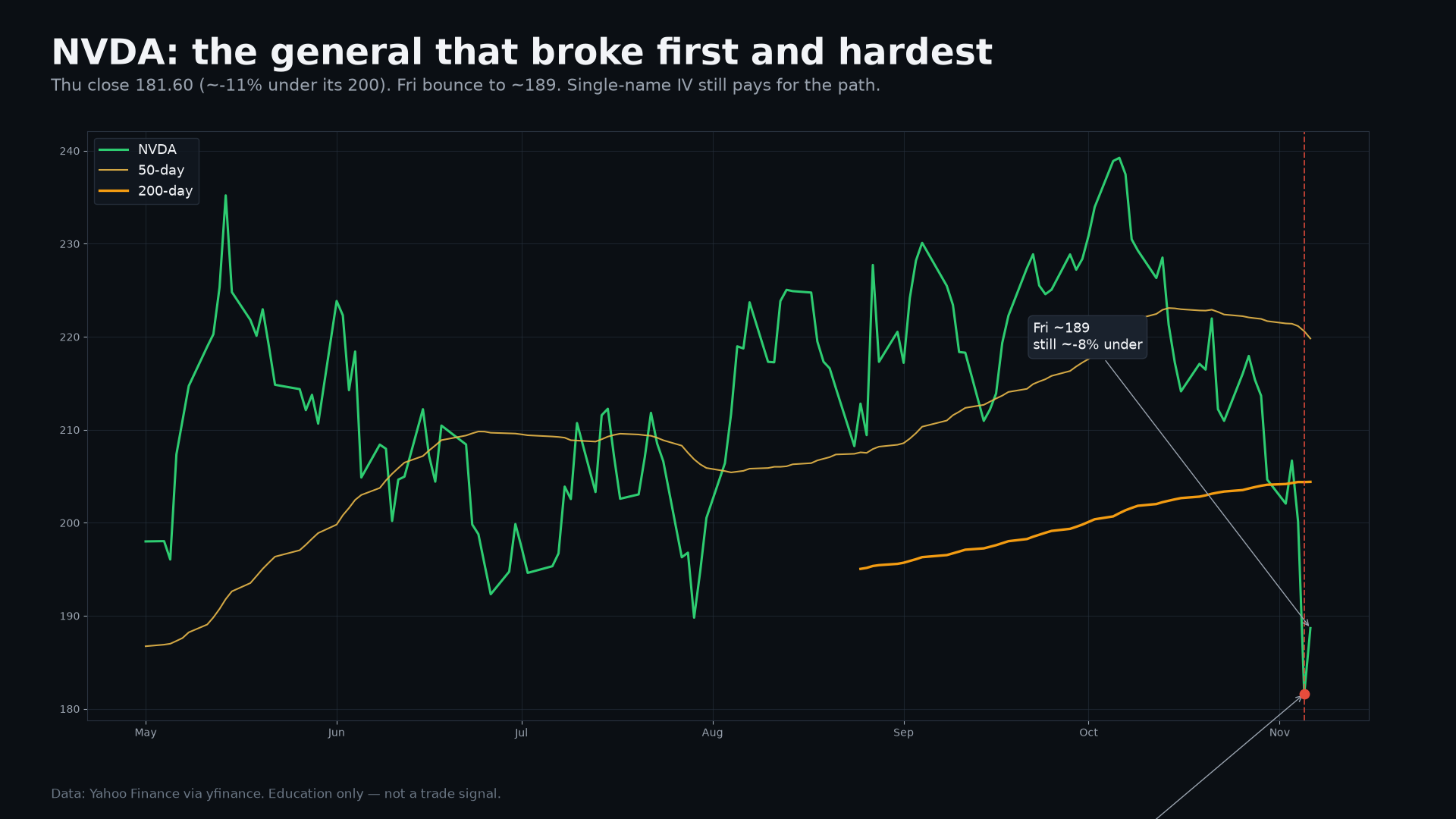
- NVDA closed 181.60 (−9.26%) — roughly 11% under its 200. Friday last ~189. Still deep.
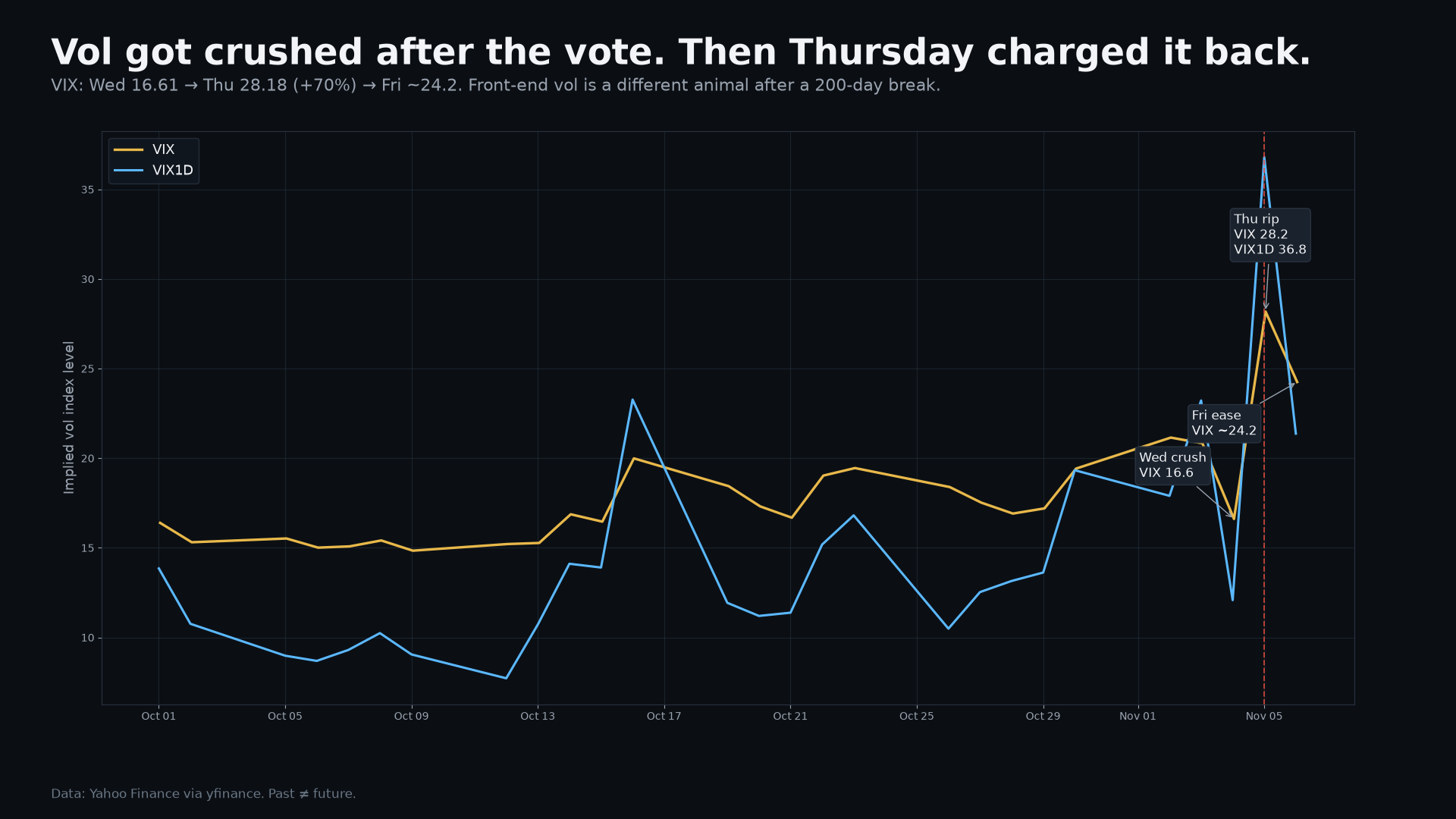
- VIX 16.61 → 28.18 Wednesday to Thursday (~+70%). Friday last ~24.3.
- VIX1D spiked to 36.80 Thursday (from 12.08 Wednesday). Friday last ~21.4.
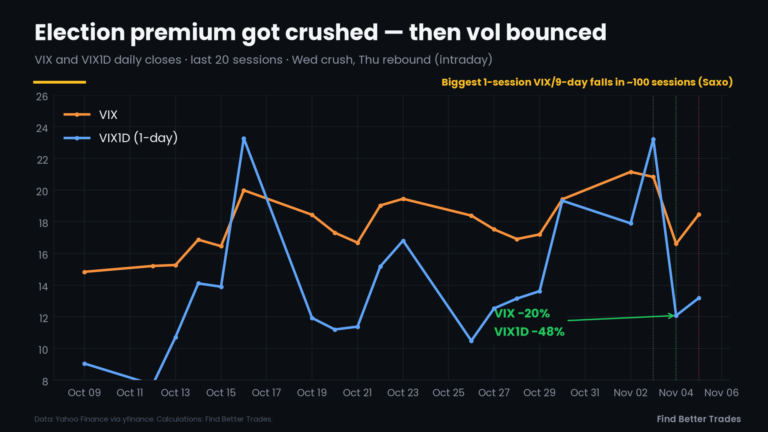
That’s the story in one breath: the AI/tech complex lost the line every trend system watches, the S&P barely held its own, and front-end vol went from “post-election crushed” to “something broke” in a single session. We walked through that crush yesterday in Election Premium Just Got Crushed. Thursday ate the calm for lunch.
Near-dated QQQ options were pricing a rough ~1.1% ATM straddle into Friday’s session and closer to ~2.3% into Monday’s expiration (Yahoo Finance option chains, mid prices, ~10:45 AM ET). That’s your ruler. A move inside the band is “priced.” A move that blows through it is new information. Don’t confuse the two.
What a 200-day break does to how options traders think
Plain English. The 200-day moving average is just the average close over ~200 sessions. No magic. Big money still stares at it because enough other big money does — CTAs, trend systems, risk models. A sustained break flips a lot of default biases from “buy dips” to “respect downside.”
For options, that flip shows up in three places:
- Implied vol jumps — you’re not just pricing normal noise anymore. You’re pricing regime risk. Thursday’s VIX rip from 16.6 to 28 was the market saying “this isn’t a soft Tuesday.”
- Skew stays bid — crash protection doesn’t get cheap just because spot bounced Friday morning. After a deep index break, far OTM puts often keep a bid even when the VIX eases a few points.
- Expected moves widen — same strike, fatter premium. Buying calls into a bounce feels cheap next to Thursday’s panic. It might not be cheap next to Monday’s path.
Public chart tools (heat maps, multi-MA stacks, coiled-spring style compression reads) are useful here as context, not as a green light. A heat map lighting up red on semis after a −11% SMH day tells you where the pain lived. A coiled look after a vertical dump tells you the tape can snap — both ways. None of that replaces “where am I wrong” and “how big is my size if VIX is still 24.”
Want a cleaner way to read expected moves and IV when the tape flips regimes? Grab our free options report — it walks through how we frame setups before the next move hits. No fluff. Just the process.
Bull case vs bear case (options lens)
Bull case: Friday’s bounce sticks and turns into a real reclaim. Get QQQ back through ~680 (the 200-day neighborhood) and hold a close — not a poke. SPY already sat above its 200 on Thursday. If the broader market keeps that line and semis stop leading every selloff, short-dated fear premium gets offered again, realized vol cools under implied, and the people who sold the panic look smart for a few sessions. History on the price side (see the TSG 200-day piece) says plenty of breaks reclaim fast. Options traders who sized for vol — not for the story — survive either way.
Bear case: The bounce is just a bounce. QQQ fails under ~680, leaders keep printing lower highs, and NVDA staying ~8% under its 200 (Fri last vs MA) keeps single-name IV sticky. Front vol easing from 28 to 24 is not the same as vol being cheap. Selling premium into a failed reclaim is how accounts get clipped twice — once on the break, once on the fakeout. April 2022 is the ugly cousin sitting in the same dataset: deep, sticky, months under the line.
I’m not picking a team. I’m saying the regime question is binary for a lot of systematic money: above the 200 on a close, or not. Options pricing will keep arguing about that until the tape picks a side.
Practical playbook (education, not signals)
No promised returns. No “buy this strike.” Just how I’d think about it:
- Trade the reclaim line, not the bounce headline. ~680 on QQQ is the regime line. Above it on a close, the “broke” story weakens. Stuck under it, you’re still in break territory — bounce or not.
- Size for the vol you have, not the vol you miss. VIX went 16.6 → 28 in a day. Same contract size that felt fine Wednesday is a different risk bet Friday even with VIX at ~24. Cut size until the curve calms — or until your stop is actually small enough.
- Respect the expected move. That ~1% Friday / ~2% into Monday ATM straddle band is your ruler. Inside it = priced. Outside it = new info. Chasing calls because “it bounced” inside a priced band is how theta eats you.
- Don’t confuse index vol with NVDA vol. QQQ can reclaim while NVDA stays under its 200 and keeps its own IV. Single-name path risk ≠ index regime risk. Price them separately.
- Define wrong before you click. If your thesis is “reclaim,” wrong is failing under ~680 again — not “it felt heavy.” If your thesis is “breakdown continuation,” wrong is a held close back above the 200. Write it down.
- Cash is a position. After a −6.5% QQQ day and a +70% VIX spike, standing aside is not weakness. It’s admitting the tape just changed the rules mid-hand.
Bottom line
QQQ just printed its first close under the 200-day since April — deep, not a kiss — while SPY held its own line and NVDA led the damage. Friday bounced. Vol eased a bit. Neither one is a reclaim.
Options traders don’t need a crystal ball for that tape. They need a ruler (expected move), a regime line (~680), and size that survives a second ugly day. Trade the premium that’s actually left. Don’t trade the ghost of Wednesday’s VIX — or Thursday’s panic — blind.
— Ben