Bull Call Spread Strategy: Cheaper Bets on Rising Stocks

📚 Options Strategies, Step by Step — Part 1 of 30
- Part 1: The Bull Call Spread: A Cheaper Way to Bet on a Rise (you are here)
⚡ Key Takeaways
- A bull call spread cuts the cost of betting on an uptrend by pairing a bought call with a sold call at a higher strike price.
- Your maximum risk is strictly capped at the net debit you pay when opening the trade.
- In exchange for a cheaper entry and lower breakeven point, you agree to cap your maximum potential profit.
— Ben, Find Better Trades
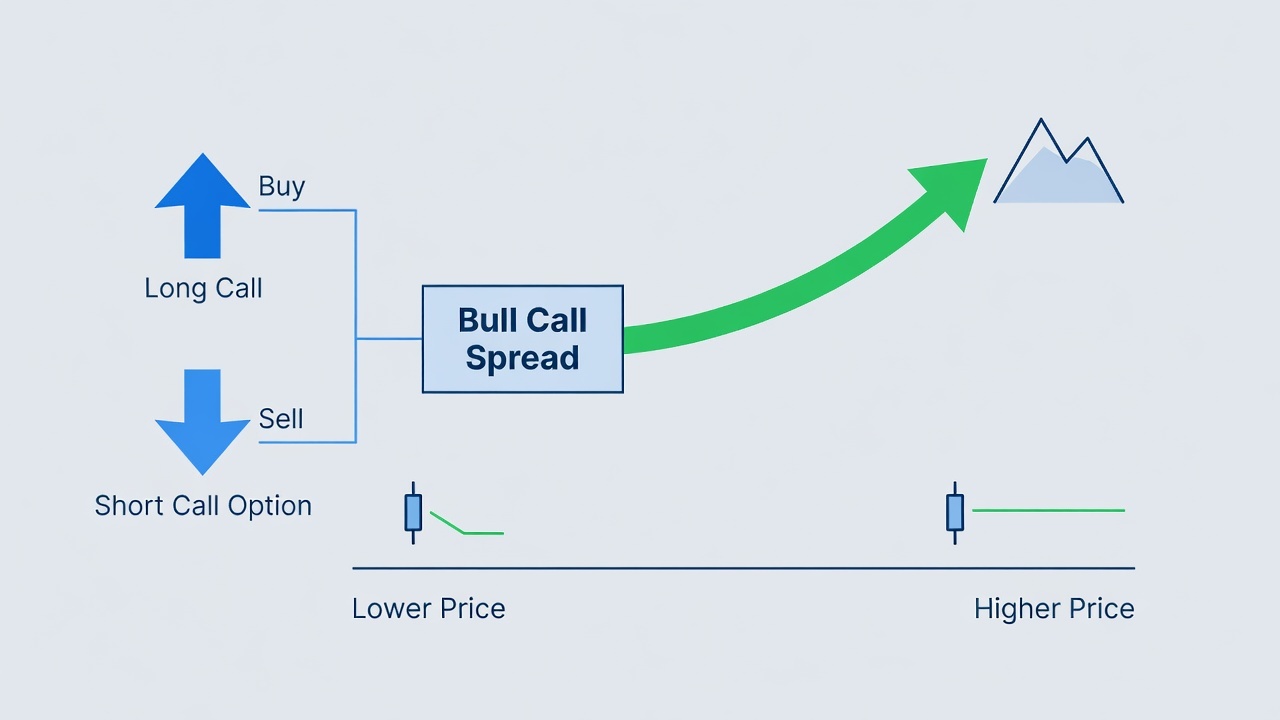
A bull call spread is a two-leg options strategy where you buy a call option and simultaneously sell another call option with a higher strike price on the same underlying stock and expiration date. Welcome to Part 1 of my 30-part series, where we leave the textbook theory behind and look at how actual trades run in a real account.
The tool I use for this: Terraline Indicator. Terraline auto-draws algorithmic trendlines that adjust in real time — perfectly connecting the swings you’d spend hours finding manually. Let Terraline Draw For You →
When traders finish learning what a single call option is, their first instinct is usually to buy naked calls on every stock they like. Most of them get crushed by time decay or high upfront prices before the stock ever moves in their favor.
I trade the bull call spread because it solves that exact problem. It lets you take a directional swing at a rising stock without paying full retail price for the ticket.
What Is a Bull Call Spread?
A bull call spread is a vertical debit spread designed to profit from a moderate increase in the price of an underlying asset. You construct it by purchasing a lower-strike call option while selling a higher-strike call option sharing the same expiration cycle.
Think of it like buying a concert ticket, but you immediately sell someone else the backstage pass privileges you do not plan on using. You pay money out of pocket for the ticket, but selling that secondary perk brings in immediate cash that offsets what you spent.
Because you pay more for the lower-strike call than you collect from selling the higher-strike call, cash leaves your account when the order fills. Traders call this a net debit.
That net debit represents your absolute worst-case scenario. If the stock falls off a cliff, you can never lose a single penny more than the original cash you handed over to open the position.
The trade-off comes on the upside. By selling that higher strike call, you give up any extra profit if the stock goes on a monstrous, parabolic tear past your sold strike.
Why Trade a Bull Call Spread Instead of a Naked Call?
A bull call spread sharply lowers your break-even point compared to buying a naked call alone. When you buy a regular call option, the stock has to rise by the entire amount of the premium you paid just for you to break even at expiration.
Selling the higher strike call acts like an instant rebate on that purchase. That cash discount pulls your break-even line down closer to where the stock is currently trading.
Another massive advantage is muting the damage from time decay, known to traders as theta. When you hold an outright long call, every day that passes without a stock rally burns away your option value.
In a bull call spread, you own one option losing value to time, but you also short an option that gains value for you as time burns away. The two positions fight each other, softening the daily bleed on your account balance.
This structure also protects you if implied volatility drops. When market excitement cools off, the price drop in the option you sold helps shield the value of the option you bought.
Free For Traders
One Clear Arrow. Every High-Probability Setup. Free.
The Fusion Indicator combines multiple signals into a single buy/sell arrow on TradingView so you never miss a move.
 → Get The Free Fusion Indicator
How to Set Up a Bull Call Spread Step by Step
Setting up a bull call spread starts with picking an underlying stock that you expect to rise steadily over a specific window of time. I look for stocks breaking out of clean consolidation bases rather than names caught in wild, unpredictable ranges.
Next, choose an expiration date that gives your thesis enough room to breathe. I typically look for contracts expiring between 30 and 45 days out from the day I place the order.
That 30 to 45-day window gives the stock plenty of time to move while avoiding the aggressive time decay that strikes in the final two weeks of an option cycle.
For the long strike, select an at-the-money or slightly in-the-money call option. This contract carries intrinsic value or sits right on the current stock price, meaning it starts gaining ground immediately when the stock ticks higher.
For the short strike, select an out-of-the-money call option situated at or just below a logical technical resistance level. You sell this strike because you do not expect the stock to realistically run much further past that barrier during your timeframe.
Always submit the trade as a single order ticket called a vertical spread. Entering both legs simultaneously prevents you from suffering slippage on one side while waiting for the other side to fill.

Bull Call Spread Math: A Full Worked Example
Let’s say XYZ stock is trading at $100 per share, and you believe it will climb toward $106 over the next month. You pull up the options chain expiring in 35 days to construct your spread.
You buy the $100 strike call for $4.00 per share, which represents $400 in total cash. At the exact same moment, you sell the $105 strike call for $1.50 per share, bringing in $150 in cash.
Your net debit is $4.00 minus $1.50, which equals $2.50 per share, or $250 total for one contract spread. That $250 is your maximum loss on the trade.
Your maximum profit is calculated by subtracting your net debit from the width between your two strikes. The width between the $100 strike and the $105 strike is $5.00.
Subtracting your $2.50 debit from the $5.00 width leaves you with a maximum profit of $2.50 per share, or $250. Your break-even price at expiration is simply the long strike of $100 plus the $2.50 debit, landing right at $102.50.
| Metric | Calculation | Result |
|---|---|---|
| Maximum Loss | Net Debit Paid | $250 ($2.50/share) |
| Maximum Profit | Strike Width ($5.00) – Net Debit ($2.50) | $250 ($2.50/share) |
| Break-Even Point | Long Strike ($100) + Net Debit ($2.50) | $102.50 |
| Capital Required | Net Debit Paid | $250 |
Second Worked Example: Out-of-the-Money Spread for Higher Leverage
Now let’s examine an out-of-the-money setup, which offers a smaller cash outlay in exchange for a lower probability of hitting maximum profit. Suppose ABC stock trades at $50 per share, and you want to position for a push to $57 over the coming month.
Instead of buying at the current price, you decide to set up an out-of-the-money bull call spread expiring in 40 days. You buy the $52 strike call for $1.80 and simultaneously sell the $56 strike call for $0.60.
Your net cost to enter the position is $1.80 minus $0.60, leaving you with a net debit of $1.20 per share, or $120 total. Your total risk is locked at that $120.
The width between the $52 call and the $56 call is $4.00. To find your maximum gain, take that $4.00 width and subtract your $1.20 entry cost, leaving you with $2.80 per share, or $280 total profit.
Your break-even price on this trade is the $52 long strike plus the $1.20 net debit, which equals $53.20. Let’s look at how this position performs across several possible prices when expiration day arrives.
| ABC Stock Price at Expiration | $52 Long Call Value | $56 Short Call Value | Net Position Value | Net Profit / Loss |
|---|---|---|---|---|
| $48.00 | $0.00 | $0.00 | $0.00 | -$120 (Max Loss) |
| $52.00 | $0.00 | $0.00 | $0.00 | -$120 (Max Loss) |
| $53.20 (Break-Even) | $1.20 | $0.00 | $1.20 | $0.00 |
| $56.00 | $4.00 | $0.00 | $4.00 | +$280 (Max Profit) |
| $60.00 | $8.00 | -$4.00 | $4.00 | +$280 (Max Profit) |
Notice that if the stock flies all the way to $60, your long call is worth $800, but your short call is underwater by $400. That leaves you with the exact same $400 gross value, or $280 net profit, because your upside stopped accumulating above $56.
From Find Better Trades
Consistent Income. Any Market Direction.
The Income Project’s low-risk debit spread system generates steady returns whether the market runs up, down, or sideways.
 → See The Income Project

Managing the Trade: When to Take Profit and Cut Losses
Managing a bull call spread requires a firm exit plan that does not rely on waiting around until expiration day. Options prices swing aggressively in the final days of a contract, and letting spreads run to the wire invites unnecessary gamma risk.
I target taking profits when the spread captures between 50% and 75% of its maximum potential gain. If I paid $2.00 for a spread with a maximum value of $5.00, my max profit is $3.00, meaning I look to exit once the spread trades around $3.50 to $4.00.
Closing early frees up your capital and eliminates the risk of an unexpected reversal wiping out your hard-earned paper profits. You do not need to squeeze every last dime out of an options trade to build an equity curve.
On the downside, I set a mental stop to cut the trade if the value of the spread drops by 50% of the initial debit I paid. If I spent $200 to open the position, I exit if the spread’s market value declines to $100.
Never let a full debit spread bleed down to zero out of pure stubbornness. Cutting losers at predetermined thresholds saves your account balance so you can fund the next clean opportunity.
When Should You NOT Trade a Bull Call Spread?
You should not trade a bull call spread when you anticipate a massive, explosive catalyst like an unexpected clinical trial result or a corporate buyout. When a stock has the potential to double overnight, putting a ceiling on your upside with a short call leaves huge money on the table.
In those explosive scenarios, a simple naked long call or direct shares serve you far better than a capped vertical spread. A bull call spread is a measured tool built for orderly, steady advances.
You should also avoid this strategy when option implied volatility is sitting at rock-bottom multi-year percentiles. When options are historically cheap across the board, buying outright calls costs very little, eliminating the need to sell a call to finance the position.
Finally, steer completely clear of stocks with low options volume and wide bid-ask spreads. Because a vertical spread requires filling two legs at the same time, wide spreads will bleed your entry and exit prices through poor execution fills.
Common Mistakes Beginners Make With This
Picking strikes that are too wide apart. Beginners often buy an at-the-money call and sell an out-of-the-money call ten or twenty points away to chase bigger potential profit numbers. Doing this turns the spread right back into an expensive, naked-style trade that offers almost no downside offset from the sold strike.
Holding all the way into expiration Friday. New traders frequently hold profitable spreads until the final bell just to extract the last fifteen dollars of profit. A surprise afternoon reversal can wipe out weeks of gains in thirty minutes, making the risk-to-reward on those final dollars completely irrational.
Trading illiquid strike chains. Placing vertical orders on thinly traded contracts forces market makers to pick your pockets on the bid-ask spread. If the difference between the bid and ask on either contract is wider than ten cents, look for a more liquid underlying ticker.
Ignoring early assignment risk on ex-dividend dates. If your short strike goes deep into the money and the underlying stock pays a dividend, the party holding the long side may exercise early to capture the dividend payment. Always be aware of your short strike’s proximity to the money when an ex-dividend date approaches.
Bull Call Spread FAQ
What happens if my bull call spread expires between the two strikes? If the stock finishes between your strikes at expiration, your short call expires worthless and your long call finishes in the money. Your broker will automatically exercise the long call into 100 shares of stock, or close the position for cash value prior to the bell depending on your account settings.
Can I lose more money than I paid for a bull call spread? No, you cannot lose more than the initial net debit you paid to enter the position, provided you hold both legs together. Because your long call gives you the right to buy shares at a lower price than you are obligated to sell them at on the short call, your downside is completely locked.
Is a bull call spread better than buying shares of stock? A bull call spread provides leverage and strictly defines your dollar risk, requiring far less cash than buying 100 shares outright. However, stock shares never expire, whereas a bull call spread must hit its price target before the selected expiration date or it loses value.
When should I close a bull call spread before expiration? You should close the spread early when you capture between 50% and 75% of your maximum potential profit, or if your stop-loss rule gets hit. Exiting early removes expiration-week volatility risk and lets you redeploy your trading capital into fresh setups.
Now that you know how to build a defined-risk bullish position for a discount, get ready for Part 2, where we flip the board completely and look at how to profit from a falling stock using the bear put spread.
📈 Want More? Join Our Free Trading Community
- Trading Strategy Guides Telegram — daily strategy tips and market insights
- Find Better Trades Telegram — free trade signals delivered to your phone
- Find Better Trades on YouTube — live trade breakdowns and tutorials
Lesson 52 of 52 in the free Options Trading Course.
← Previous: First 30 Days Trading Options: A Beginner’s Action PlanYou have reached the latest lesson. New lessons are added every week.