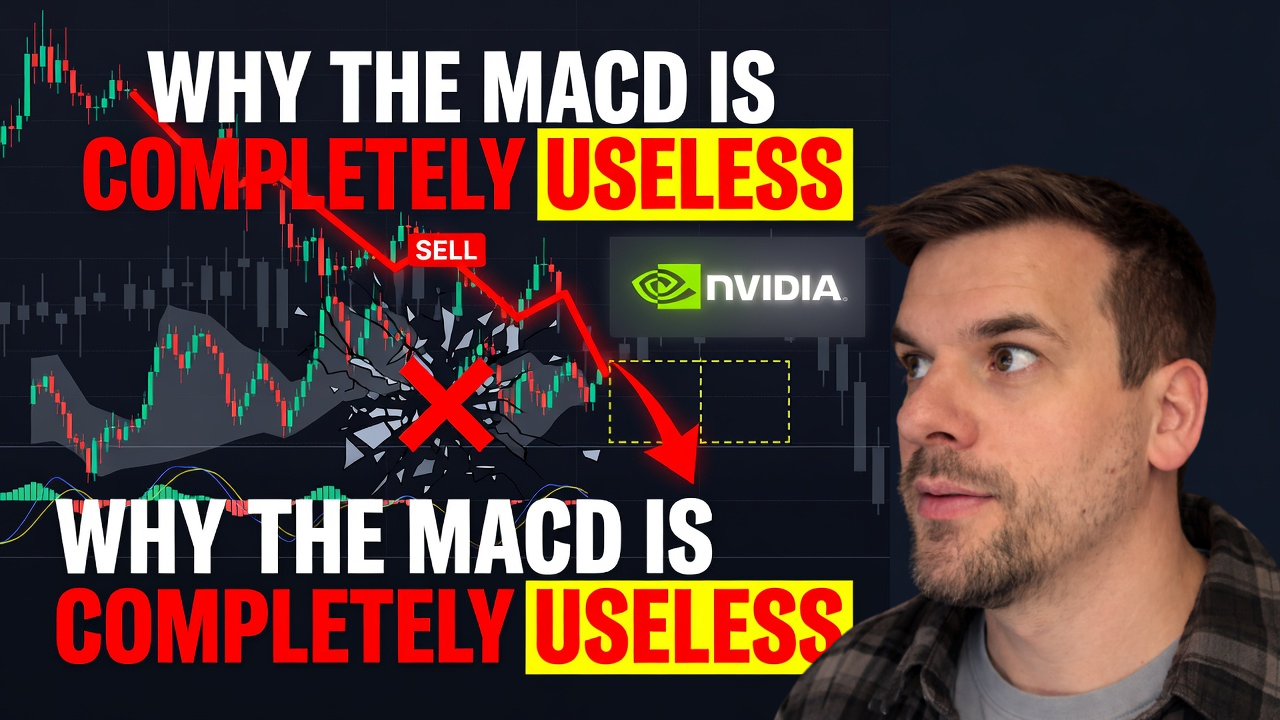
Why the MACD is Completely Useless for Modern Day Trading

📊 July 12, 2026
- The MACD is a lagging relic of the 1970s that will destroy your account in modern, high-frequency markets.
- Its reliance on simple moving average crossovers makes it far too slow to react to modern liquidity sweeps and stop runs.
- Ditch the lagging histograms and focus directly on pure price action, volume profile, and key support or resistance levels instead.
— Ben, Find Better Trades
If you are still trying to trade the markets in 2026 using MACD crossovers, you are essentially bringing a butter knife to a railgun fight. This indicator was designed in 1979 for daily charts of slow-moving blue-chip stocks, yet retail traders still expect it to work on a five-minute chart today. It is lagging, it is noisy, and it is actively costing you money.
Let me guess how your typical MACD trade goes. You see a bullish crossover below the zero line, you buy the breakout, and the very next candle is a massive red engulfing bar that stops you out before the MACD line even begins to curve back down.
The truth is that modern markets are dominated by algorithmic execution and rapid liquidity sweeps. Relying on an indicator that needs twenty periods of historical data just to tell you where the price was five minutes ago is a recipe for disaster.
Why Everyone Gets This Wrong
The conventional wisdom taught by generic trading gurus is that the MACD is the ultimate momentum tool. They tell you to buy when the MACD line crosses above the signal line, and sell when it crosses below. This logic is deeply flawed because moving averages are lagging indicators by design.
Think about what actually happens during a standard stop hunt. Price aggressively drives down to sweep a key swing low, triggering retail sell stops. Because of that sharp downward velocity, the MACD lines cross bearishly and the histogram bars expand rapidly to the downside, signaling a strong sell.
But the institutional buyers are actually absorbing those sell orders at a discount. Within moments, the price aggressively reverses upward, leaving you trapped in a short position because your lagging indicator told you to sell at the absolute bottom of the move.
By the time the MACD finally registers this sharp reversal and prints a bullish crossover, the move is already seventy percent complete. You are forced to chase the entry, buying at the exact top just as the smart money starts taking profits.
What Actually Works
If you want to survive in modern markets, you need to stop looking at derivatives of price and start looking at price itself. The absolute best replacement for lagging indicators is a deep understanding of market structure and liquidity pools.
Instead of waiting for a crossover, train your eyes to identify where retail stop-losses are resting. Look for clean double bottoms or obvious support levels, wait for the market to aggressively pierce through those levels, and watch how the price reacts immediately afterward.
If the market sweeps a key level and instantly closes back inside the previous range on high volume, that is your signal to enter. You do not need a colorful histogram to tell you that momentum has shifted; the raw price action and volume have already told you the entire story.
Combine this raw price action with volume profile to see where the heaviest transactions are actually occurring. Entering trades at the Point of Control or high-volume nodes gives you a real structural edge that mathematical formulas simply cannot replicate.
When the MACD Can Still Help
To be completely fair, the MACD is not completely useless if you restrict it to a very specific, high-timeframe context. On daily or weekly charts, it can serve as a decent filter to gauge the macro trend of an index or a highly liquid stock.
If the weekly MACD is in a strong uptrend, it tells you to bias your intraday trades to the long side. However, using it as a directional bias on a macro chart is a world away from using it as an execution trigger on your active trading charts.
MACD Frequently Asked Questions
Q: Does MACD divergence still work for identifying market reversals?
A: Rarely, because divergence can persist for days or weeks during strong trends, causing retail traders to continuously fight the dominant trend and blow their accounts before the reversal actually occurs.
Q: Can I make the MACD faster by changing the default settings?
A: No, shortening the settings only makes the indicator more sensitive to market noise, resulting in an overwhelming number of whipsaws and false signals that will eat away your capital through commissions.
🎯 Get High-Probability Trade Setups — Free
The Big Dipper Dashboard delivers curated trade ideas straight to your screen every morning. Know what to watch before the opening bell.

📈 Want More? Join Our Free Trading Community
- Trading Strategy Guides Telegram — daily strategy tips and market insights
- Find Better Trades Telegram — free trade signals delivered to your phone
- Find Better Trades on YouTube — live trade breakdowns and tutorials