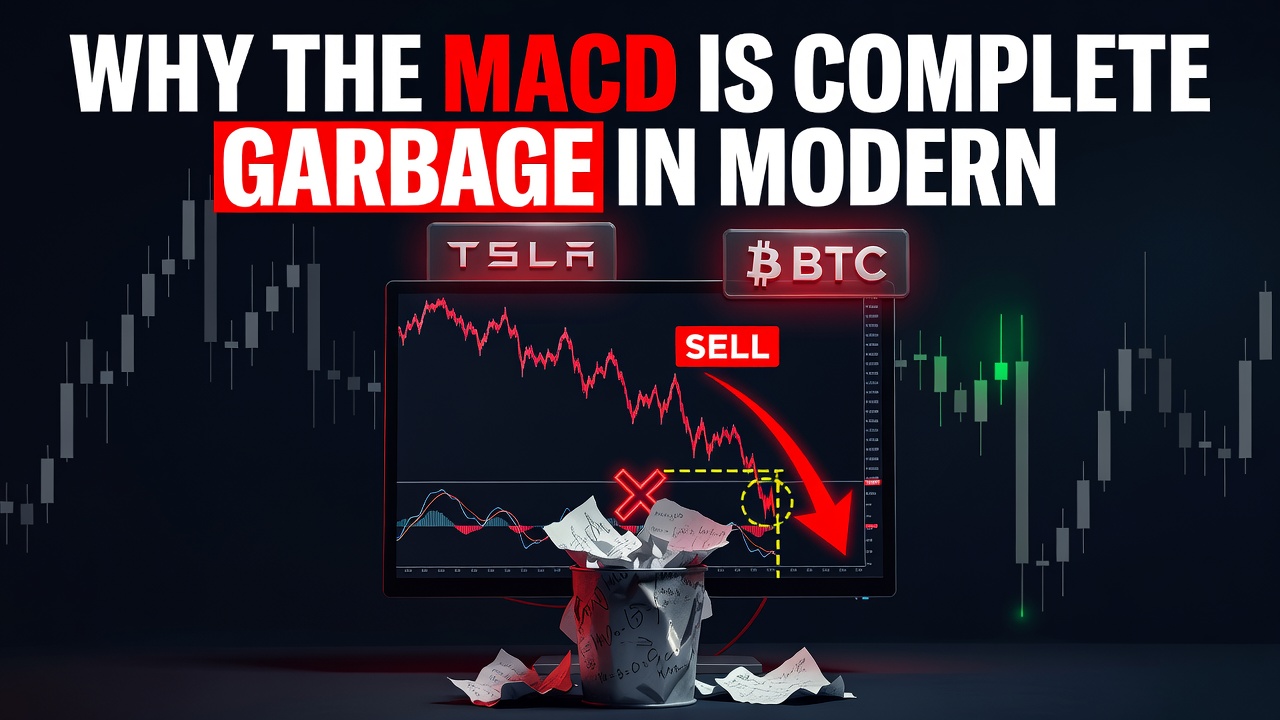
Why the MACD is Complete Garbage in Modern Markets

📊 July 11, 2026
- The MACD is an outdated, lagging indicator that acts as a wealth hazard in modern high-frequency trading environments.
- Its reliance on simple moving average crossovers ensures you enter trends late and get chopped up during inevitable range-bound distribution phases.
- Trade raw price action and volume profiles instead of relying on delayed, smoothed-out math formulas.
— Ben, Find Better Trades
Every rookie trader gets lured in by the MACD because it looks like a cheat code with its clean signal lines and pretty histogram. The reality is that relying on this lagging relic is one of the fastest ways to blow up your account in modern markets. If you are still trading crossover signals in 2026, you are essentially bringing a knife to a laser fight.
Why Everyone Gets This Wrong
The Moving Average Convergence Divergence indicator was built in the late 1970s, an era when floor traders ruled and markets moved at a snail pace. It is calculated by subtracting a 26-period Exponential Moving Average from a 12-period EMA, then smoothing that with a 9-period EMA signal line. This means you are looking at a derivative of a derivative, which guarantees your data is heavily lagging.
Think about a typical market scenario where a stock consolidates in a tight range and then aggressively breaks out on heavy institutional volume. By the time the fast EMA crosses the slow EMA and the MACD actually registers a bullish crossover, the initial explosive move is already over. You end up buying the exact local top right as the smart money starts distributing their shares to retail bagholders.
Even worse is the dreaded choppy, sideways market. When price action consolidates, the MACD lines will cross back and forth repeatedly, generating dozens of false buy and sell signals in a row. Following these signals blindly leads to death by a thousand cuts through commissions and slippage, destroying your capital before a real trend even begins.
What Actually Works
If you want to survive in modern markets, you need to ditch lagging indicators and focus on leading variables: raw price action and volume. Institutions do not execute multi-million dollar block trades based on a MACD crossover; they move markets based on liquidity pools and order flow. You need to train your eyes to see where these big players are actually positioning themselves.
Instead of waiting for a lagging line crossover, start mapping out key support and resistance zones based on high-volume nodes. Look for aggressive impulse moves out of these zones followed by low-volume retests of the breakout level. This tells you that sellers are exhausted and the path of least resistance is higher, giving you an entry with tight, defined risk.
Combine this with the Volume Profile to see exactly where the highest concentration of trading activity has occurred. Buying at the Value Area Low during a bullish market structure gives you a massive statistical edge over the trader waiting for a MACD signal. You get in early with a tight stop-loss, while the MACD trader gets in late with a massive, unmanageable risk profile.
When the MACD Can Still Help
To be perfectly fair, the MACD is not completely useless if you strip away the crossover nonsense and use it purely as a momentum gauge. The only time I ever look at it is to spot momentum divergence on higher timeframes like the daily or weekly chart. Even then, it serves merely as a secondary filter, never as a primary trigger for an entry.
If price is making a higher high but the MACD histogram is making a lower high, it tells you the buying pressure is weakening. This divergence warns you to tighten your trailing stops on existing long positions or stop looking for new breakout buys. It is a decent warning siren, but using it as an active trading execution tool in intraday charts will get you absolutely slaughtered.
Frequently Asked Questions About MACD
Q: Is the MACD reliable for day trading liquid stocks?
A: Absolutely not, because day trading requires rapid execution and the MACD lag is far too severe on small timeframes, leading to constant whipsaws.
Q: Can I fix the MACD by changing the default settings?
A: Changing the inputs to make it faster just increases the number of false signals, while making it slower increases the lag, meaning you cannot outsmart the basic math of the indicator.
🎯 Get High-Probability Trade Setups — Free
The Big Dipper Dashboard delivers curated trade ideas straight to your screen every morning. Know what to watch before the opening bell.

📈 Want More? Join Our Free Trading Community
- Trading Strategy Guides Telegram — daily strategy tips and market insights
- Find Better Trades Telegram — free trade signals delivered to your phone
- Find Better Trades on YouTube — live trade breakdowns and tutorials