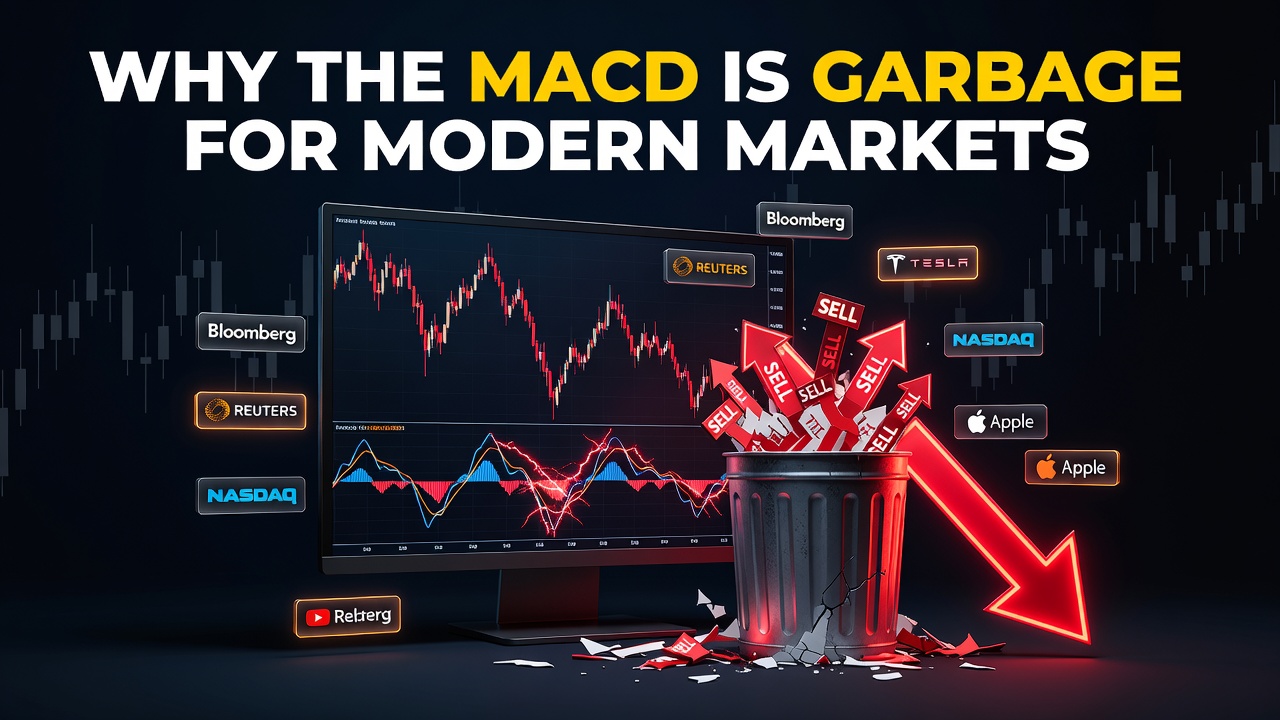
Why the MACD Is Garbage for Modern Markets

📊 July 9, 2026
- The MACD is a slow, lagging relic that will chew up your account in modern algorithmic markets.
- Its reliance on dual exponential moving averages means you enter trades right as the momentum is already exhausting.
- Switch to price action structure and raw volume profiling to find entries before the crowd reacts.
— Ben, Find Better Trades
If you are still waiting for a MACD crossover to enter your trades, you are practically donating your capital to high-frequency algorithms. This indicator was designed in the late 1970s when charts were drawn by hand and markets moved at a crawl. In today’s environment, relying on it is like bringing a butter knife to a railgun fight.
Let me guess how your last MACD trade went. You saw the fast line cross above the slow line, the histogram flipped green, and you bought the breakout. Within two candles, the market reversed, hit your stop, and left you wondering how a textbook setup failed so quickly.
Why Everyone Gets This Wrong
The core issue is that the MACD is a lag built on top of another lag. It calculates the difference between two Exponential Moving Averages, and then smooths that result with another moving average to create the signal line. By the time this math filters down to your screen, the institutional money has already positioned itself and is looking for liquidity to dump their shares onto.
Imagine a stock consolidating in a tight trading range between fifty and fifty-two dollars. The price suddenly breaks out to fifty-four dollars on high volume, which finally forces the lagging MACD lines to cross upward. You buy the crossover at fifty-four, but the smart money is already taking profits, pulling the price back down to fifty-two dollars and trapping you at the absolute top.
Retail traders love it because it looks simple and clean on a chart. It promises to turn the chaotic reality of price delivery into neat, binary buy and sell signals. But hiding behind those smooth lines is a structural delay that guarantees you will always be late to the party.
What Actually Works
To survive in modern markets, you need to stop looking at derivatives of price and start looking at price itself. I threw the MACD off my charts years ago and replaced it with volume-at-price data and market structure. Instead of waiting for an indicator to tell you momentum has shifted, you can see the shift happen in real-time by watching how price reacts to key liquidity pools.
Look for aggressive sweeps of previous highs or lows that immediately reject back into the trading range. When you combine these liquidity sweeps with a sudden expansion in relative volume, you get a highly reliable leading signal. This allows you to position yourself at the very start of a move, rather than chasing it halfway up the mountain.
If you absolutely need a visual momentum guide, use a single, fast moving average paired with raw volume. When price holds above a short-term volume-weighted average price during a high-volume expansion, that is your confirmation. You do not need a secondary lagging oscillator to tell you what is already staring you in the face.
When the MACD Can Still Help
To be completely fair, the MACD is not entirely useless if you change how you use it. Its only real value in the modern era lies in identifying multi-week divergence on high-timeframe charts like the daily or weekly. When price makes a higher high over several weeks but the MACD histogram makes a clear lower high, it tells you the underlying buying pressure is fading.
However, this should never be used as an entry trigger. It is simply a warning sign to tighten your stops on existing positions or to stop looking for new longs. Using it as a macro filter is acceptable, but using it on a five-minute chart to time your entries is a fast track to ruin.
MACD Trading FAQ
Q: Is the MACD histogram better than the line crossover?
A: Yes, because the histogram shows the rate of change between the lines, making it slightly faster, but it still suffers from the same fundamental lag that causes false signals in choppy markets.
Q: Can I fix the MACD by changing the default settings?
A: No, shortening the periods only makes the indicator erratic and prone to whipsaws, while lengthening them increases the lag to the point of uselessness.
🎯 Get High-Probability Trade Setups — Free
The Big Dipper Dashboard delivers curated trade ideas straight to your screen every morning. Know what to watch before the opening bell.

📈 Want More? Join Our Free Trading Community
- Trading Strategy Guides Telegram — daily strategy tips and market insights
- Find Better Trades Telegram — free trade signals delivered to your phone
- Find Better Trades on YouTube — live trade breakdowns and tutorials